

Copyright registration in Nepal is the voluntary recording of an original work at the Nepal Copyright Registrar's Office under the Copyright Act 2059. Registration is not mandatory, because copyright protects original literary, artistic, musical and similar works automatically on creation.
The copyright registration process in Nepal runs in 5 steps:
- Step 1: Prepare the work and copies with author details.
- Step 2: Submit the application to the Copyright Registrar's Office.
- Step 3: Undergo examination of the application.
- Step 4: Pass the publication or objection period.
- Step 5: Receive the copyright registration certificate.
The Registrar issues the certificate within 35 days, and it serves as evidence of ownership. For copyright registration, Nepal's Registrar asks for 7 documents, a NPR 10 stamp and a NPR 100 fee.
Protection lasts for the author's life plus 50 years. The owner holds economic and moral rights, enforced in the District Court through fines, imprisonment and compensation.
A company holds the copyright in work its employees create in their duties, and that company starts with company registration in Nepal.
What Is Copyright?
Copyright is the exclusive right of an author over an original literary, artistic, musical or similar work. In Nepal, the Copyright Act 2059 grants this exclusive right over an original work to the person who creates it, the author.
The Act protects any work presented originally and intellectually in literature, art or science. The Copyright Rules 2061 set the registration procedure under the Act.
The Nepal Copyright Registrar's Office, the national registering authority, administers copyright under the Ministry of Culture, Tourism and Civil Aviation. Related rights, known as neighbouring rights, protect performers, sound-recording producers and broadcasting organizations for 50 years under Sections 9 to 12.
Is Copyright Registration Mandatory in Nepal?
No, copyright registration is not mandatory in Nepal, because protection arises automatically when the author creates the work. Section 5 of the Copyright Act 2059 states that registration is not required to acquire the right.
Registration is voluntary: an owner who wants it applies to the Registrar, the officer named under Section 30 of the Act. The registration then serves as evidentiary proof of ownership in a dispute.
The Registrar enters each registered work in a register book and issues a registration certificate. An unregistered work keeps full protection, so registration adds proof of ownership, not the right itself.
Which Works Can Be Copyrighted?
Every original work of literature, art or science qualifies for copyright in Nepal, from a book or a song to a computer program. The Copyright Act 2059 names 7 groups of protectable works.
- Literary works: books, pamphlets, articles and theses
- Dramatic works: dramas, dramatic-music and dumb shows
- Musical works: musical notation with or without words
- Audiovisual works: cinematographic works viewed on a screen, with or without sound
- Artistic works: paintings, sculptures and photographs
- Architectural designs
- Digital works: computer programs (software)
Translations, arrangements, collections, databases and works derived from folklore gain protection too, without prejudice to the original work. A literary work or an artistic work is protected whether or not the owner registers it.
What Is the Copyright Registration Process?
The copyright registration process in Nepal runs in 5 steps at the Copyright Registrar's Office, from preparing the work to receiving the certificate. Under the Copyright Rules 2061, the Registrar decides within 35 days of a complete application.
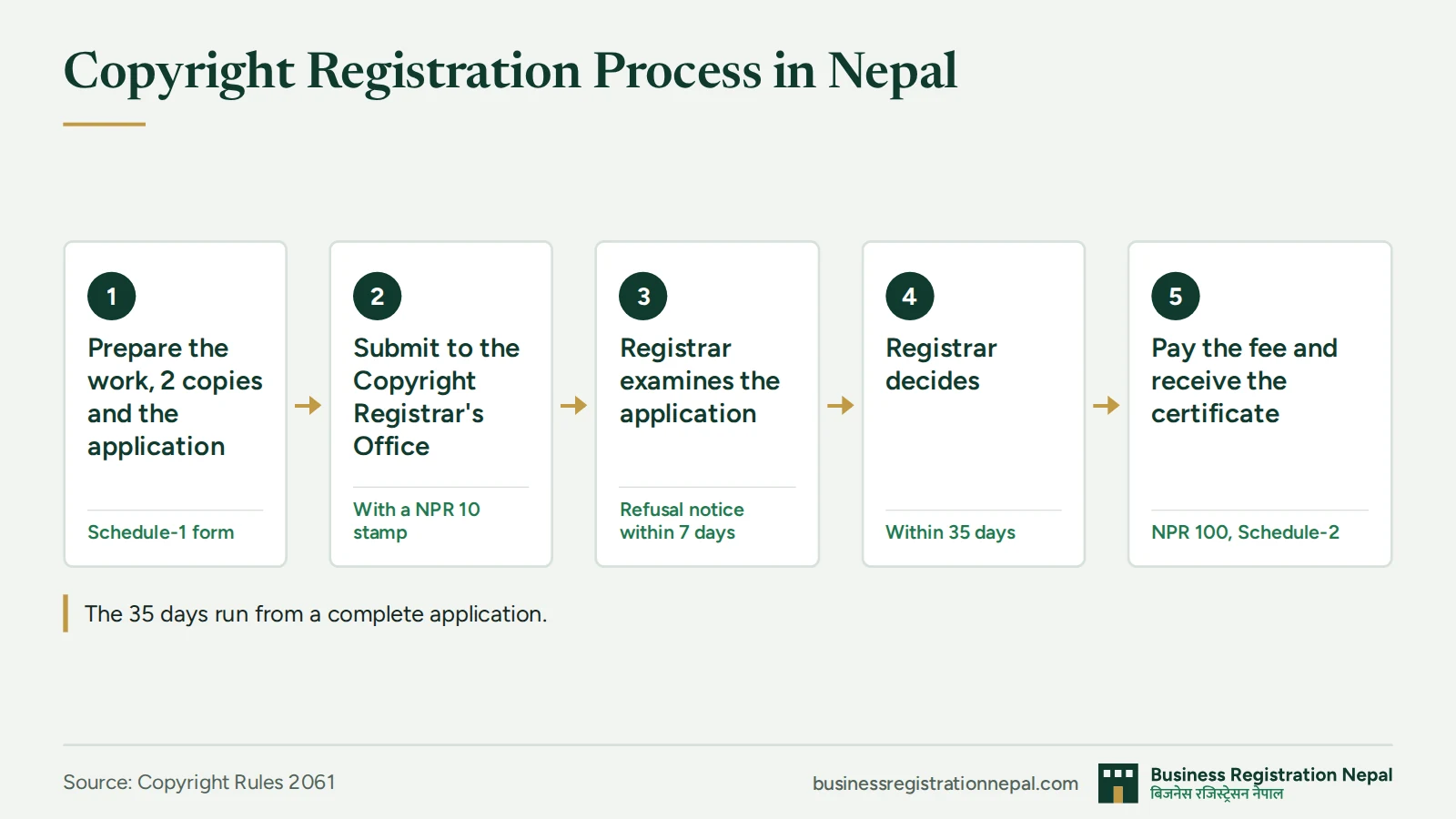
- Step 1: Prepare the work and copies with author details. The owner prepares 2 copies of the work and fills in the Schedule-1 application. The form asks for the author's name, address, citizenship and date of birth, and the work's title, language and completion date.
- Step 2: Submit the application to the Copyright Registrar's Office. The owner submits the form with a NPR 10 stamp at the office in Narayanhiti, Kathmandu. The office website carries an Online Apply link to its registration system, and paper filing at the office remains available.
- Step 3: Undergo examination of the application. The Registrar examines the application and its evidence and asks for more documents where a gap appears. A refused application receives a written notice with reasons within 7 days.
- Step 4: Pass the publication or objection period. The Copyright Rules 2061 set no public-notice or objection period for a work. This stage is therefore the Registrar's decision window of up to 35 days, and the Registrar settles any objection raised before deciding.
- Step 5: Receive the copyright registration certificate. The owner pays the NPR 100 fee after the Registrar decides to register the work. The office then issues the certificate in the Schedule-2 format.
An author or owner who asks how to register copyright in Nepal follows these 5 steps to register original work. Nepal's Copyright Registrar's Office records each registered work in its register book.
What Documents Are Required for Copyright Registration?
The Copyright Registrar's Office in Nepal requires 7 documents for copyright registration, led by the application, copies of the work and the owner's citizenship certificate. The office lists them in its citizen charter, and the owner files them with the application.
0 of 7 ready
The ownership document carries weight where the applicant is not the author, such as a publisher or a buyer holding a written assignment. A foreign owner files a passport copy in place of the citizenship certificate.
How Long Does Copyright Protection Last?
Copyright protection in Nepal lasts for the author's life plus 50 years, counted from the year of the author's death. Section 14 of the Copyright Act 2059 sets this general duration, a term of protection known as life plus fifty years. The term covers economic and moral rights.
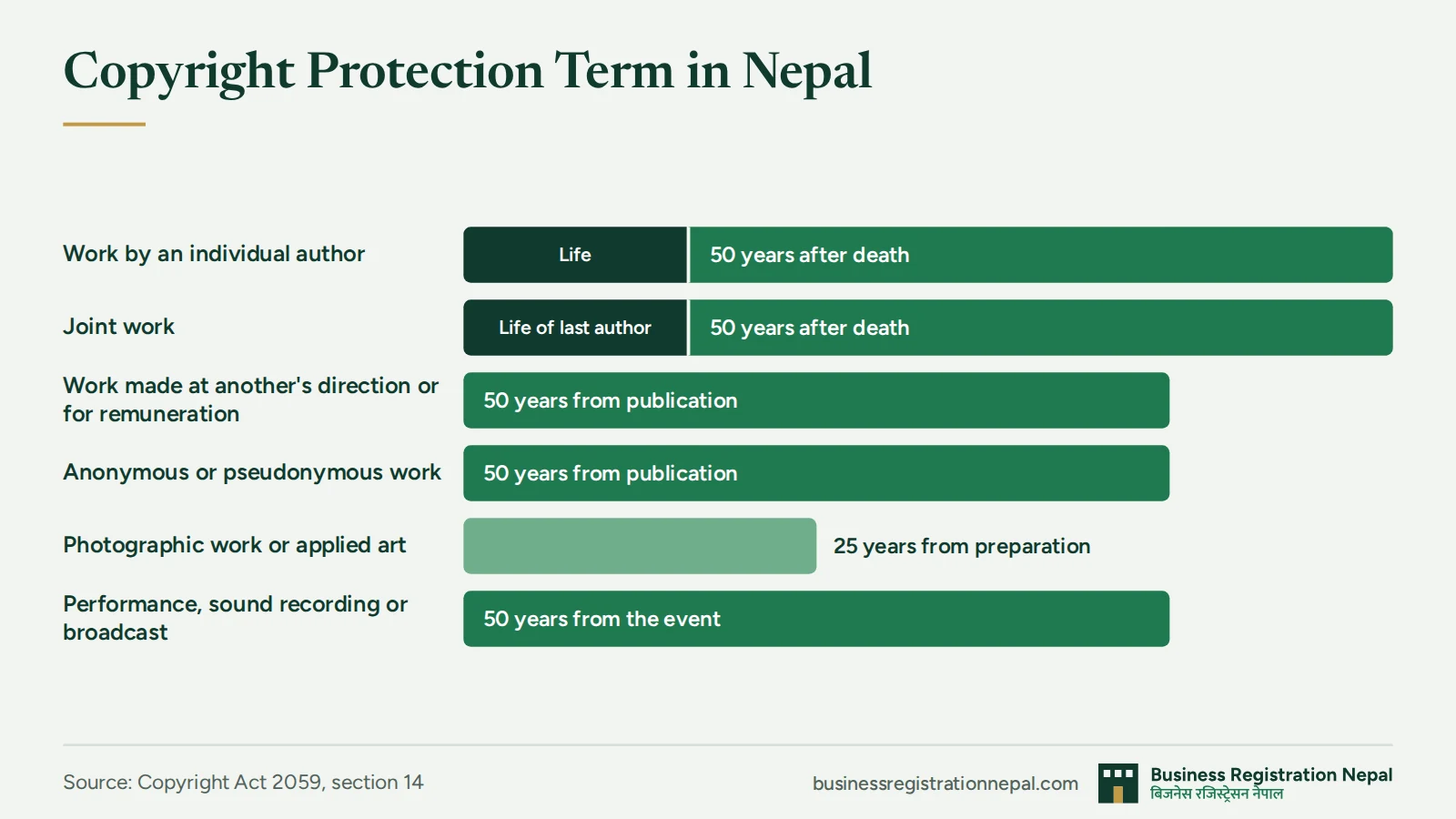
The table shows the 6 terms the Act sets by type of work or right.
| Work or right | Term of protection |
|---|---|
| Work by an individual author | Life of the author plus 50 years from the year of death |
| Joint work | 50 years from the year of death of the last surviving author |
| Work made at another person's direction or for remuneration | 50 years from the date of initial publication |
| Anonymous or pseudonymous work | 50 years from the date of initial publication |
| Photographic work or work of applied art | 25 years from the year of preparation |
| Performance, sound recording or broadcast | 50 years from the performance, publication or broadcast |
Section 14 names no separate term for an audiovisual work, whose producer holds the economic right under Section 6. Registration changes none of these terms, because the Act counts protection from creation, death or publication.
What Rights Does a Copyright Owner Have?
A copyright owner in Nepal holds 2 sets of rights: economic rights, the rights to exploit the work, and moral rights, the author's personal rights. Sections 7 and 8 of the Copyright Act 2059 define these economic and moral rights.
Under Section 7, the owner holds the exclusive right to reproduce, distribute and perform the work in public. The same section covers translating, adapting, arranging, renting, importing, exhibiting, broadcasting and communicating the work to the public.
A written agreement transfers or licenses any economic right, and the payment for that use is a royalty. The Registrar supervises royalty collecting bodies under Section 30 of the Act.
Under Section 8, the author keeps 4 moral rights: attribution, a pseudonym, integrity and revision. Integrity protects the work against distortion or mutilation that harms the author's reputation. Moral rights stay with the author for life and pass to the heirs after death.
How Is Copyright Infringement Enforced?
Copyright infringement in Nepal is enforced through the District Court, which punishes the infringer, stops the activity and orders compensation for the owner. Section 25 of the Copyright Act 2059 treats unauthorised use of a protected work as infringement.
The copyright infringement remedies under the Act fall into 5 civil and statutory measures.
- Fine of NPR 10,000 to NPR 100,000, imprisonment of up to 6 months, or both, for an initial offence (Section 27)
- Penalty of NPR 20,000 to NPR 200,000, imprisonment of up to 1 year, or both, for a repeat offence
- Confiscation of infringing copies and the devices used to reproduce them
- Compensation for the owner's loss, realised from the infringer
- Court order from the District Court to stop the infringing activity (Section 36)
The District Court tries these cases under Section 35, and offences under Sections 27 and 28 proceed as state cases. A suit to enforce the right is filed within 3 months of learning of the infringement (Section 38).
The Copyright Registrar's Office receives infringement complaints and works to settle disputes between the parties. Unauthorised import of copies carries a fine of NPR 10,000 to NPR 100,000 under Section 28.
Frequently Asked Questions
Can a foreigner register copyright, and are foreign works protected?
Yes, foreign works are protected in Nepal, and a foreign author or owner registers copyright at the Copyright Registrar's Office. Nepal joined the WTO on 23 April 2004 and the Berne Convention on 11 January 2006.
Section 13 of the Copyright Act 2059 protects works by authors of WTO member countries and works published in Nepal. Rule 3 of the Copyright Rules 2061 opens registration to any owner of a work. A foreign owner can file through a representative in Nepal under a power of attorney, with a passport copy and notarised documents.
Who owns the copyright in commissioned work?
The person or organization that pays remuneration for a work owns its economic right under Section 6 of the Copyright Act 2059. The commission contract sets the terms, and a written assignment records who holds each right.
Section 24 requires a written agreement for any transfer of economic rights. The author keeps the moral rights, including attribution.
Who owns the copyright in work created by an employee?
The employer holds the copyright in a work an employee creates as part of employment duties, subject to the employment agreement. The Copyright Registrar's Office states this rule in its public brochure.
The employment agreement sets any different split of rights. The employee keeps the moral rights of authorship.
Can copyright be assigned or transferred?
Yes, the owner assigns, transfers or licenses economic rights by written agreement under Section 24 of the Copyright Act 2059. The new holder exercises only the rights the agreement transfers.
Moral rights stay with the author during life and are not transferable. After death, they pass to the author's heirs.
What is the difference between copyright, a trademark and a patent?
Copyright protects an original work, a trademark protects a brand sign, and a patent protects an invention. A brand sign registers as a trademark at the Department of Industry (DOI), not at the Copyright Registrar's Office.
An invention follows patent rules under the Patent, Design and Trade-mark Act 2022, the Act that governs trademarks.
Can I use an image found online without permission?
No, an image found online stays protected, and using it without the owner's permission infringes copyright. Section 25 of the Copyright Act 2059 treats unauthorised reproduction or communication to the public as infringement.
A photograph keeps protection for 25 years from its preparation. A licence from the owner, or a work released as free to reuse, permits the use.
How long does copyright registration take?
Copyright registration takes up to 35 days from a complete application at the Copyright Registrar's Office, under Rule 3 of the Copyright Rules 2061. A refused application receives a notice with reasons within 7 days.
The 35 days run from the date extra documents arrive when the Registrar asks for them. The citizen charter adds that an outside opinion, where the Registrar seeks one, starts the count from its receipt.