

A company in Nepal closes through 1 of 3 routes: voluntary liquidation of a solvent company, de-registration (strike-off) by the Office of the Company Registrar (OCR), or court-ordered insolvency liquidation. The company closure or liquidation process in Nepal follows the Companies Act 2063 and the Insolvency Act 2063.
Shareholders liquidate a solvent company in 5 steps:
- Step 1: Pass a special resolution at the general meeting.
- Step 2: Appoint a liquidator and auditor and notify the OCR.
- Step 3: Recover assets, settle liabilities and distribute any surplus.
- Step 4: Obtain tax clearance and complete the final audit.
- Step 5: File the final report, after which the OCR strikes the company off.
A court-appointed liquidator winds up an insolvent company. A voluntary liquidation file holds 8 documents, led by the special resolution and the final report. Company closure takes no single statutory period, because the company fixes the liquidator's term.
The OCR de-registration fee is NPR 1,000 or NPR 5,000, depending on paid-up capital. A dissolved company leaves the OCR register that recorded its company registration in Nepal.
What Is the Difference Between Liquidation, De-registration and Insolvency?
Voluntary liquidation winds up a solvent company, de-registration strikes a company off the register, and insolvency liquidation is a court-ordered closure of a company that cannot pay its debts. Solvency, the decision-maker and the governing law separate the 3 routes.
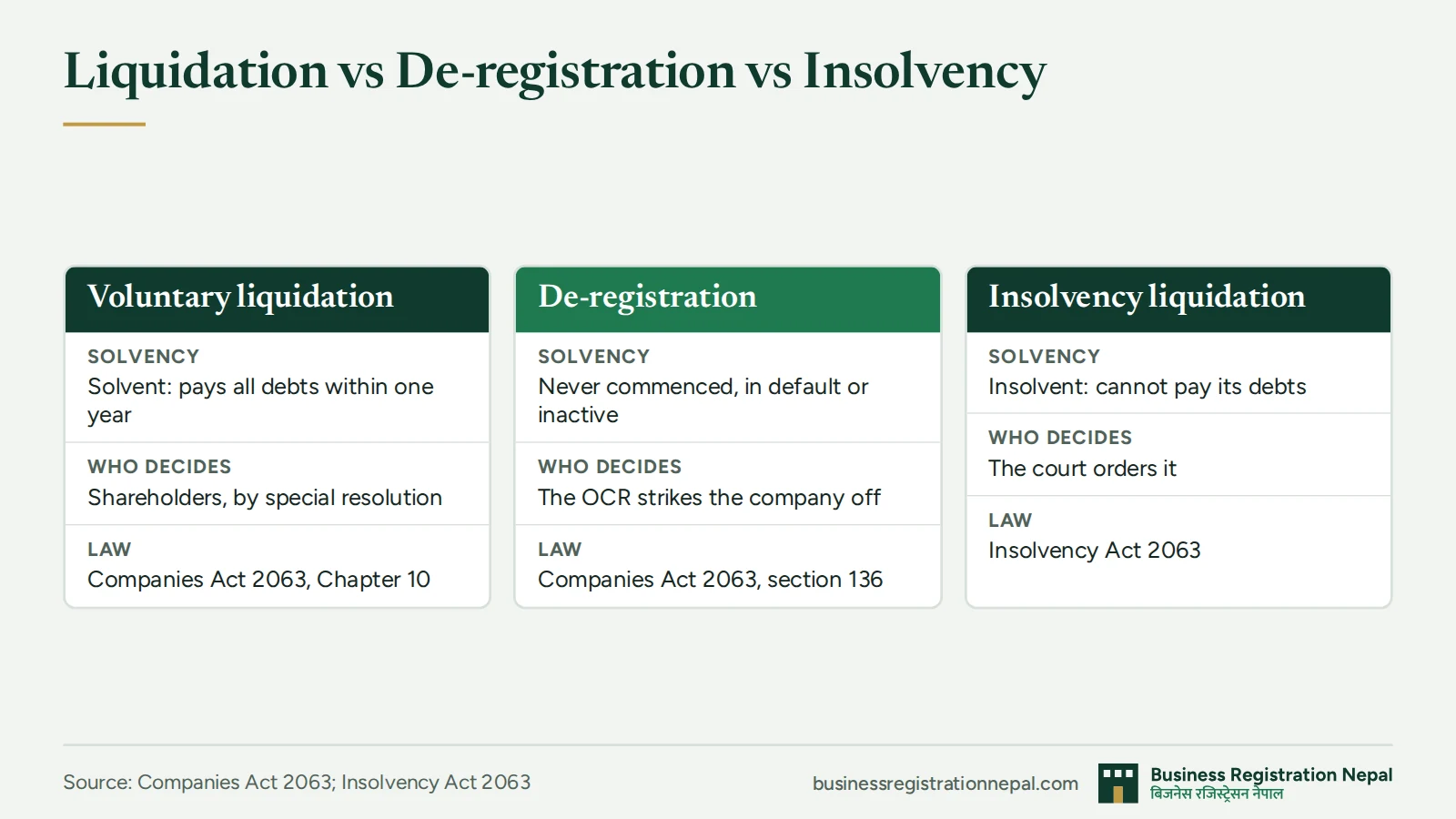
Liquidation, the legal process of winding up or dissolution, ends a company after its assets settle its debts. Under the Companies Act 2063, voluntary liquidation is open only to a company that is not insolvent, and its shareholders start it by special resolution.
De-registration, known as striking off, is company closure by the Office of the Company Registrar (OCR). The OCR is the Company Registrar that keeps the company register under the Companies Act 2063.
Section 136 lets the OCR deregister a company on 3 grounds. A promoter applies because business never commenced, the company leaves returns or fines unpaid for 3 consecutive financial years, or the OCR finds that the company no longer operates. Section 136A adds a special arrangement for winding up, and the OCR published a notice on that process on 2081/12/13. It covers a company that never started or has stopped operating, and a company in default of its section 80 annual filings. The company files its overdue financial statements and annual details, a general meeting resolution and a self-declaration of no liabilities through CAMIS. It pays the lower of its accumulated fines or 0.5% of its latest paid-up capital, and the OCR publishes a 30-day notice for objections before it cancels the registration.
Insolvency is a company's inability to pay debts, and the Insolvency Act 2063 governs it. Under section 129 of the Companies Act 2063, a liquidator who finds a company insolvent mid-liquidation applies for an insolvency review.
Company closure cost in Nepal differs by route. For company deregistration, Nepal's OCR charges NPR 1,000 up to NPR 10 lakh of paid-up capital and NPR 5,000 above it. A voluntary liquidation pays the remuneration the company fixes for its liquidator and auditor, and the OCR confirms any filing charge on the liquidation papers at submission.
The table compares the 3 closure routes on 6 attributes.
| Attribute | Voluntary liquidation | De-registration (strike-off) | Compulsory (insolvency) liquidation |
|---|---|---|---|
| Company's position | Solvent: pays all debts within one year of the resolution | Never commenced business, in default or inactive | Insolvent: unable to pay its liabilities |
| Started by | Shareholders, by special resolution | A promoter's application or the OCR | An application to the court by the company, creditors holding at least 10% of its debt, shareholders or debenture holders with at least 5%, a liquidator or the sector regulator |
| Who winds up | A liquidator the company appoints | No liquidator; the OCR cancels the registration | A liquidator the court appoints |
| Governing law | Companies Act 2063, Chapter 10 | Companies Act 2063, section 136 | Insolvency Act 2063 |
| Government fee | Liquidator and auditor remuneration; any OCR filing charge confirmed at submission | NPR 1,000 up to NPR 10 lakh paid-up capital; NPR 5,000 above (on a promoter's application) | Costs of the insolvency process, paid first from the company's assets |
| End point | The OCR strikes the name off and publishes a dissolution notice | The OCR cancels the registration and publishes a notice in a national daily | The court's liquidator informs the OCR, which records the cancellation |
A solvent trading company takes voluntary liquidation, and a company that never commenced business applies for de-registration. An insolvent company goes to court.
What Is the Voluntary Liquidation Process?
The voluntary liquidation process in Nepal runs in 5 steps, from the shareholders' special resolution to the OCR striking the company off the register. Shareholders of a solvent company close it this way under Chapter 10 of the Companies Act 2063, with a licensed liquidator in charge from step 2.
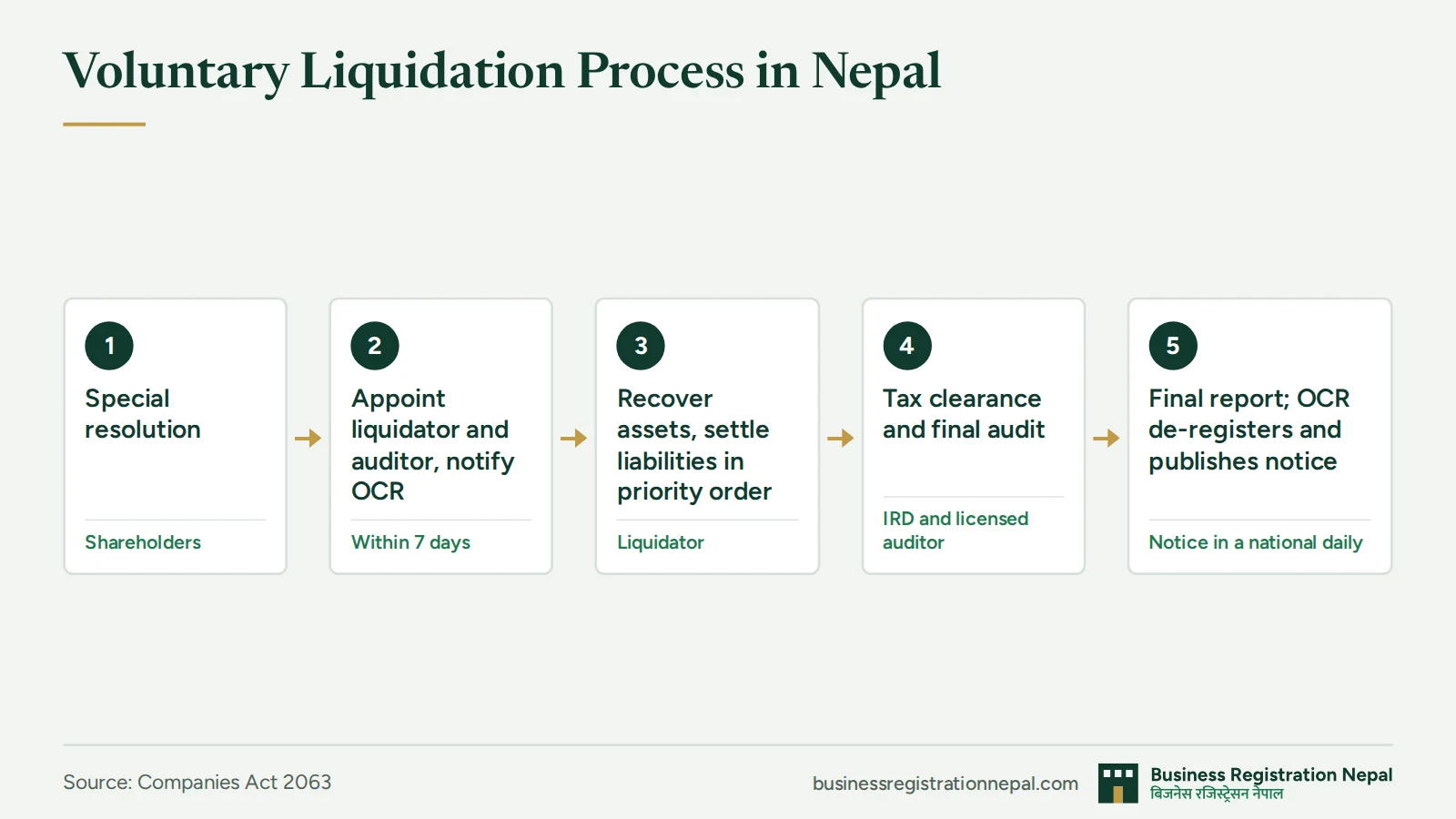
- Step 1: Pass a special resolution at the general meeting. The directors declare in writing that the company can pay its debts in full within one year of the resolution. The company sends the resolution and that declaration to the OCR within seven days of adopting it.
- Step 2: Appoint a liquidator and auditor and notify OCR. The liquidator, or winding-up officer, holds a licence under Nepal's auditing law, and the company notifies the OCR within seven days of the appointment. The directors' powers pass to the liquidator from that day.
- Step 3: Recover assets and settle liabilities in priority order. The liquidator takes the company's property into custody, recovers amounts owed to it and repays every creditor, while secured creditors keep their right to enforce their security. Surplus assets reach shareholders once holders of at least 75% of the paid-up capital consent to the distribution.
- Step 4: Obtain tax clearance and complete the final audit. The liquidator settles the company's tax with the Inland Revenue Department (IRD), and the OCR asks for the IRD tax clearance before it accepts the final closure filing. The IRD issues a tax clearance certificate once the liquidation settles those tax dues. A licensed auditor carries out the final audit of the liquidation, as in each annual statutory audit in Nepal.
- Step 5: File the final liquidation report; OCR de-registers and publishes notice. The liquidator files the final report on assets recovered, creditors paid and amounts returned to shareholders, with the auditor's report attached. Under section 132, the OCR then strikes the company off the register and publishes a dissolution notice in a national daily.
The published notice ends the company's legal existence and completes the voluntary liquidation. Under the company liquidation process, Nepal's OCR acts on the liquidator's report and needs no court order for winding up a company that pays its debts.
When Is Compulsory (Insolvency) Liquidation Used?
Compulsory liquidation is used when a company cannot pay its liabilities and a court orders its winding up under the Insolvency Act 2063. A court-appointed liquidator, not the shareholders, then runs the closure and ranks the creditors' claims.
Under section 126 of the Companies Act 2063, a company already insolvent under the insolvency law has no voluntary liquidation route. Its closure starts in 2 ways: a petition to the court by the company, creditors holding at least 10% of its debt, or shareholders or debenture holders holding at least 5% (Insolvency Act 2063, section 4), or a liquidator's application under section 129 when a voluntary liquidation uncovers insolvency.
The Insolvency Act 2063 names the court as the commercial bench that the Government of Nepal designates in the Nepal Gazette after consulting the Supreme Court. On a dissolution order, that court appoints one liquidator from the persons licensed to carry out insolvency work.
The court's liquidator realises the assets and pays creditors in the priority the Insolvency Act 2063 sets. Section 128 of the Companies Act 2063 applies the same law to decide who counts as a creditor.
The court's liquidator then informs the OCR, which records the cancellation, and the company counts as cancelled from that record.
What Documents Are Required to Close a Company?
8 documents are required to close a company through voluntary liquidation, from the registration certificate to the liquidator's final report. The OCR receives them at different stages of the liquidation.
0 of 8 ready
The Companies Act 2063 names 3 of these filings directly: the resolution with the solvency declaration, the appointment notice and the final report. A de-registration on a promoter's application uses its own OCR file.
How Long Does Company Closure Take?
Company closure has no single statutory time limit in Nepal: a voluntary liquidation lasts for the period the company fixes when it appoints the liquidator. The directors' solvency declaration commits the company to settle its debts within one year of the resolution.
The Companies Act 2063 fixes 4 time points inside a voluntary liquidation:
- 7 days to file the special resolution and the solvency declaration with the OCR
- 7 days to notify the OCR of the liquidator's appointment
- 6 months between income and expenditure statements to the OCR and progress reports to shareholders
- 15 days for a creditor or shareholder to complain to the court about the liquidator's act
The company extends the liquidator's term when a justified reason delays completion, so the total length varies, commonly from 6 months to more than a year. A de-registration that the OCR starts gives the company 2 months from the notice to answer.
A compulsory liquidation follows the timetable of the court and its liquidator under the Insolvency Act 2063. The court fixes a hearing within 15 days of a duly made application, creditors submit claims within 15 days of the claims notice, and the liquidator reports progress to the court and the OCR within 3 months of appointment.
Frequently Asked Questions
Is a tax clearance certificate required before closing a company?
Yes, a tax clearance from the IRD forms part of closing a company before the OCR strikes it off, and the OCR asks for it before it accepts the final closure filing. The IRD issues that clearance once the company's tax dues are settled. Under the VAT Act 2052, the tax officer cancels a closing company's VAT registration, with tax due on closing stock that carried input credit.
Can a struck-off company be restored later?
Yes, a struck-off company is restored by a court order on a petition filed within five years of the published cancellation notice. Section 137 of the Companies Act 2063 lets the company, a shareholder or a creditor petition, and the OCR re-enters the name once the section 81 fines are paid. The route covers a registration the OCR cancelled under section 136, and the restored company counts as existing from its original registration date.
What happens to assets, debts and employees during liquidation?
The liquidator takes the assets into custody, realises them, pays the debts and returns any surplus to the shareholders. Employees' service ends automatically when the liquidator is appointed, though the liquidator keeps the staff the work needs. Employee dues are among the claims the liquidator settles. In an insolvency liquidation, section 57 of the Insolvency Act 2063 pays employees' unpaid wages, then their leave, gratuity and provident fund dues, ahead of other creditors once the costs of the process are met.
Are directors personally liable for company debts after liquidation?
No, directors carry no personal liability for company debts after liquidation, except for fraud or, after an OCR cancellation, debts that their own management left unpaid. Under section 134 of the Companies Act 2063, the liquidator takes legal action against a director, employee or shareholder who committed fraud or deception.
After a cancellation under section 136, the people responsible for the default personally bear any debt the devolved assets leave unpaid. Each case turns on its own facts.
Do I still need to file final tax returns and an audit before closure?
Yes, a company files its final audited accounts and final tax returns before closure, as part of obtaining clearance to close. The income-tax return reaches the IRD within three months of the end of the income year under the Income Tax Act 2058. The auditor's report travels with the liquidator's final report to the OCR under section 131 of the Companies Act 2063.
How are creditors' claims prioritised during winding up?
Creditors' claims are paid in the order the law sets: secured and preferential claims rank ahead of ordinary creditors, and shareholders come last. In an insolvency liquidation, section 57 of the Insolvency Act 2063 pays the costs of the process first, then employees' wages and benefits, then other accepted creditor claims, then interest, with preference shareholders ahead of other shareholders. Section 135 of the Companies Act 2063 preserves a secured creditor's right to enforce its security during liquidation. Section 128 decides who counts as a creditor under the insolvency law.