

Company renewal (Adyawadik, अद्यावधिक) in Nepal is the mandatory annual update of a company's records at the Office of the Company Registrar (OCR). A company has perpetual succession under the Companies Act 2063, so nothing expires. Its yearly duty is filing the AGM decisions and audited accounts within six months of fiscal year end, by mid-January.
The company renewal process in Nepal runs in 5 steps:
- Step 1: Hold the AGM.
- Step 2: Prepare the audited financial statements.
- Step 3: Submit the update on OCR CAMIS.
- Step 4: Clear any late fees.
- Step 5: Receive the Adyawadik confirmation.
The filing carries 4 document sets, led by the audited statements. Late filing costs NPR 1,000 to NPR 20,000 a year by paid-up capital, and missed updates bring trouble with banks and other services and, after three consecutive years of default, cancellation. Each update keeps current the record that company registration in Nepal creates.
What Is Company Renewal (Adyawadik) in Nepal?
Adyawadik, known as company renewal in Nepal, is the mandatory annual update of a company's records at the Office of the Company Registrar (OCR), through its AGM decisions and audited financial statements. The Companies Act 2063 sets this duty for every registered company.
The OCR is the government office that registers companies and keeps the company register. Adyawadik is the Nepali word for this annual update. English searches call it company renewal, Nepal's everyday name for the duty, and Nepali searches use nabikaran, the word for renewal.
Under the Companies Act 2063, a company is an autonomous body corporate with perpetual succession. Its registration carries no expiry date, so no company is renewed to stay alive, and company renewal in Nepal means keeping the register entry current.
Company renewal, in practice, is the annual OCR filing: the audit and AGM submission that brings the company's record up to date each fiscal year. Company Adyawadik in Nepal therefore follows the audit and the annual general meeting (AGM) every year.
Is Company Renewal Mandatory Every Year in Nepal?
Yes, company renewal (Adyawadik) is mandatory every year for every registered company in Nepal, through the annual filing of its audited accounts and AGM details with the OCR. The duty repeats each fiscal year for as long as the company stays on the register.
Section 80(2) of the Companies Act 2063 requires every company to file audited annual financial statements with the auditor's report within six months of fiscal year end. The Act sets no audit exemption by size, so a small or dormant company is audited too. A public company adds the AGM return under section 80(1). A private company holds its general meeting as its articles of association or consensus agreement provide, and it still files its audited statements.
The OCR update is separate from the ward or local business renewal. The ward office renews the company's local business registration each fiscal year as a separate local duty, at the fee the municipality sets in its annual finance act. To comply with the law, a company keeps both records current, because neither renewal replaces the other.
What Is the Deadline for Company Adyawadik?
The deadline for company Adyawadik is within six months of fiscal year end, which falls at the end of Poush, about mid-January. Nepal's fiscal year, or financial year, runs from Shrawan to Asar and ends on the last day of Asar, in mid-July.
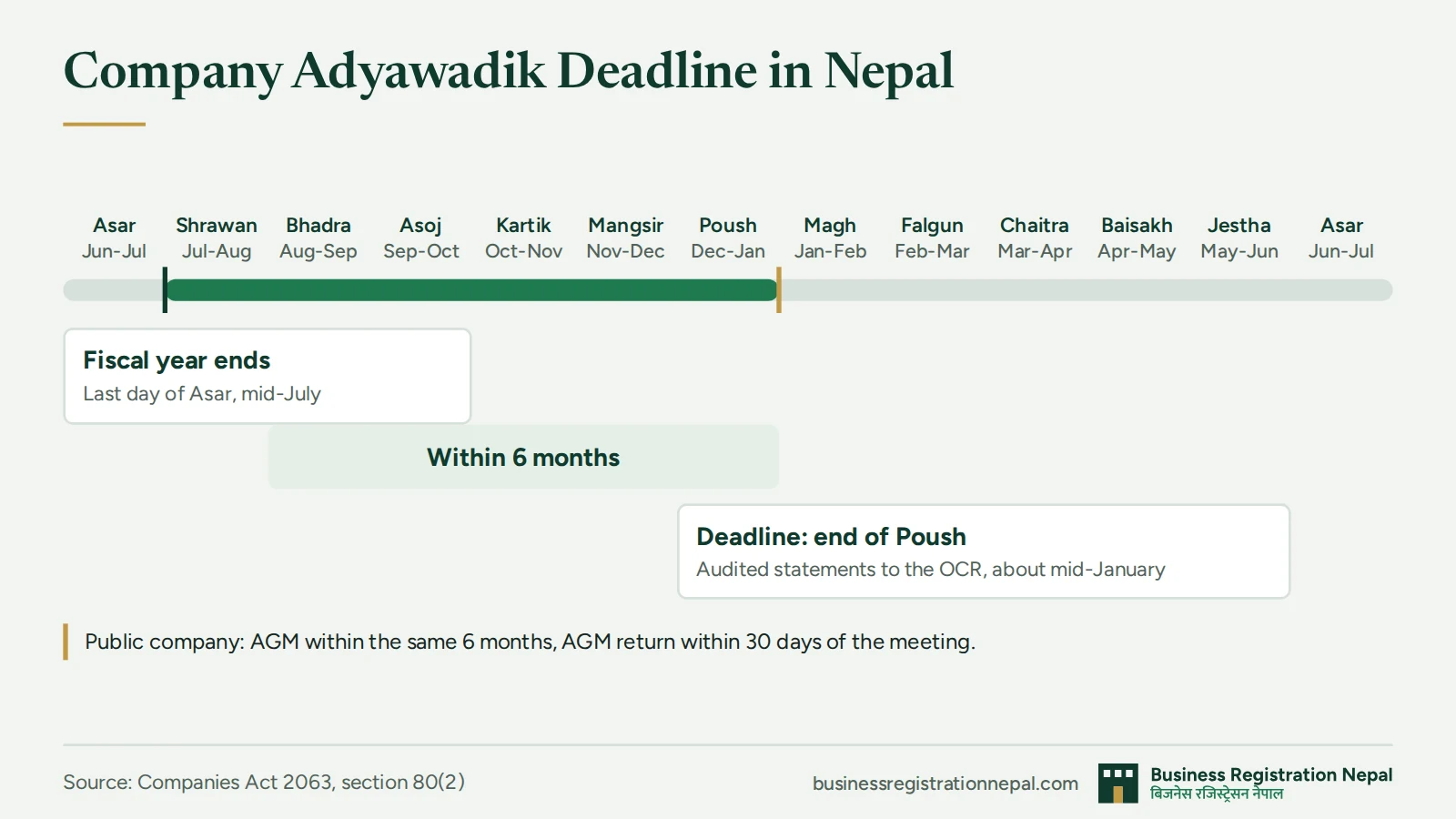
The company renewal deadline in Nepal comes from section 80(2) of the Companies Act 2063, which covers the audited annual financial statements. The Gregorian date of Poush end shifts each year with the Nepali calendar. For FY 2082/83, which closed in mid-July 2026, the limit is the last day of Poush 2083, 14 January 2027.
A private company files its audited statements with the OCR within six months of fiscal year end. A public company holds its AGM within the same six months and files the AGM return within 30 days of the meeting. The OCR extends a public company's AGM deadline by up to 3 months when the company applies with a reasonable cause.
A return filed after the limit is late, and its fine band rises at 3, 6 and 12 months of delay.
What Is the Company Adyawadik Process?
The company Adyawadik process runs in 5 steps, from the AGM decisions to the OCR confirmation on CAMIS. The annual OCR filing in Nepal carries the results of the audit and the AGM, so both come before the online submission.
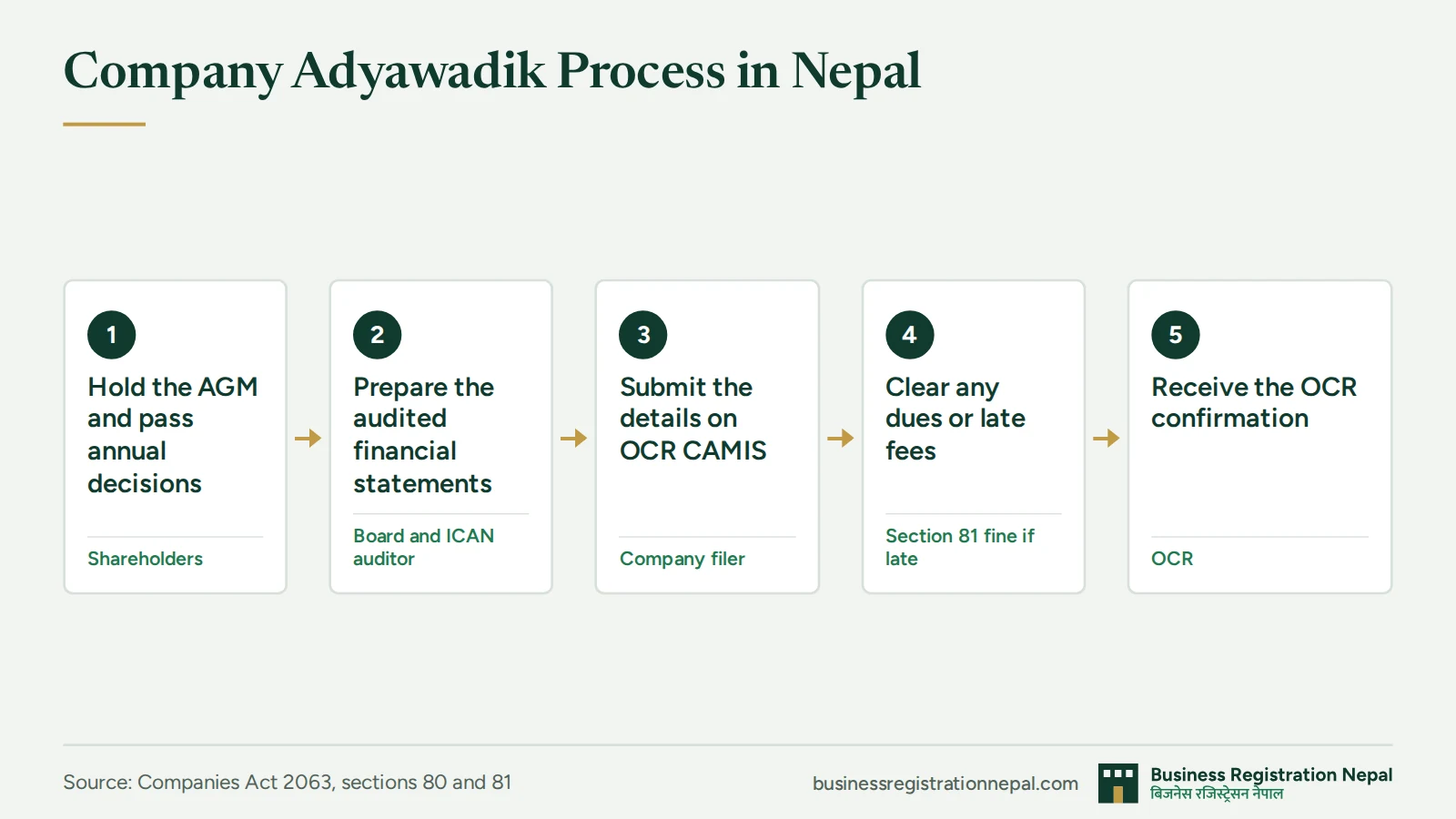
- Step 1: Hold the AGM and pass the annual decisions. A public company holds its AGM within six months of fiscal year end, and a private company follows its articles. The general meeting's resolutions feed the OCR return, and AGM in Nepal sets out the notice, quorum and minutes behind them.
- Step 2: Prepare the audited financial statements. The board of directors approves the balance sheet, profit and loss account and cash flow statement. An auditor licensed by the Institute of Chartered Accountants of Nepal (ICAN) audits them. The Adyawadik filing carries the auditor's report from the statutory audit in Nepal, which the auditor conducts on the year's accounts.
- Step 3: Log in to OCR CAMIS and submit the Adyawadik / annual-update details. CAMIS, the Company Administration Management Information System, is the OCR's online portal at camis.ocr.gov.np. The filer verifies the company particulars and uploads the statements and documents electronically, as section 80(3) of the Companies Act 2063 permits.
- Step 4: Clear any dues or late fees. A company that files after the deadline pays the section 81 fine to the OCR together with the overdue return.
- Step 5: Receive the Adyawadik confirmation. The OCR keeps the filing in the company's electronic record, and the confirmation, known as the Adyawadik patra (अद्यावधिक पत्र), shows the record is up to date. The OCR issues it after it verifies the submitted documents.
The confirmation closes the year's company renewal process, and the 5 steps start again after the next fiscal year end.
What Documents Are Required for Company Renewal?
Company renewal requires 4 sets of documents: the audited financial statements, the AGM minutes or decisions, the annual returns and the updated company particulars. The company uploads them to the OCR on CAMIS as one annual update.
0 of 4 ready
Sections 80(1) and 80(2) of the Companies Act 2063 set the contents of the AGM return and the audited statements. The current CAMIS upload list and file formats follow the OCR's online form at the time of filing.
What Are the Fees and Penalties for Late Adyawadik?
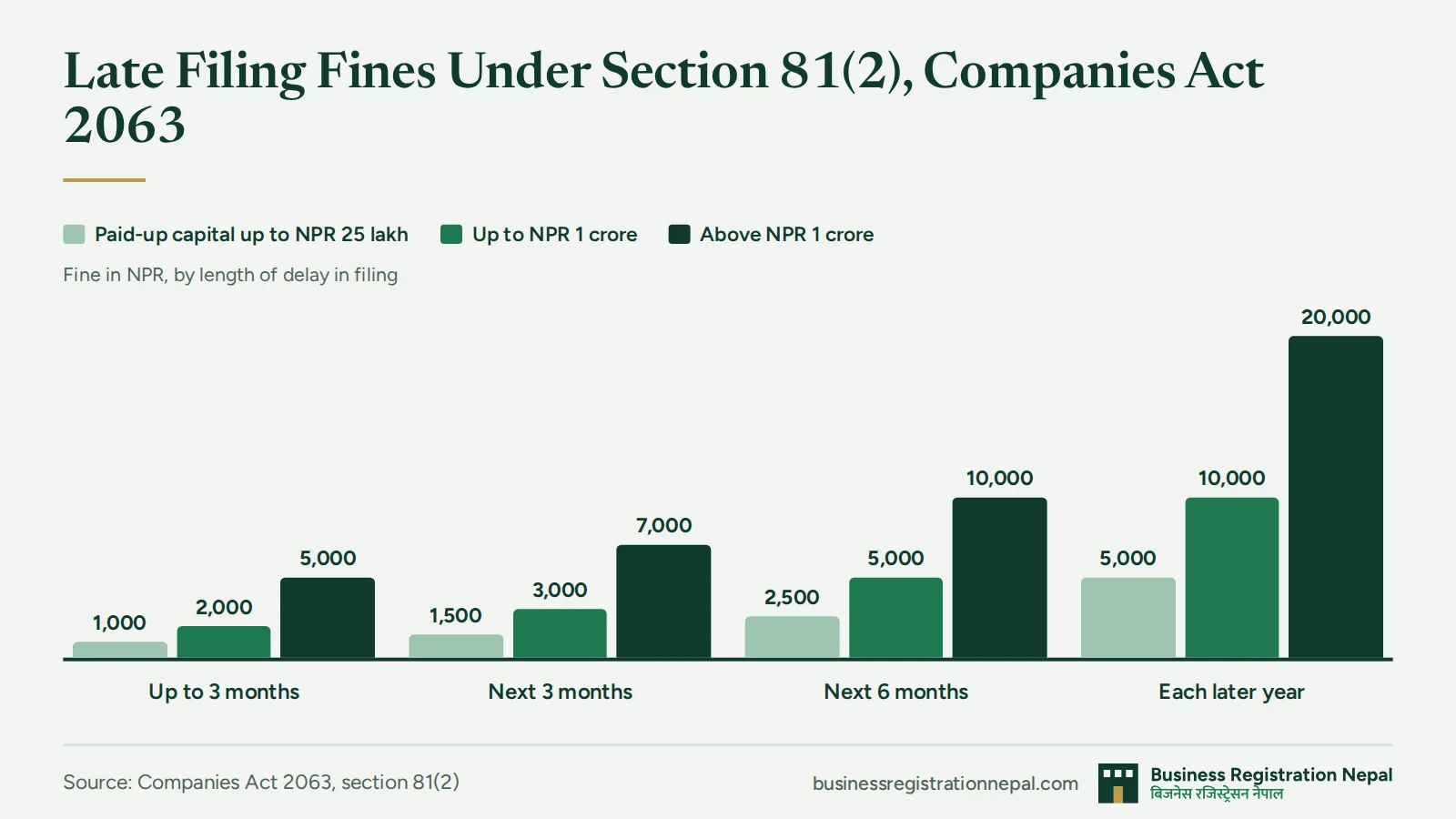
A late Adyawadik draws a fine of NPR 1,000 to NPR 20,000 a year, set by the company's paid-up capital and the length of the delay. The fine, or penalty, repeats for each year the return stays overdue, and the director responsible pays it.
The company renewal fee in Nepal has 2 parts: any OCR filing fee for the update and the late fine. The OCR revenue schedule sets the late fines, and CAMIS shows any filing charge at the time of submission.
Under section 81(2) of the Companies Act 2063, the directors or officers responsible for a late return pay a fine. The Nepali word for this fine is jariwana, and the OCR publishes the same schedule on its revenue page.
The table shows the section 81(2) fine in NPR by length of delay and paid-up capital.
| Delay in filing | Paid-up capital up to NPR 25 lakh | Up to NPR 1 crore | Above NPR 1 crore |
|---|---|---|---|
| Up to 3 months | NPR 1,000 | NPR 2,000 | NPR 5,000 |
| The next 3 months | NPR 1,500 | NPR 3,000 | NPR 7,000 |
| The next 6 months | NPR 2,500 | NPR 5,000 | NPR 10,000 |
| Each year after that | NPR 5,000 per year | NPR 10,000 per year | NPR 20,000 per year |
A profit-not-distributing company pays the rate for paid-up capital up to NPR 1 crore. The fine goes to the OCR together with the overdue return, so this late filing penalty grows with every missed year.
Other notices the Act requires, such as a change in company details, carry a smaller late renewal penalty. The OCR charges NPR 200 a month after one month's delay, up to NPR 1,000 in one fiscal year.
What Happens If You Do Not Update (Renew) Your Company?
A company that does not update (renew) its records faces 5 consequences: escalating fines, denial of OCR services, company bank account problems, possible public listing of its status and action against its directors. Three consecutive years of default open the way to cancellation of its registration.
The 5 consequences build on each other the longer the records stay overdue:
- Fine escalation: the section 81(2) fine moves to a higher band with each period of delay and repeats every later year.
- Denial of OCR services: a company with an overdue record finds other filings and approvals harder to obtain until the update is complete.
- Company bank account problems: a bank asks for the Adyawadik letter and a tax clearance certificate for account renewals, loan processing and other transactions.
- Public listing: severe or repeated default can lead to public listing of the company's status, which damages its standing until it regularises the record.
- Action against directors: the director or officer with the filing duty pays the section 81 fine, so director liability follows every missed return.
Under section 136 of the Companies Act 2063, the OCR has the power to cancel a company's registration after three consecutive financial years of default. That default covers the section 80 returns or the section 81 fines. The OCR gives notice beforehand, and the company has 2 months to show why its registration stands.
Frequently Asked Questions
Is Adyawadik the same as the annual return or the tax return?
No, Adyawadik is not the tax return: it is the yearly update of the company's records at the OCR, filed through the annual return and the audited accounts. The income-tax return goes to the Inland Revenue Department (IRD) within three months of the end of the income year under the Income Tax Act 2058. Both filings rest on the same audited accounts, but the update goes to the OCR and the tax return to the IRD.
What happens if a company does not renew?
A company with overdue updates loses normal access to bank and government services until it files the overdue updates and pays the fines. Default for three consecutive financial years gives the OCR the power to cancel the registration under section 136 of the Companies Act 2063, a step known as striking off. The company regularises its record by filing every missed return and paying each section 81 fine.
Can a struck-off company be revived after missed updates?
Yes, a struck-off company is revived when the court orders its restoration on a petition filed within five years of the published cancellation notice. Under section 137 of the Companies Act 2063, the company, a shareholder or a creditor files that petition.
The court restores a company that was still doing business, or where restoration serves the proper management of its assets and liabilities. The OCR re-enters the name only after the section 81 fines are paid.
Who is authorised to sign and submit the Adyawadik filing?
An authorised director or a company representative signs and submits the Adyawadik filing on CAMIS, with a professional's support where the company appoints one. Under section 81 of the Companies Act 2063, the director or officer who holds the filing duty answers for a late return and pays its fine. The auditor signs and dates the audit report that the filing carries.
How is company renewal different from renewing a PAN or business licence?
Adyawadik, the company renewal at the registrar, updates the company's record at the OCR, and the PAN, VAT registration and any sector licence stay with their own offices. The IRD keeps the PAN and VAT records and takes changes through its registration and amendment forms. A sector licence renews with the regulator that issued it, and the ward office renews the local business registration under the municipality's annual finance act. Each regulator sets its own licence renewal cycle.
How many years of missed updates can be regularised at once?
Missed years are regularised together by filing every overdue return and paying the section 81 fine for each year. The OCR accepts the missing returns for all earlier fiscal years in that regularisation. The yearly fine reaches NPR 5,000, 10,000 or 20,000 by paid-up capital, and three consecutive years of default let the OCR cancel the registration. Under the Finance Act 2083, the OCR notice of 3 Ashar 2083 waives the taxes, fees, interest and fines of earlier years for a company that files its FY 2082/83 details and pays that year's dues by the end of Asoj 2083 (mid-October 2026).