

After registering a company in Nepal, the post-incorporation checklist runs in 9 steps:
- Step 1: Hold the first board meeting and set up statutory registers.
- Step 2: Open a company bank account and deposit the share capital.
- Step 3: Obtain a PAN before invoicing, and VAT above the threshold.
- Step 4: Register at the ward office and obtain any sector licence.
- Step 5: Appoint an auditor and report the name to the OCR within 15 days.
- Step 6: Issue share certificates after share payment.
- Step 7: Set up bookkeeping.
- Step 8: Display the PAN and registration certificates and a Nepali nameplate.
- Step 9: Enrol employees with the SSF.
Foreign-invested companies record bank-channel capital with NRB under FITTA. Ongoing annual obligations follow: the audit, tax return, OCR filing, AGM and renewals each fiscal year.
This guide to post registration activities for companies in Nepal follows how to register a company, and both form part of company registration in Nepal.
What Are the First Steps After Company Registration?
After company registration in Nepal, a company takes 2 immediate steps: the opening board meeting with statutory registers, then a bank account for the share capital. Both steps follow the Certificate of Incorporation that the Office of the Company Registrar (OCR) issues.
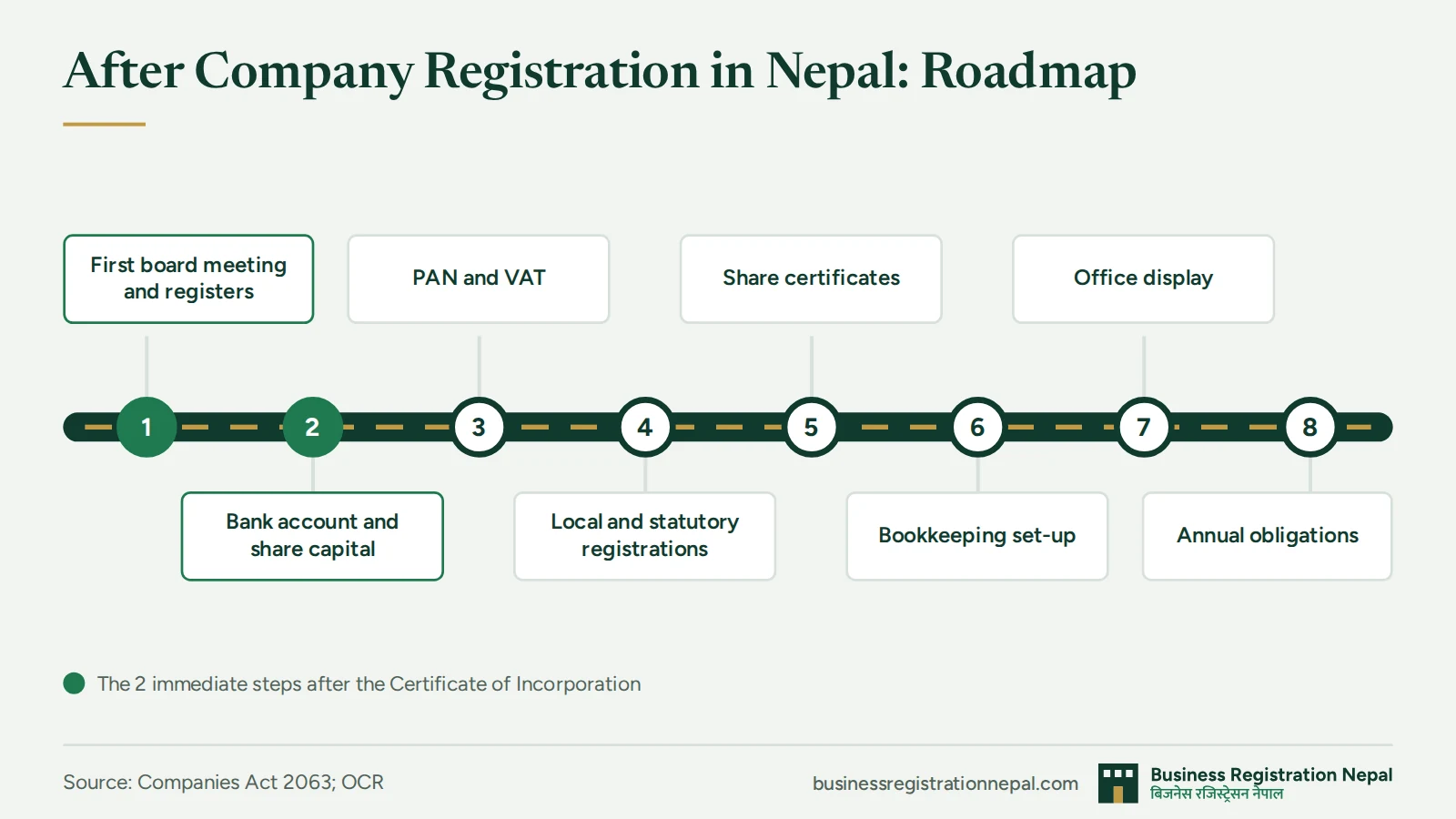
- Step 1: Hold the first board meeting and set up statutory registers. The board of directors records the incorporation, names the authorized signatories and passes the resolution to open a bank account. Under the Companies Act 2063, the statutory registers, such as the register of shareholders and the register of directors, record corporate ownership and management.
- Step 2: Open a company bank account and deposit the share capital. Shareholders pay the subscribed share capital into this account, which gives the company a banked record of its paid-up capital. The registered company presents its incorporation documents and board resolution when opening a company bank account.
The two steps give the company its governing records and a funded account, the base for tax registration at the Inland Revenue Department (IRD). A public company adds one more step and applies to the OCR for permission to start business once shareholders pay the share capital.
How Do You Complete Tax Registration (PAN and VAT)?
To complete tax registration, a company obtains a PAN before it invoices, then registers for VAT once turnover or its sector requires it. The IRD runs both registrations, the PAN under the Income Tax Act 2058 and VAT under the VAT Act 2052.
Tax registration runs in 3 steps, from the PAN application to the VAT decision.
- Step 1: Apply for a PAN at the Inland Revenue Office that covers the company's registered office. The application carries the Certificate of Incorporation and the details of the company and its directors, with the MOA and AOA, the directors' citizenship certificates and proof of the office address, such as the lease agreement. The company files the application online on the IRD taxpayer portal and takes the printed form to that office for verification.
- Step 2: Obtain the 9-digit PAN before the company starts business. PAN is mandatory for every company, and every invoice and tax return carries it.
- Step 3: Register for VAT when taxable turnover crosses NPR 50 lakh for goods or NPR 30 lakh for services. A VAT-mandatory sector registers from the start of trading, whatever its turnover. A VAT-registered company charges VAT at 13% and files VAT returns with the IRD.
The company's PAN registration in Nepal ends with a PAN certificate, which the company later displays at its office. A company below both thresholds and outside the VAT sectors stays PAN-only, and VAT registration in Nepal follows once turnover crosses the threshold.
What Local and Statutory Registrations Are Needed?
A new company needs 4 local and statutory registrations: ward registration, an auditor reported to the OCR, any sector licence, and SSF enrolment for employees. Each registration goes to a different office, from the ward to the Social Security Fund.
Ward registration is the local registration of the business at the ward office of the municipality that holds the registered office. The ward records the business in its area and charges a local business-registration fee at the rate the municipality sets in its annual finance act, with renewal each fiscal year.
Under the Companies Act 2063, a private company appoints its auditor as its MOA, AOA or consensus agreement provides. Where those documents are silent, the general meeting makes the appointment, and the company sends the auditor's name to the OCR within 15 days. The company also files a return of allotments with the OCR within 30 days of each share allotment, under section 31 of the Companies Act 2063, and gives the OCR notice of its office within three months of incorporation, under section 184.
The statutory auditor, a chartered accountant licensed by the Institute of Chartered Accountants of Nepal (ICAN), audits the company's annual accounts. Companies that appoint an auditor at this stage prepare for the statutory audit in Nepal at fiscal year end.
A company in a regulated sector obtains a licence from its regulator, such as the Insurance Board or Nepal Rastra Bank (NRB), the central bank. The company informs the OCR within 15 days of receiving that licence or permit.
A company with employees enrolls with the Social Security Fund (SSF), the fund that operates under the Contribution Based Social Security Act 2074. Enrolment covers every employer with employees, whatever the headcount, and the employer enrolls each employee within three months of joining. The monthly contribution is 31% of basic salary: 11% from the employee and 20% from the employer. Social Security Fund registration and employer contributions follow the SSF enrolment process for companies.
How Do You Set Up Bookkeeping and Accounting?
To set up bookkeeping and accounting, a company establishes invoices, receipts, vouchers and ledgers before its opening transaction. A VAT-registered company keeps the authorized VAT registers alongside those books from the date of its VAT registration.
The setup runs in 4 steps, from the sales document to the ledger.
- Step 1: Set up the invoice format with the company name, address and PAN, and number each invoice in sequence.
- Step 2: Issue a receipt for every amount the company receives, in cash or through the bank account.
- Step 3: Prepare a voucher for every payment and adjustment, with the bill or document that supports it.
- Step 4: Post each voucher to the ledgers, the books of account that group transactions by account.
The ledgers feed the annual accounts, the auditor's report and the income-tax return, so a gap in the books delays each of them. Bookkeeping kept from the opening transaction lets the company comply with the IRD and the OCR at fiscal year end. Companies that outsource this work use accounting and bookkeeping services in Nepal to keep ledgers ready for the audit.
What Must You Display at Your Office?
Every company displays its PAN certificate and its registration certificate at the office, and puts up a nameplate in Nepali. The OCR requires the signboard in Nepali, the national language, at the registered office and at every place of business.
The office display covers 3 items:
- The PAN certificate that the Inland Revenue Office issues
- The Certificate of Incorporation, the registration certificate from the OCR
- The nameplate or signboard with the company name in Nepali
The display applies from the day the company starts business at the premises. A company that opens a branch or moves its office puts up the same signboard at the new place of business.
What Are the Ongoing Annual Obligations?
The ongoing annual obligations are 5 recurring duties: the audit, the income-tax return, the OCR filing, the AGM and renewals. Post-registration compliance in Nepal follows the fiscal year, which runs from Shrawan to Asar (mid-July to mid-July).
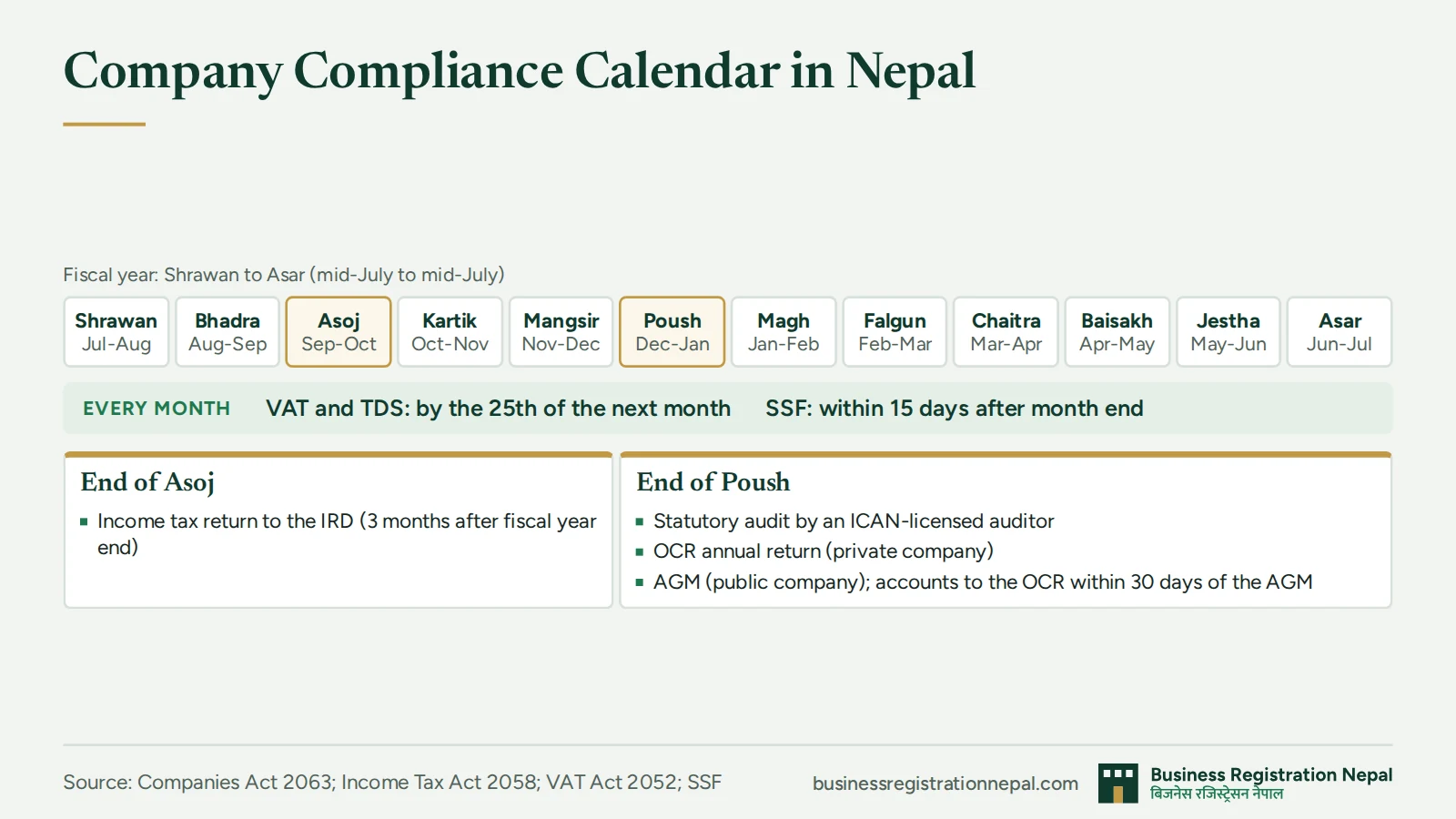
The 5 annual obligations fall on these offices:
- Audit: the statutory auditor audits the annual accounts after fiscal year end.
- Income-tax return: the company files its return with the IRD on the audited figures within three months of fiscal year end, by the end of Ashwin (mid-October), under section 96 of the Income Tax Act 2058. The IRD can extend this date on application.
- OCR filing: a private company submits its audited annual financial statements to the OCR within six months of fiscal year end, under section 80 of the Companies Act 2063.
- AGM: a public company holds its annual general meeting within six months of fiscal year end, and since the 2074 amendment to the Companies Act 2063, a private company holds its AGM within the same six-month period under section 76.
- Renewals: the company renews its ward registration each fiscal year and any sector licence when it falls due.
The annual return, the OCR filing, closes each cycle, and the audited accounts feed both it and the tax return. The annual compliance checklist orders these duties by deadline across the fiscal year. The audit, tax return and OCR update recur every fiscal year, and annual compliance and filings covers that registered-company cycle.
What Extra Steps Apply to Foreign-Invested Companies?
A foreign-invested company takes 3 extra steps: it brings its capital through the banking channel, records that capital with NRB, and follows the FITTA sector rules. FITTA is the Foreign Investment and Technology Transfer Act 2019, the law that governs foreign direct investment (FDI) in Nepal.
The 3 extra steps follow the domestic checklist in this order.
- Step 1: Bring the foreign capital into the company bank account through the banking channel, so every inflow carries a bank record.
- Step 2: Record the foreign capital with NRB, which tracks each foreign investment that enters Nepal, within six months of the inflow. The NRB Foreign Investment and Foreign Loan Management Bylaw 2078 sets the window, and the application carries the DOI approval, the bank's inflow certificate, the registration and PAN certificates and the updated OCR shareholder record.
- Step 3: Follow the FITTA sector rules, which close the sectors on its negative list to foreign investment. The list covers sectors such as small and cottage industries, personal services, arms and ammunition, real estate trading (other than construction), retail trade, travel and trekking agencies, mass media and professional consultancy, and the DOI confirms the current list at approval.
The NRB record of the capital supports repatriation of profits when the company later pays dividends to its foreign shareholders. The Department of Industry (DOI) approval comes before incorporation under FDI and foreign company registration, at NPR 20 million or more per foreign investor.
Frequently Asked Questions
What comes after company registration in Nepal?
A newly registered company completes 6 core tasks after company registration in Nepal: PAN and any VAT, a bank account, ward registration, an auditor, share certificates and bookkeeping. The PAN and the bank account come before trading, and the auditor's name reaches the OCR within 15 days of the appointment.
How long do I have to complete post-registration steps?
Post-registration steps run on 2 timelines: the PAN, the bank account and the board meeting come before business starts, and OCR submissions and share certificates carry set windows. The auditor's name and any sector licence each reach the OCR within 15 days. Share certificates follow within two months of allotment under section 33 of the Companies Act 2063, and the return of allotments reaches the OCR within 30 days of allotment under section 31.
Is a PAN certificate mandatory after registration?
Yes, a PAN certificate is mandatory: every company obtains a PAN from the IRD before it operates or invoices. The Inland Revenue Office that covers the registered office issues the 9-digit number, and the company displays the certificate at its office.
When must share certificates be issued?
Share certificates must be issued within two months of the allotment of shares, under section 33 of the Companies Act 2063. The shareholder pays for the shares before the certificate issues, and the register of shareholders records the same entry.
Is SSF registration required after registering a company?
Yes, SSF registration is required for a company that has employees, under the Contribution Based Social Security Act 2074, whatever the number of employees. The company enrolls itself with the Social Security Fund as an employer and then enrolls its employees.