

A company in Nepal is registered in 6 steps under the Companies Act 2063:
- Step 1: Reserve the company name on CAMIS, the portal of the Office of the Company Registrar (OCR).
- Step 2: Prepare the MOA and AOA.
- Step 3: Submit the application and documents online on CAMIS.
- Step 4: Receive the Certificate of Incorporation from the OCR.
- Step 5: Register PAN, and VAT above the threshold, at the IRD.
- Step 6: Register at the ward office and obtain any sector licence.
The company registration process in Nepal needs 6 documents, led by the application, the MOA and AOA, and shareholder IDs. Online business registration for a new company takes about 7 to 15 working days once the CAMIS file is complete. A private company needs at least NPR 1 lakh of authorized capital, a public company NPR 1 crore of paid-up capital, and each foreign investor at least NPR 20 million.
The cost combines the OCR fee on authorized capital, from NPR 1,000, with ward, tax and professional fees. Founders choose among 6 entity types, led by the private limited company. After registering, the company opens a bank account and runs bookkeeping, the AGM, the annual audit and renewal, all part of company registration in Nepal.
What Do You Need Before You Register a Company in Nepal?
Founders need 5 items before they register a company: names, IDs, an office, objectives and capital, and a draft MOA and AOA. These company registration requirements come from the Companies Act 2063.
0 of 5 ready
Each item fills a field of the CAMIS application, so the file is complete before the online form opens.
What Are the Steps to Register a Company in Nepal?
Registering a company in Nepal takes 6 steps: 4 with the OCR on CAMIS, then 2 at the Inland Revenue Department (IRD) and the ward office. OCR company registration ends with the Certificate of Incorporation.
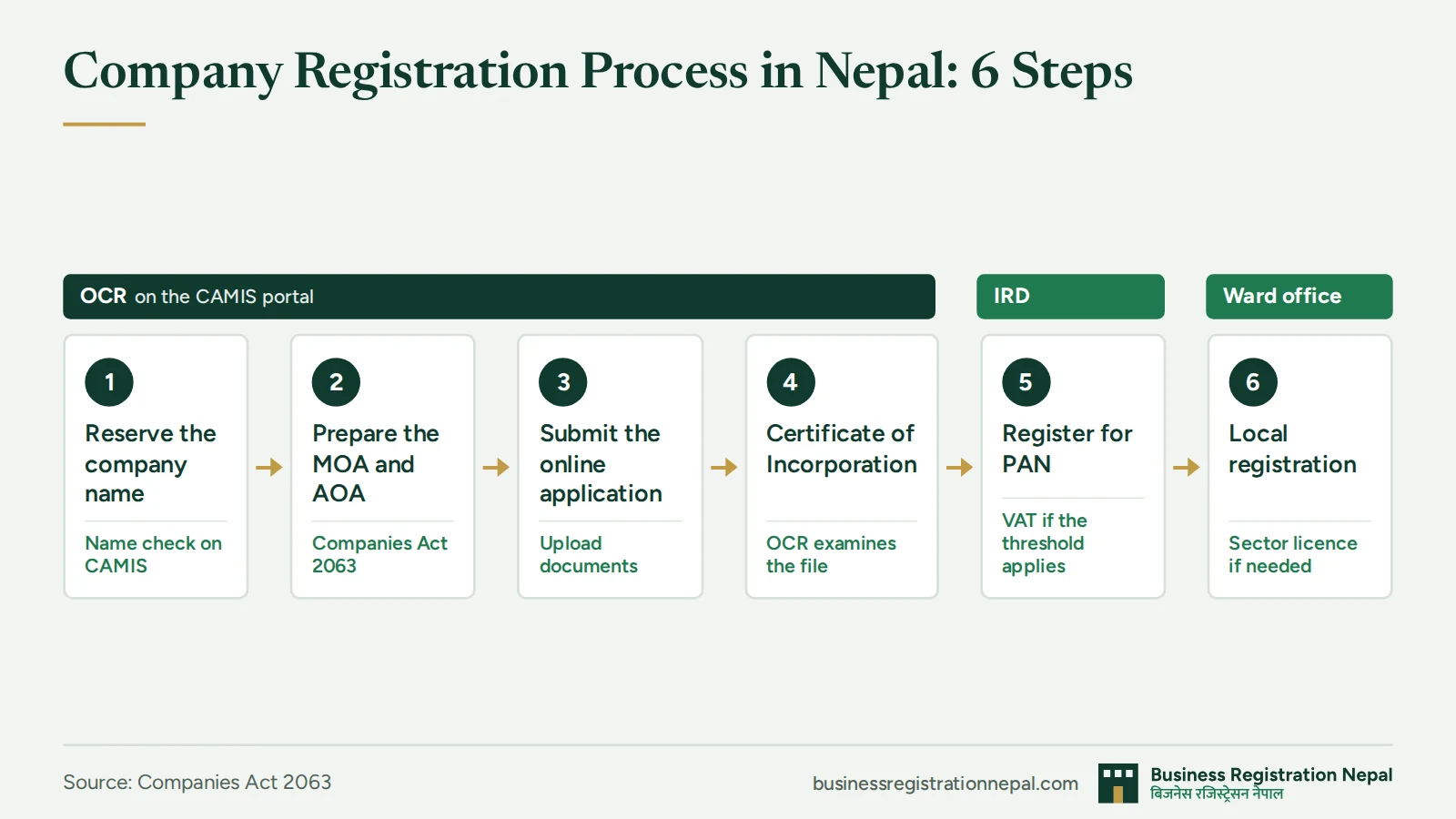
- Step 1: Reserve the company name on the OCR CAMIS portal (create a login, check the name is available and reserve it). The company name availability check shows whether a name is free, and name reservation at OCR works as a name approval for the application. The approved name stays reserved for 35 days, so the full application goes in within that window.
- Step 2: Prepare the MOA and AOA in line with the Companies Act 2063. The Memorandum of Association states the company's objectives and capital, and the Articles of Association set its internal rules.
- Step 3: Submit the online application and upload documents on CAMIS. CAMIS, the OCR online portal, takes the scanned MOA, AOA, IDs and application in one file.
- Step 4: OCR examines the file and issues the Certificate of Incorporation. The OCR approves a complete file, and the certificate works as the company's registration certificate.
- Step 5: Register for PAN, and for VAT if the threshold applies, at the IRD. The company's PAN registration in Nepal follows incorporation, and VAT registration in Nepal follows once turnover crosses the threshold.
- Step 6: Register at the local ward / municipality and obtain any sector licence. Regulated sectors such as banking, insurance and education add a licence from their own regulator.
To register a private limited company (Pvt Ltd), founders follow these 6 steps in order. That sequence, known as company incorporation or company formation, is how to register a company in Nepal on CAMIS.
What Documents Are Required to Register a Company in Nepal?
The documents required for company registration are 6 items, led by the application and the MOA and AOA. Founders in Nepal upload them on CAMIS, and each document must match the Companies Act 2063 format and the OCR's published document list.
0 of 6 ready
The application, MOA and AOA are mandatory for every company, and OCR staff verify each document before approval. Foreign investors add approval from the Department of Industry (DOI) under the Foreign Investment and Technology Transfer Act 2019 (FITTA).
How Long Does Company Registration Take in Nepal?
Company registration in Nepal takes about 7 to 15 working days from a complete CAMIS application to the Certificate of Incorporation. The OCR count starts once CAMIS accepts the full file. PAN, VAT and ward registration then take their own processing days.
3 events lengthen the timeline: a rejected company name, document corrections that the OCR requests, and DOI approval for foreign investment before incorporation.
How Much Capital Is Required to Register a Company in Nepal?
No high statutory minimum capital is required for a private company in Nepal. A public company and a foreign-invested company each face a set minimum. The capital declared in the MOA sets the OCR fee.
Authorized capital is the maximum share capital the MOA lets the company issue. Paid-up capital is the amount shareholders have paid for issued shares. A public company carries a statutory minimum paid-up capital of NPR 1 crore under the Companies Act 2063.
Under the Government of Nepal's 2022/23 budget, the minimum foreign investment is NPR 20 million per foreign investor. An investment company registration in Nepal with foreign capital follows FDI and foreign company registration in Nepal, with DOI approval before incorporation.
How Much Does It Cost to Register a Company in Nepal?
The cost of company registration in Nepal has 3 parts: the OCR government registration fee, additional fees and any professional fee. The OCR fee rises with authorized capital, on separate scales for private and public companies.
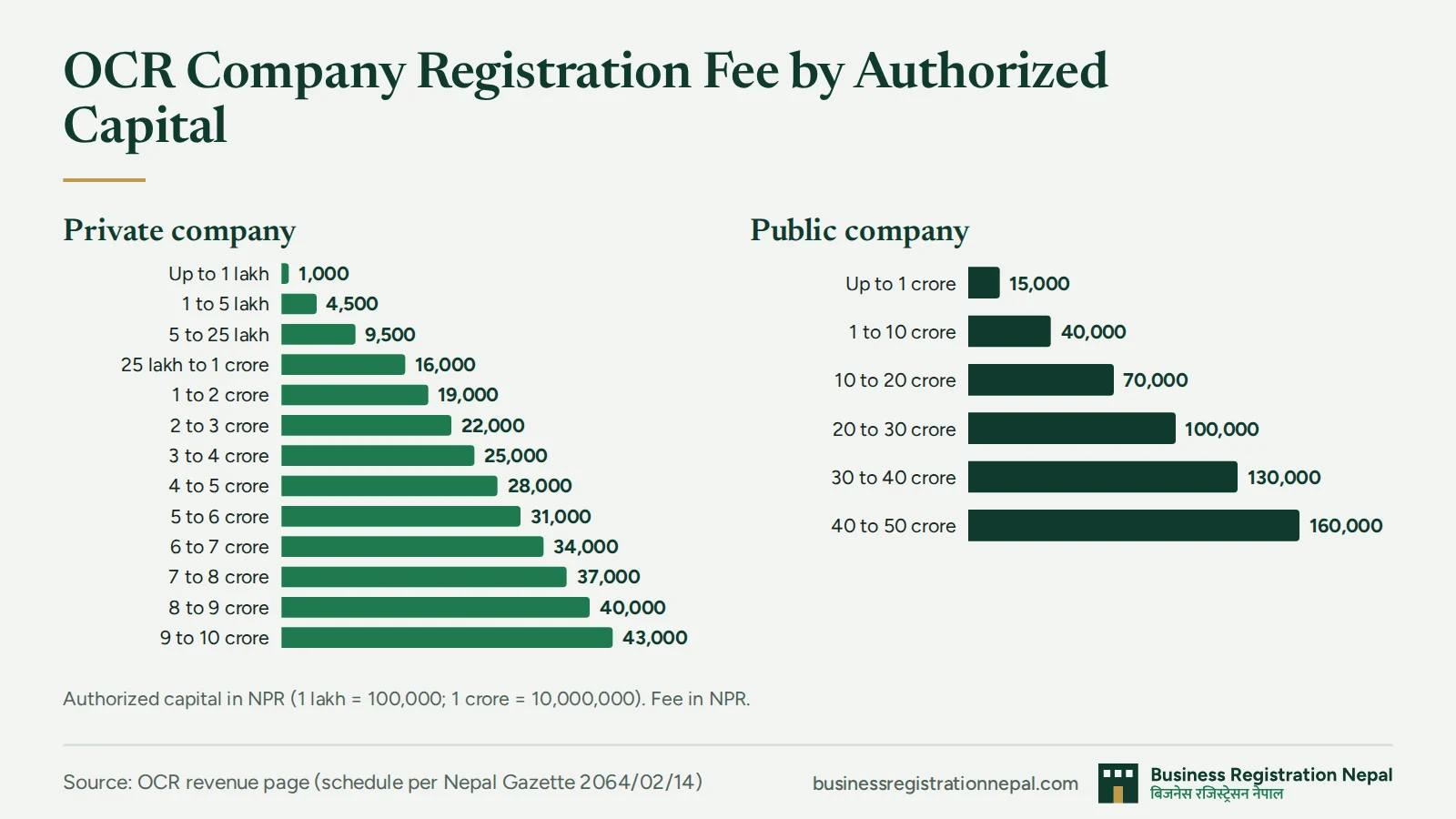
Company registration fees in Nepal follow the OCR capital bands, from NPR 1,000 for a private company with authorized capital up to NPR 1 lakh. Company registration cost and fees in Nepal lists every band, and the company registration cost calculator works out the fee for a given capital.
3 additional fees apply beyond the OCR charge:
- A refundable NPR 20,000 DOI deposit for a foreign-invested company
- The ward or municipality business-registration fee, paid each year at the rate the local level sets in its annual finance act
- House-rent tax on a rented registered office, at the rate the local level sets (10% in Kathmandu Metropolitan City)
Company registration charges from a professional firm add to these amounts when the firm prepares and files the documents.
Types of Companies You Can Register in Nepal
Founders in Nepal choose between 6 types of business entity, from the private limited company to the foreign-invested company. The type decides the registering office, the shareholder limit and the capital rule.
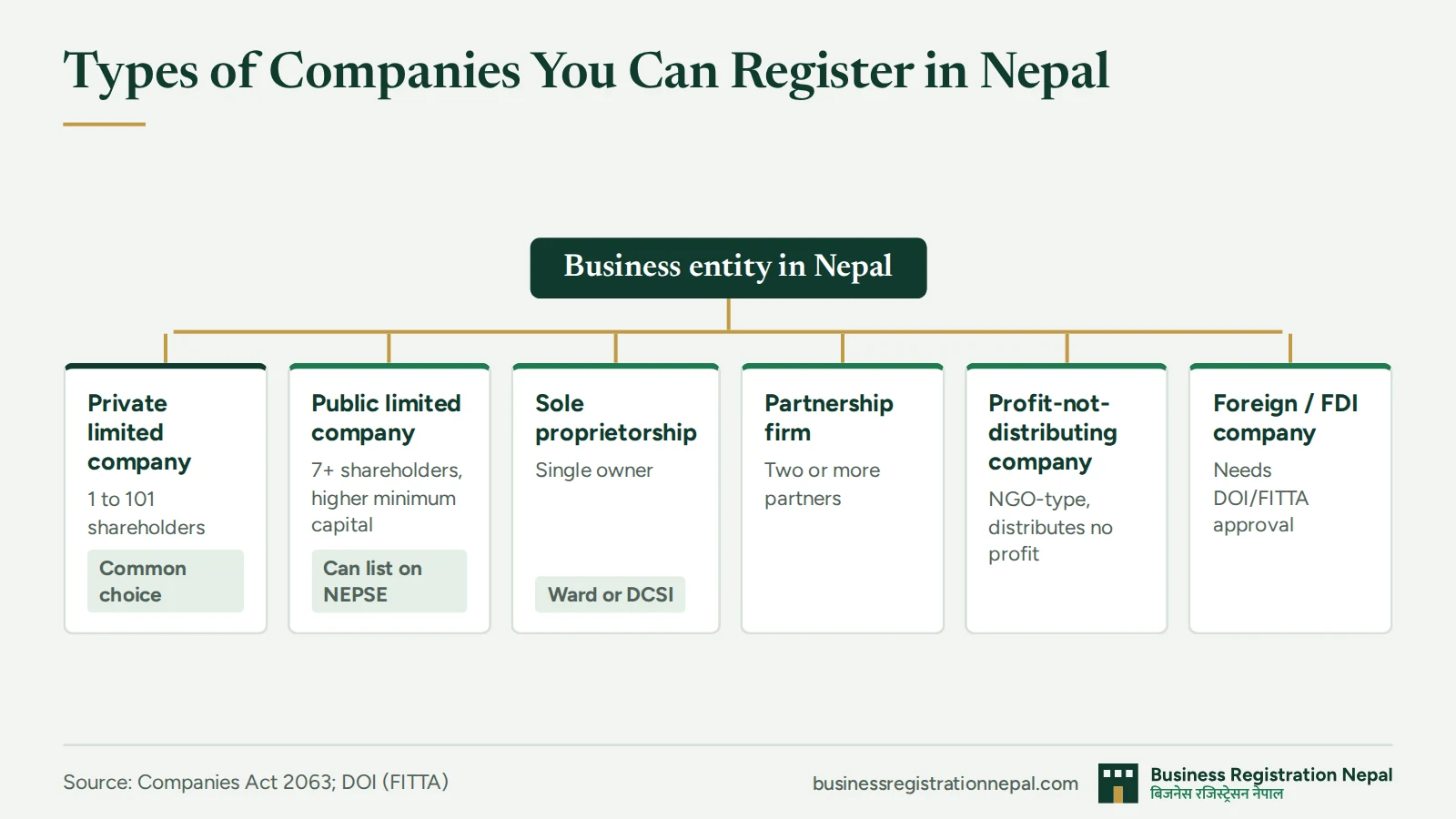
| Company type | Owners | Key point |
|---|---|---|
| Private limited company | 1 to 101 shareholders | The common choice |
| Public limited company | 7 or more shareholders | Higher minimum capital; can list on NEPSE |
| Sole proprietorship | Single owner | Registered with the ward or DCSI |
| Partnership firm | Two or more partners | Registers under the Partnership Act 2020, usually with the Department of Commerce, Supplies and Consumer Protection |
| Profit-not-distributing company | NGO-type; follows NGO registration in Nepal rules | |
| Foreign / FDI company | Foreign investors | Needs DOI / FITTA approval |
NEPSE, the Nepal Stock Exchange, lists only public limited companies, and the NGO-type form is a non-profit company that distributes no profit.
Sole proprietorship registration in Nepal happens at the ward or the Department of Cottage and Small Industries (DCSI). A partnership firm registers under the Partnership Act 2020, usually with the Department of Commerce, Supplies and Consumer Protection. Which company type to register compares the 6 forms on liability, tax and compliance.
What Should You Do After Registering Your Company?
After registering a company, the owners complete 6 compliance tasks, from tax registration to annual renewal. Each task keeps a newly incorporated company in good standing with the IRD, the OCR and the ward office.
- Complete PAN and, if applicable, VAT registration. Companies above the VAT threshold register PAN and VAT together, and that threshold is NPR 50 lakh of annual turnover for goods.
- Open a company bank account. The account holds the company's funds, and opening a company bank account in Nepal lists the bank's document set.
- Set up bookkeeping and accounting. A company keeps books of account from incorporation, and accounting and bookkeeping services in Nepal maintain them for the audit.
- Hold the first board meeting and the AGM on time. The board of directors meets soon after incorporation, and AGM in Nepal sets out the annual general meeting deadlines.
- Plan the annual statutory audit and tax filing. Each registered company files audited accounts every fiscal year through annual compliance and filings with the OCR and the IRD.
- Renew the company and licences each year. The yearly OCR update is company renewal (Adyawadik), and ward and sector licences renew on their own dates.
Owners who finish the 6 tasks comply with the Companies Act 2063, the Income Tax Act 2058 and local rules from the opening year.
Frequently Asked Questions
Can a single person register a company in Nepal?
Yes, a single person registers a private company in Nepal, because the Companies Act 2063 permits a private company with one shareholder. That person holds all the shares and signs the MOA and AOA alone, and the AOA sets how many directors the company has.
Can a foreigner own 100% of a Nepali company?
Yes, a foreigner can own 100% of a Nepali company in a sector open to foreign investment under FITTA. Sectors on the FITTA negative list stay closed or capped, so the sector check comes before the DOI application. The negative list sits in the Schedule to FITTA 2075, and listed consultancy services, for example, cap foreign ownership at 51%.
Can I register a company from abroad without visiting Nepal?
Yes, a founder abroad registers a company through an authorised representative who holds a power of attorney. A Nepali citizen abroad signs it before a Nepali embassy or consulate, which attests it, and sends the original to the representative. The representative files on CAMIS and signs the documents in Nepal.
Can I use a residential address as the registered office?
Yes, a residential address serves as the registered office where the local ward accepts business use at that address, which the ward confirms when it registers the business. The OCR records the address, and official notices reach the company there.
Is a lawyer or chartered accountant required to register?
No, the Companies Act 2063 does not require a lawyer or chartered accountant to register a company. Professional help reduces returned filings because the MOA, AOA and CAMIS application follow set formats.
How is registering a company different from a sole proprietorship or firm?
A registered company is a separate legal entity with limited liability, while a sole proprietorship or partnership firm has no such separation. The company registers with the OCR, while a proprietorship or firm registers with a ward office or a department, such as the Department of Cottage and Small Industries or the Department of Commerce, Supplies and Consumer Protection.
How do I check the status of my registration application?
The CAMIS portal shows the status of each registration application under the applicant's login until the OCR issues the certificate. OCR queries on the file arrive through the same account, where the company also downloads its electronic certificate.