

Trademark registration in Nepal enters a brand's name, logo or mark in the Department of Industry (DoI, उद्योग विभाग) register under the Patent, Design and Trade-mark Act 2022, and gives the owner exclusive rights to it. The trademark registration process in Nepal runs in 5 steps:
- Step 1: Search the DoI records for conflicting marks.
- Step 2: File the application with 4 specimens and the class.
- Step 3: Pass examination at the DoI.
- Step 4: Clear publication and the 90-day opposition window.
- Step 5: Receive the registration certificate.
A distinctive word, logo, device or combination qualifies as a mark. The documentation required for registration covers 6 documents, led by the application form and the specimens. The cost is NPR 1,000 to apply and NPR 5,000 to register for each Nice class.
The validity term of a registered mark is 7 years, and each renewal adds 7 years. A foreign company files through a local agent holding its power of attorney. Infringement of a registered mark carries a fine of up to NPR 100,000.
The DoI trademark register runs apart from the Office of the Company Registrar (OCR), which handles company registration in Nepal.
What Is a Trademark?
Under the Patent, Design and Trade-mark Act 2022, a trademark is a word, symbol or picture, or a combination of them, that distinguishes one trader's goods or services from those of others. A firm, company or individual uses the mark to identify the source of a product.
The Act writes the term as trade-mark, and traders call the same sign a brand mark. The Department of Industry (DoI), the federal department that registers industrial property in Nepal, keeps the trademark register through the DoI (Industrial Property Section).
A registered mark is a distinctive sign entered in that register. Its registered proprietor is the registered owner who holds title to it.
An unregistered mark is a sign in trade use without that entry, and the Act gives it no title. The Act bars the use of an unregistered mark as a registered trademark.
A company name follows a separate route. The Office of the Company Registrar (OCR) approves it under the Companies Act 2063, and that approval gives no trademark rights. The OCR refuses a company name identical or similar to a trademark, so the DoI register and the OCR company register stay apart.
Why Register a Trademark in Nepal?
Registering a trademark in Nepal gives the owner exclusive rights to the mark, legal protection against copying, a brand asset with value and the right to license or assign it. Under the Patent, Design and Trade-mark Act 2022, title to a trademark arises on registration at the DoI.
The 4 benefits of registration work as follows:
- Exclusive use: the registered proprietor alone uses the mark on the goods or services of its class.
- Legal protection: the Act forbids copying or using a registered mark without a transfer or the owner's written permission, and a breach carries a fine of up to NPR 100,000.
- Commercial brand value: the registered mark is a recorded asset that passes with a transfer of ownership, so the brand carries value in a sale or an investment.
- Transferable rights: the owner assigns the mark or licenses its use in writing, and the DoI records the change.
Each benefit depends on the entry in the DoI register, so a business that trades under an unregistered brand holds none of the 4. Registration is how a Nepali business protects the name and logo its customers recognise.
What Can Be Registered as a Trademark?
A word, a logo, a device or a combination of these qualifies as a trademark in Nepal when the sign distinguishes the owner's goods or services. The Act's definition of a trademark names these forms.
The 4 registrable forms of a mark are:
- Word marks: a brand name in plain letters, such as a product name.
- Logo marks: the stylised lettering or design of a name.
- Device marks: a symbol or picture without words.
- Combination marks: words joined with a logo or device in one sign.
A registrable mark is distinctive, because it points to one trader's goods or services. A purely descriptive word, such as "Pure Ghee" for ghee, names the product instead of its source and fails that test.
Under the Patent, Design and Trade-mark Act 2022, the DoI refuses 5 kinds of mark. A refused mark hurts the prestige of a person or institution, harms public morality, undermines the national interest, harms another trademark's reputation or copies a mark registered to someone else.
What Is the Trademark Registration Process?
The trademark registration process in Nepal runs in 5 steps at the Department of Industry, from a trademark search to the registration certificate. The Industrial Property Section handles each step under the Patent, Design and Trade-mark Act 2022.
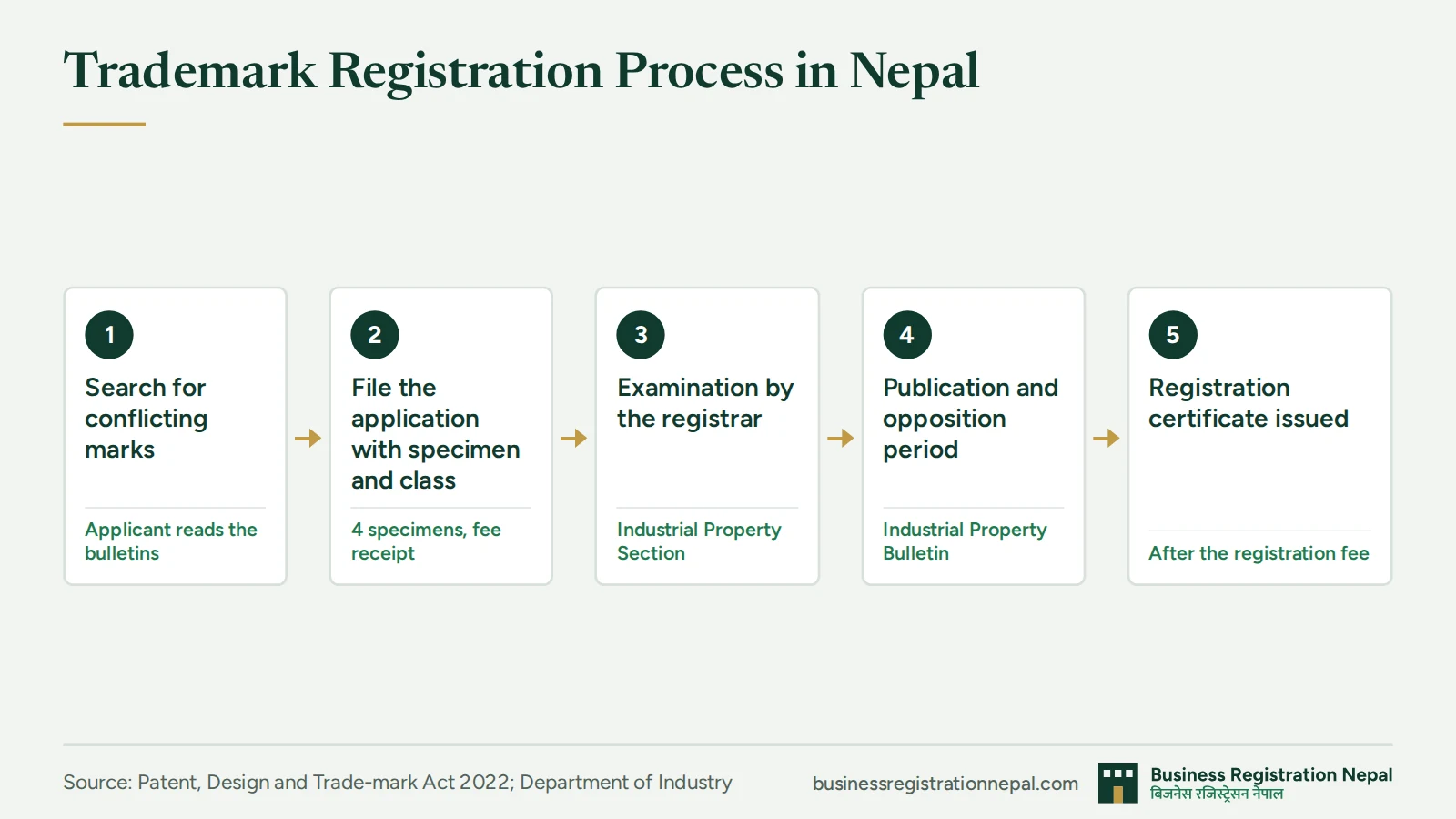
- Step 1: Conduct a trademark search for conflicting marks. The applicant reads the published Industrial Property Bulletins and asks the DoI for the registration details of identical or similar marks in the same class. The DoI refuses a mark already registered to another person, so the trademark search in Nepal comes before filing.
- Step 2: File the application at the Department of Industry with the specimen and class. The form names the proprietor, describes the mark, gives its international class and lists the goods or services. The applicant attaches 4 specimens of the mark and the application fee receipt.
- Step 3: Undergo examination by the registrar. The Industrial Property Section examines the mark against the Act's refusal grounds and earlier registrations. The DoI gives the applicant an opportunity to answer any objection before it decides.
- Step 4: Publication in the Trademark Journal and the opposition period. The DoI publishes trademark particulars in its Industrial Property Bulletin (Audyogik Sampatti Bulletin), the trademark journal of Nepal. The DoI publishes the mark in the bulletin before registration, and any person files an opposition within 90 days of publication.
- Step 5: Registration and issue of the certificate on no opposition. The DoI enters the mark in the register once no objection stands. It issues the registration certificate after the applicant pays the registration fee.
A domestic applicant follows these 5 steps to register a trademark in Nepal. The certificate names the registered proprietor and starts the term of protection.
What Documents Are Required for Trademark Registration?
The Department of Industry requires 6 documents for trademark registration in Nepal, led by the completed application form and 4 specimens of the mark. The DoI lists them in its checklist for a domestic applicant.
0 of 6 ready
The Industrial Property Section receives these trademark registration documents in Nepal in one file. A foreign applicant files the same set through its agent and adds proof of its home registration.
How Are Trademarks Classified Under the Nice Classification?
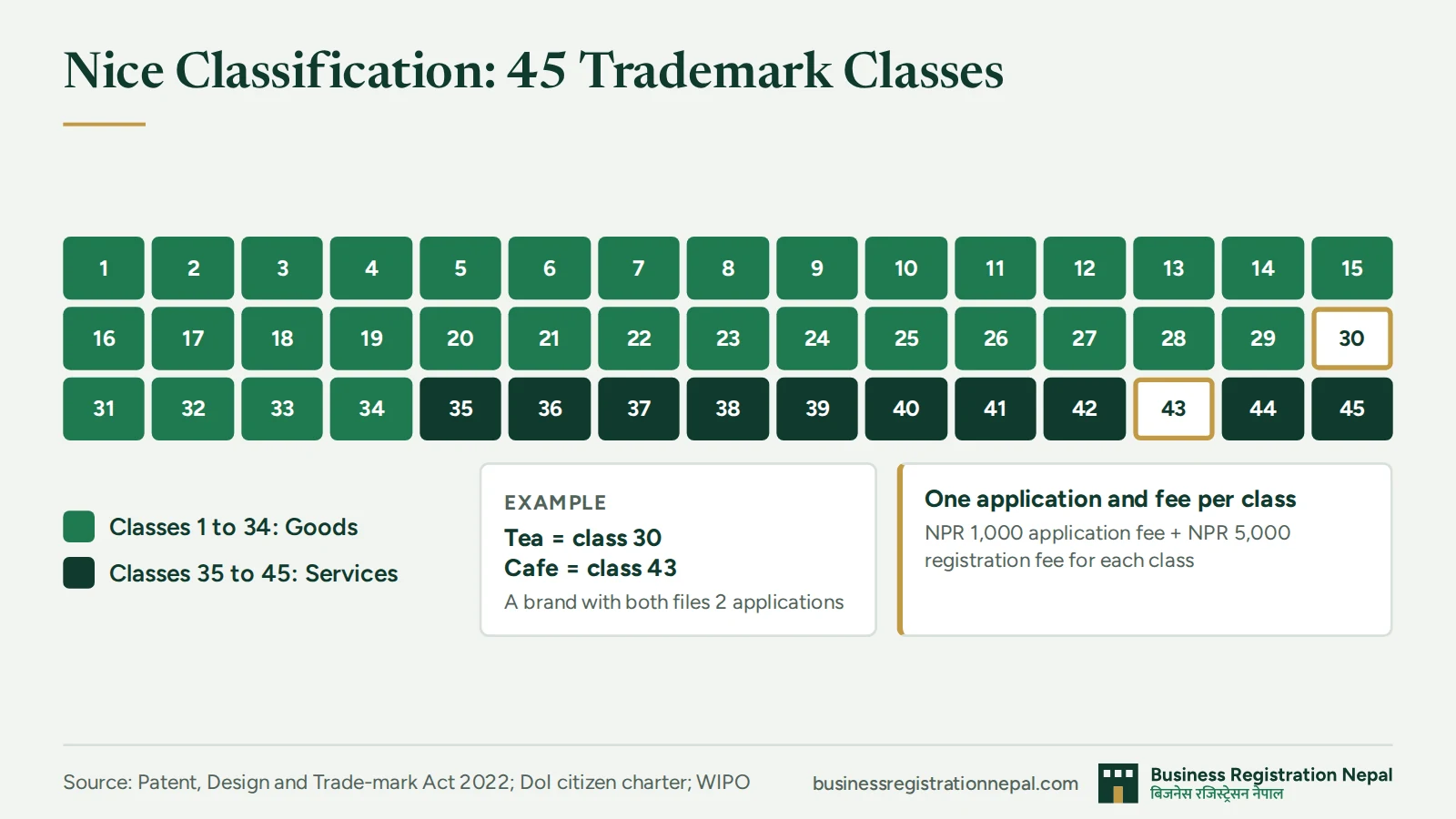
The Nice Classification sorts goods and services into 45 classes, 34 for goods and 11 for services, and the Department of Industry takes a separate application and fee for each class. The DoI application form asks for this international class.
The Nice Classification is the international class system that the Nice Agreement of 1957 set up and the World Intellectual Property Organization (WIPO) maintains. According to WIPO, around 150 offices apply it, including offices of countries outside the Agreement.
Nice Classification classes 1 to 34 cover goods, and classes 35 to 45 cover services. A brand that sells tea (class 30) and runs a cafe (class 43), for example, files 2 applications. Under the Patent, Design and Trade-mark Act 2022, each class of goods or services needs its own application, and a registered mark extends to another class through a further application.
According to the DoI citizen charter, the trademark registration cost in Nepal for each class is a NPR 1,000 application fee and a NPR 5,000 registration fee. The table shows the government fee for 1 to 3 classes.
| Classes applied for | Application fees (NPR) | Registration fees (NPR) | Government total (NPR) |
|---|---|---|---|
| 1 class | 1,000 | 5,000 | 6,000 |
| 2 classes | 2,000 | 10,000 | 12,000 |
| 3 classes | 3,000 | 15,000 | 18,000 |
The same fees apply to domestic and foreign applicants, and an agent's professional fee adds to the government total.
What Is the Validity and Renewal Term of a Trademark?
A registered trademark in Nepal stays valid for 7 years from the date of registration and renews any number of times, 7 years at a time. The Patent, Design and Trade-mark Act 2022 sets both the validity and the renewal term.
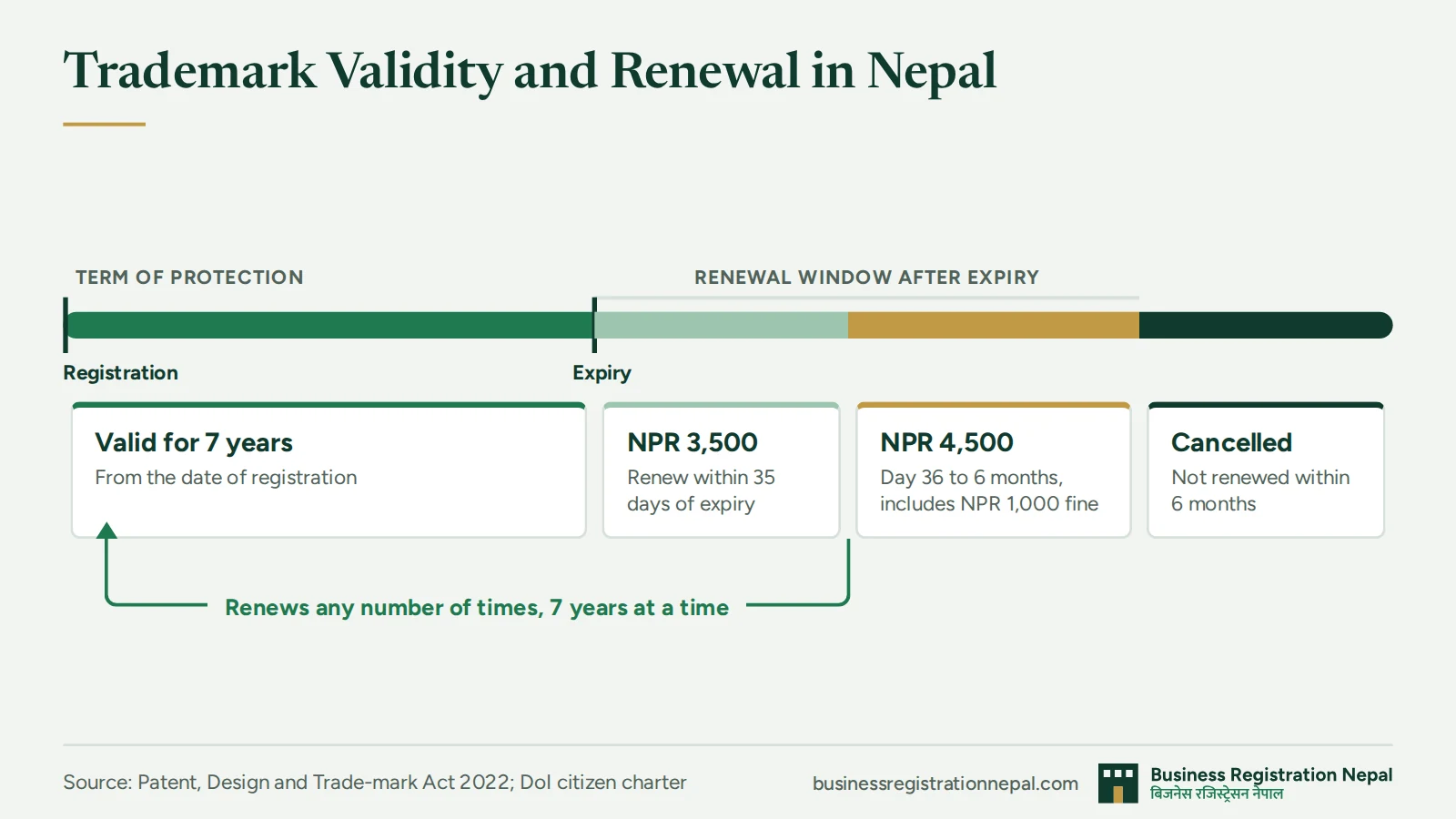
The registered proprietor files the renewal application within 35 days of expiry. A late renewal within six months of expiry carries a NPR 1,000 fine, and the DoI cancels a mark that is not renewed by then automatically.
The DoI citizen charter sets 2 renewal fees by the filing date.
| Renewal filed | Renewal fee (NPR) |
|---|---|
| Within 35 days of expiry | 3,500 |
| From day 36 to six months after expiry | 4,500 |
The NPR 1,000 gap between the 2 fees is the late-renewal fine, and the DoI processes a renewal in 3 days.
Each trademark renewal (7 years at a time) requires 5 documents. The file holds the original registration certificate, the renewal fee receipt, proof of business renewal, evidence that the mark is in use and a tax clearance. Trademark validity and renewal in Nepal therefore depend on a live business and a mark in trade.
How Can a Foreign Company Register a Trademark in Nepal?
To register a trademark in Nepal, a foreign company files through a local agent who holds its power of attorney, with a certified copy of its home registration. The Department of Industry charges the same fees as for a domestic applicant.
Foreign company trademark registration in Nepal adds 4 items to the domestic checklist:
- Power of attorney that appoints the foreign trademark filing agent in Nepal.
- Home registration certificate: a certified copy, valid on the filing date.
- Priority date letter, where the applicant claims priority from an earlier foreign filing.
- Correspondence address in Nepal for DoI notices.
The agent files the application, answers the examination and receives the certificate for the foreign owner. A foreign company that invests in Nepal pairs its trademark filing with FDI and foreign company registration, where the DoI approves the investment.
What Happens in Trademark Opposition and Infringement?
Any person opposes a published trademark within 90 days of publication, and the owner of a registered mark acts against infringement through a complaint to the Department of Industry. The DoI holds an inquiry into each case under the Patent, Design and Trade-mark Act 2022.
The opposition period runs from the date the DoI publishes the particulars, and lasts 90 days in current DoI practice. The fee schedule in use sets a NPR 1,000 fee for an objection. A third-party objection names the earlier conflicting mark or a refusal ground, and the DoI decides after the inquiry.
The owner files an infringement complaint with the complaint application, the evidence and the fee receipt. The Act gives 3 remedies against a person who copies or uses a registered mark without permission:
- Fine of up to NPR 100,000, which the DoI sets by the gravity of the offence.
- Confiscation of the goods and articles connected with the offence.
- Cancellation of a conflicting registration, after the holder gets a chance to show cause.
A party dissatisfied with a DoI order appeals to the High Court within 35 days, the High Courts having replaced the Appellate Courts named in the Act. The same fine applies to the use of a cancelled mark and to an unregistered mark presented as registered.
Frequently Asked Questions
What happens if a registered trademark is not used?
Non-use for one year from registration leads to cancellation of a registered trademark. The DoI inquires and cancels such a mark under the Patent, Design and Trade-mark Act 2022.
The applicant declares on the application form that the mark enters use within that year. Each renewal asks for evidence of use, so dated labels, invoices and advertisements keep the proof on file.
Does Nepal protect well-known foreign trademarks?
Yes, Nepal protects well-known foreign trademarks through the Paris Convention, in force for Nepal since 22 June 2001, and through the Act's bar on marks that harm another trademark's reputation. Article 6bis of the Convention requires refusal or cancellation of a confusing copy of a well-known mark. Foreign owners secure full rights by filing through a local agent.
Can a registered trademark be transferred or assigned?
Yes, a registered trademark is transferred or assigned through a joint application of both parties to the Department of Industry, which records the new owner. The owner licenses the mark instead through written approval for use, and the DoI records that approval. According to the DoI citizen charter, a trademark transfer costs NPR 2,000 and takes 7 days.
What is the difference between the TM and R symbols?
TM signals an unregistered claim to a mark, and the encircled R (®) indicates a mark officially registered at the Department of Industry. Under the Patent, Design and Trade-mark Act 2022, no trademark is used as a registered trademark without DoI registration. The ® on an unregistered mark therefore breaches the Act, with a fine of up to NPR 100,000.
Is online trademark filing available in Nepal?
No, the DoI trademark checklist and citizen charter list no online filing channel. The applicant submits the form, 4 printed specimens and the fee receipt to the Industrial Property Section. Applicants confirm the current submission channel with the DoI before they apply.
How long does trademark registration take?
The DoI citizen charter sets no fixed period for trademark registration and lists its time as "as prescribed". In practice, registration usually takes about 6 to 9 months when no opposition is filed. The time depends on the trademark search, examination, journal publication and any opposition. The same charter gives 3 days for a renewal and 7 days for a transfer.
What is the risk of using an unregistered mark?
An unregistered mark gives its user no title under the Patent, Design and Trade-mark Act 2022, so the user holds weak grounds to stop copycats. The Act's fine and confiscation remedies protect registered marks only. Registration at the DoI secures the exclusive right to the mark.