

A private limited company (Pvt Ltd) suits a business seeking limited liability and investors, and a sole proprietorship suits a small, single-owner, low-cost start. A partnership firm suits 2 or more owners, and a public limited company suits public share offers.
Nepal's 4 business structures differ on liability, legal identity, tax, registration authority and funding. The difference between Pvt Ltd and sole proprietorship is limited vs unlimited liability. The company is a separate legal entity at the OCR, and the proprietor answers for debts personally.
Firms start simply, companies carry formal compliance, and conversion handles a later change. Each structure then follows company registration in Nepal, from OCR incorporation to the permanent account number (PAN).
What Are the Main Business Structures in Nepal?
Nepal has 4 main business structures: the sole proprietorship, the partnership firm, the private limited company and the public limited company. These types of business structures in Nepal form 2 firm types and 2 company types, each under its own Act.
The 4 structures carry these definitions:
- Sole proprietorship: a private firm with single ownership, run by a sole trader. The owner and the firm share one legal identity.
- Partnership firm: a business that 2 or more partners own under a partnership agreement. The partners share its profits and its debts.
- Private limited company (Pvt Ltd): a company of 1 to 101 shareholders under the Companies Act 2063. The Office of the Company Registrar (OCR), the government registry for companies, incorporates it, and it never sells shares to the public.
- Public limited company: a company formed by at least 7 promoters that offers its shares to the public. The OCR registers it under the same Act.
Firms register under the Private Firm Registration Act 2014 and the Partnership Act 2020, and companies register under the Companies Act 2063. A not-for-profit purpose takes a separate route, either the profit-not-distributing company at the OCR or NGO registration outside company law.
Sole Proprietorship vs Partnership vs Private Limited vs Public Limited: What Is the Difference?
The difference between the 4 structures lies in liability and legal identity. A sole proprietorship or partnership carries unlimited liability and no separate legal identity, while private and public limited companies are separate legal entities with limited liability. Ownership, tax and compliance differ next.
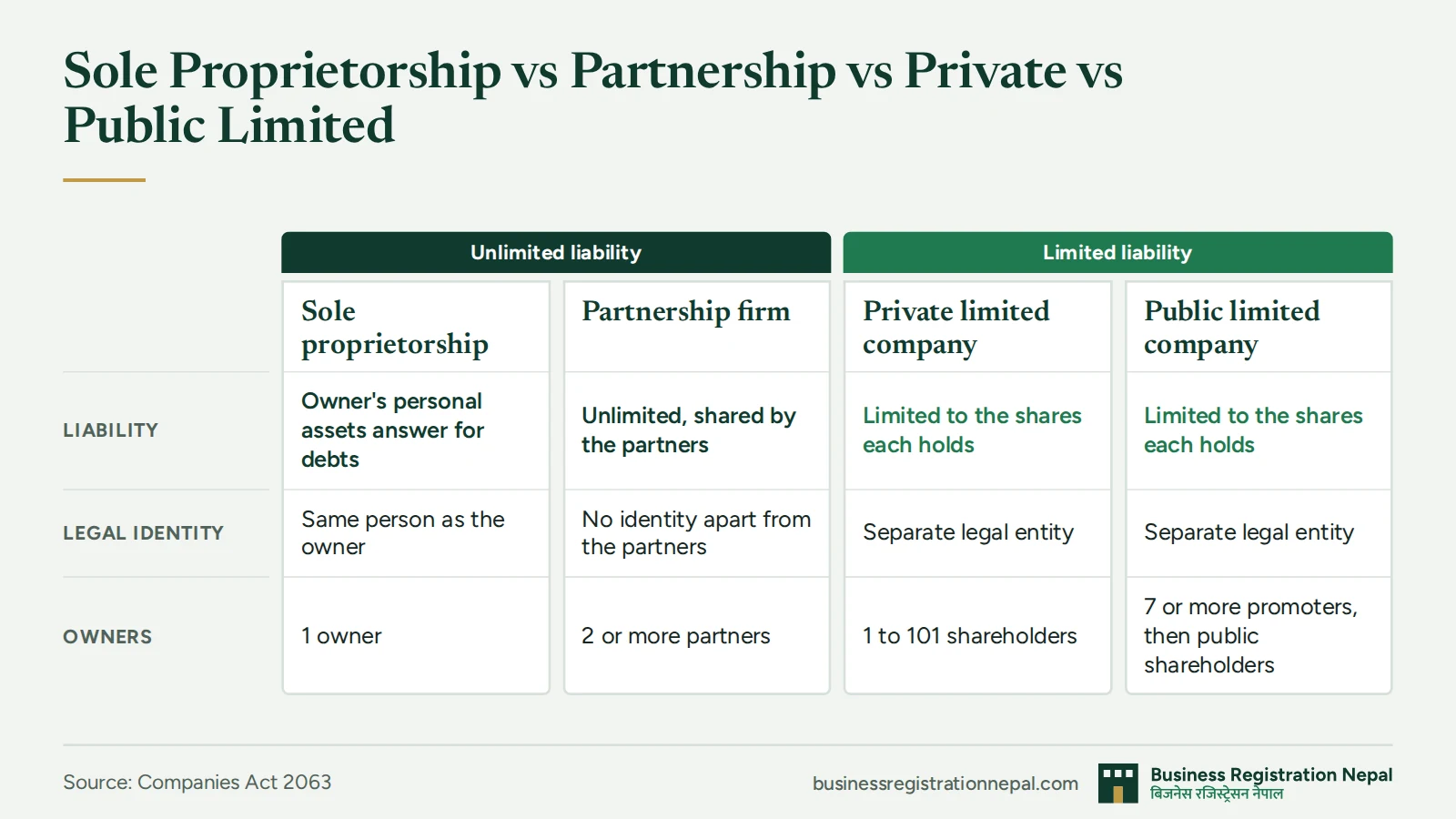
Liability is the legal responsibility for business debts. Under the Companies Act 2063, a company is an autonomous corporate body with perpetual succession. Each shareholder's liability stops at the shares bought or agreed to be bought.
The table compares the 4 business structures in Nepal on 7 attributes.
| Attribute | Sole proprietorship | Partnership firm | Private limited company | Public limited company |
|---|---|---|---|---|
| Liability | Unlimited: the owner's personal assets answer for debts | Unlimited, shared by the partners | Limited to the shares each shareholder holds | Limited to the shares each shareholder holds |
| Legal identity | Same person as the owner | No identity apart from the partners | Separate legal entity | Separate legal entity |
| Registration authority | Department of Commerce, Supplies and Consumer Protection (DoCSCP), a ward office or a cottage and small industries office: a trading firm registers with DoCSCP or the local level, and an industry registers by its fixed capital under the Industrial Enterprises Act 2076 | DoCSCP or a local registering office, with an industry registered under the Industrial Enterprises Act 2076 | Office of the Company Registrar (OCR) | Office of the Company Registrar (OCR) |
| Ownership | 1 owner | 2 or more partners | 1 to 101 shareholders | 7 or more promoters, then public shareholders |
| Tax | Personal income tax on the owner's profit, filed with the Inland Revenue Department (IRD), at progressive slab rates up to 29% from FY 2083/84 | Income tax on the firm as an entity at 25%, under the Income Tax Act 2058 | Corporate tax on company profit at 25%, or 30% for banks, financial institutions, general insurance and telecom | Corporate tax on company profit at 25%, or 30% for banks, financial institutions, general insurance and telecom |
| Compliance | Firm renewal and income-tax return | Firm renewal and income-tax return | Memorandum and articles of association (MOA and AOA), general meetings, audited accounts and OCR annual details | The private-company duties plus a prospectus for each public share issue |
| Funding | Owner's capital and loans | Partners' contributions and loans | Shares issued to its own shareholders, with no public offer | Shares offered to the public, on paid-up capital of at least NPR 1 crore |
The limited vs unlimited liability line decides most choices. In the sole proprietorship vs partnership comparison, both firms leave owners personally liable, and the owner count and governing Act set them apart. The sole proprietorship vs private limited company choice turns on liability and legal identity.
What Are the Advantages and Disadvantages of Each Structure?
Each structure trades simplicity against protection. The 2 firm types start with simple paperwork but leave owners personally liable, and the 2 company types protect personal assets but carry formal compliance. Cost and access to capital follow the same line.
The table sets out 2 advantages and 2 disadvantages for each of the 4 structures.
| Structure | Advantages | Disadvantages |
|---|---|---|
| Sole proprietorship | Simple, low-cost registration; the owner decides alone and keeps all profit after tax | Unlimited personal liability; capital limited to the owner's savings and loans |
| Partnership firm | Pooled capital and skills of 2 or more partners; a simple partnership agreement | Unlimited liability for each partner; key decisions depend on agreement among partners |
| Private limited company | Limited liability; a separate legal entity that outlives any change of shareholders | Formal duties such as the MOA and AOA, general meetings and annual OCR filings; no public share offer |
| Public limited company | Capital raised from the public through share offers; a separate legal entity with limited liability | At least 7 promoters and NPR 1 crore paid-up capital; the heaviest compliance load |
A small, single-owner trade gains most from the simple firm forms. A business with outside investors or long-term growth plans gains most from limited liability.
Which Company Type Is Right for Your Business?
The right company type for a business follows 4 scenarios. A solo, low-cost start suits a sole proprietorship, and 2 or more owners suit a partnership firm. Investors suit a private limited company, and plans to scale or list suit a public limited company.
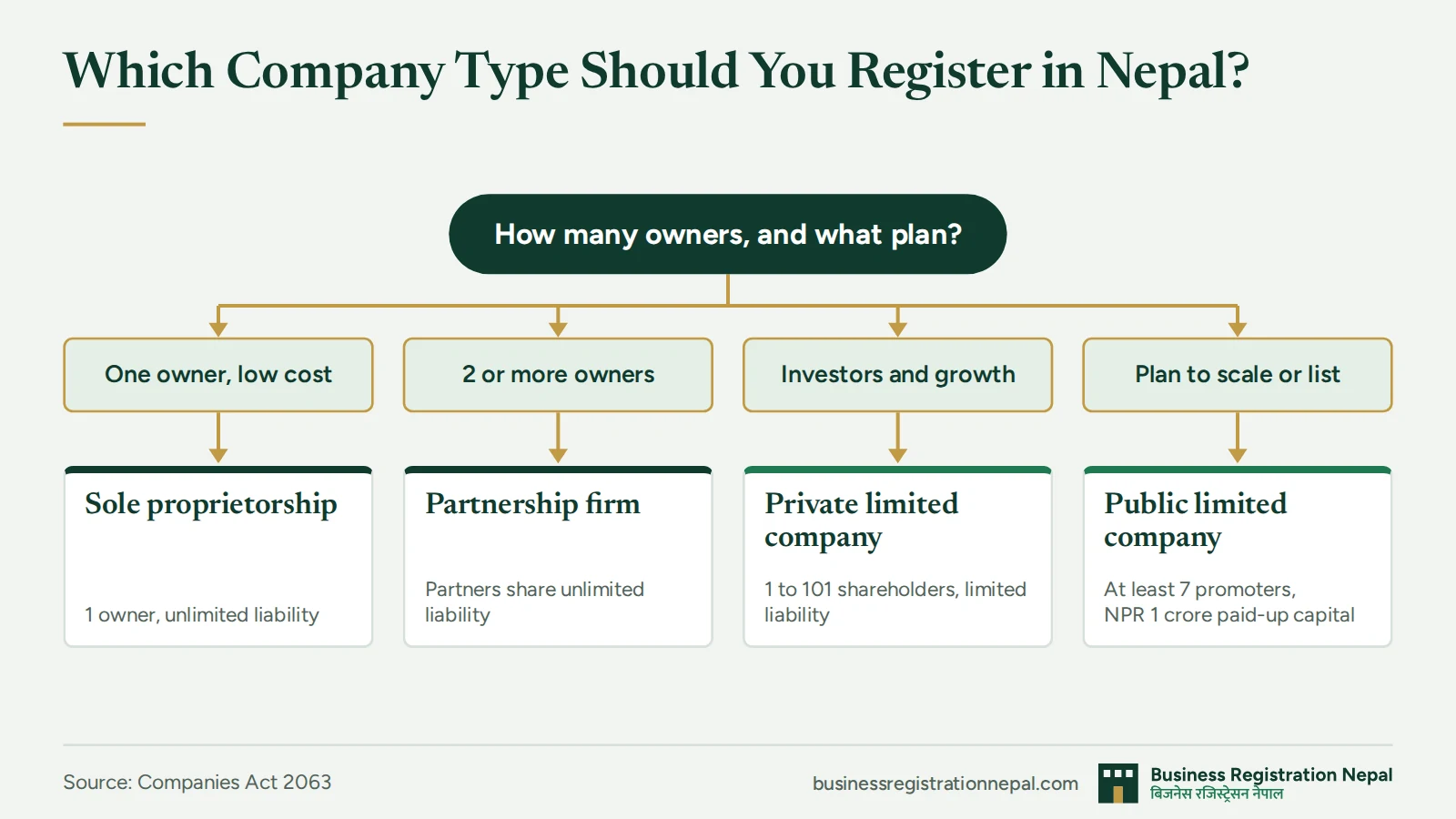
The business structure, or entity type, fixes liability before any filing starts. A founder deciding which company type to register in Nepal follows how to register a company for the OCR filing steps.
When Should You Choose a Sole Proprietorship?
A founder chooses a sole proprietorship for a small business with one owner, a low starting cost and no outside investors. The owner registers the firm alone and decides every matter without a board or shareholders.
Unlimited personal liability is the price of that simplicity. The owner's savings, land and other personal assets answer for every debt the firm owes.
When Should You Choose a Private Limited Company?
Growth, limited liability and room for investors lead a founder to choose a private limited company. The OCR incorporates it with 1 to 101 shareholders, and each investor's risk stops at the shares held.
Banks and institutional buyers deal with the company as a separate legal entity with its own accounts, which supports bank credit and formal contracts. The private limited company is the common choice for a Nepali business that plans to scale.
A business that picks this form follows private limited company registration, with its MOA and AOA filed at the OCR.
When Is a Public Limited Company Appropriate?
A public limited company is appropriate for a business that raises large capital from a wide base of shareholders. Under the Companies Act 2063, it starts with at least 7 promoters and paid-up capital of at least NPR 1 crore.
In the private vs public company choice in Nepal, only the public limited company offers shares to the public. Those shares become eligible for listing on the Nepal Stock Exchange (NEPSE). That reach brings higher compliance, including a prospectus for each public share issue and general meetings open to public shareholders.
Handling a Change of Structure Later
A change of structure later runs through conversion under the Companies Act 2063. A private company converts into a public company by a special resolution of its general meeting. A public company converts into a private company under section 14 when its shareholders fall below 7 or its paid-up capital falls below NPR 1 crore.
A sole proprietorship or partnership firm moves into company form by incorporating a new company at the OCR, moving the firm's business into it and then closing the firm's registration. Each switch between private and public follows the company conversion process, with the OCR recording the new company type.
Frequently Asked Questions
What is the difference between a sole proprietorship and a private limited company in Nepal?
A sole proprietorship has one owner with unlimited personal liability and no separate legal identity, while a private limited company is a separate legal entity with limited liability. The difference between Pvt Ltd and sole proprietorship extends to registration: the OCR incorporates the company, and the proprietorship registers as a private firm.
Which is better for a small business in Nepal - sole proprietorship or private limited?
For a small business in Nepal, a sole proprietorship suits a simpler, cheaper start, and a private limited company suits an owner who wants limited liability. The private limited company gives easier access to investors and bank credit as the business grows. The business structure therefore follows the owner's risk and growth plans.
What is the difference between a partnership and a private limited company?
A partnership is owned by 2 or more partners who share unlimited liability, while a private limited company limits each shareholder's liability to share capital. The company is a separate legal entity registered at the OCR, and the partnership firm has no legal identity apart from its partners.
Can I change my company type later in Nepal?
Yes, a company in Nepal changes its type later through conversion under the Companies Act 2063, for example from private to public. A sole proprietorship moves into company form through a new company registration at the OCR.
How many shareholders can a private limited company have in Nepal?
Between 1 and 101 shareholders own a private limited company in Nepal under the Companies Act 2063. A business that needs more than 101 shareholders registers as, or converts into, a public limited company.