

The company conversion process in Nepal changes a company's legal type in 5 steps under the Companies Act 2063:
- Step 1: Pass a special resolution at the general meeting.
- Step 2: Amend the MOA and AOA.
- Step 3: Apply to the Office of the Company Registrar (OCR) within 30 days.
- Step 4: Receive the OCR conversion certificate.
- Step 5: Obtain approval from the Securities Board of Nepal (SEBON) for any public offering.
Company transformation runs private to public, public to private, or from a firm into a new company. A public company needs at least 7 shareholders and NPR 1 crore of paid-up capital. The file carries 7 documents, and the OCR stage of a private-to-public conversion takes up to 90 days.
The conversion target is chosen through which company type to register. Every conversion builds on the original company registration in Nepal.
What Types of Company Conversion Are Common in Nepal?
Company conversion in Nepal takes 3 common forms: private to public, public to private, and a firm moving into a new private company. A company converts its company type under the Companies Act 2063, and a firm changes form through a fresh registration.
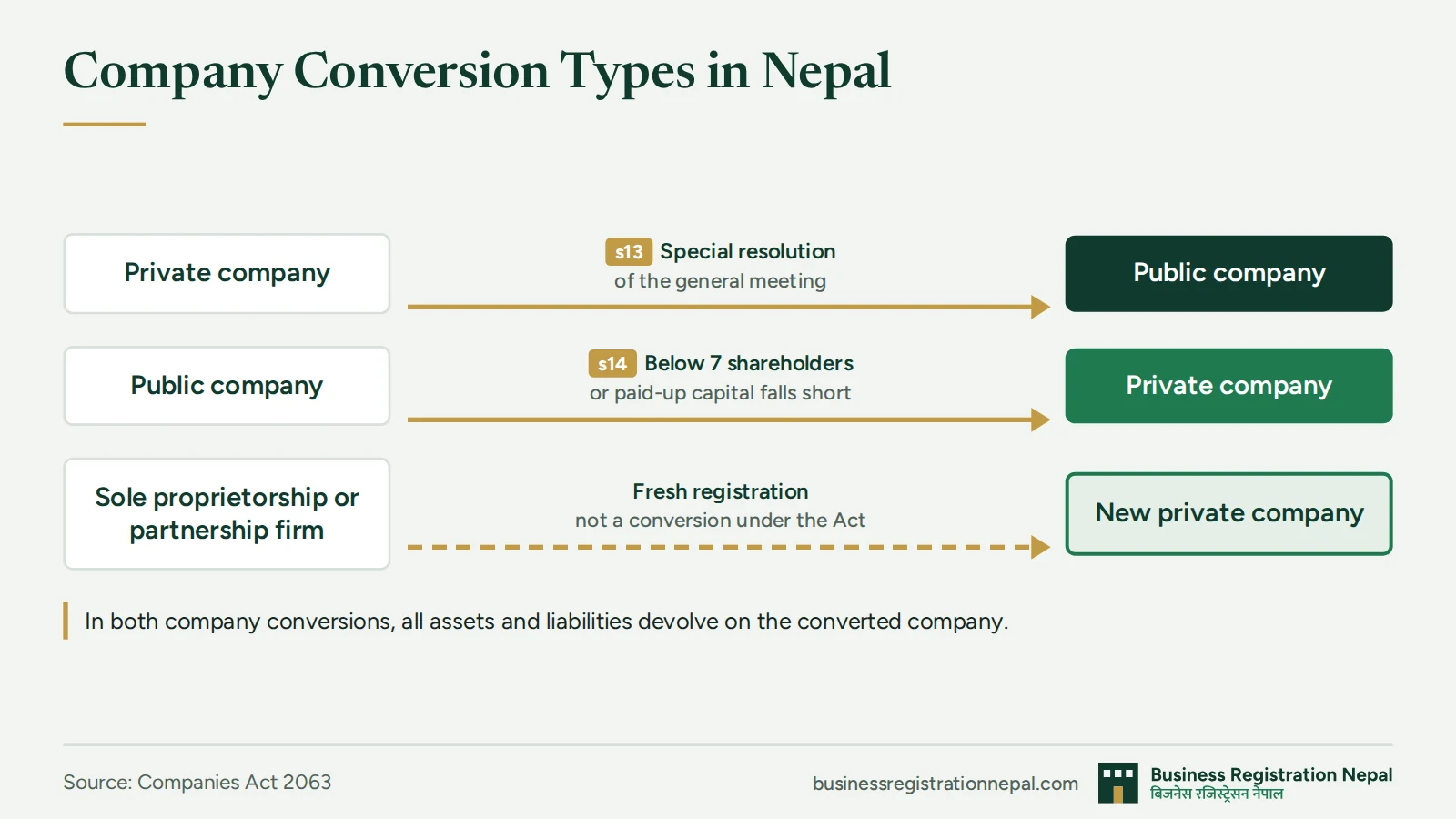
The 3 conversion types differ by trigger and by the law that governs them:
- Private to public company: a private company goes public by a special resolution of its general meeting, under Section 13 of the Companies Act 2063.
- Public to private company: under Section 14, a public company converts back when its shareholders fall below 7 or its paid-up capital falls short.
- Sole proprietorship or partnership to private company: a firm does not convert under the Companies Act 2063. Its owner registers a new private company and moves the business into it under a business transfer agreement, then cancels the firm's registration at the office that registered it.
The Office of the Company Registrar (OCR), the government office that keeps the company register, records the 2 company-to-company conversions. In both, all assets and liabilities of the old form devolve on the converted company.
What Is the Conversion Process (Private to Public)?
The private to public company conversion in Nepal runs in 8 steps, from a special resolution to listing on the stock exchange. Section 13 of the Companies Act 2063 sets the OCR stage, and SEBON governs the public offering that follows.
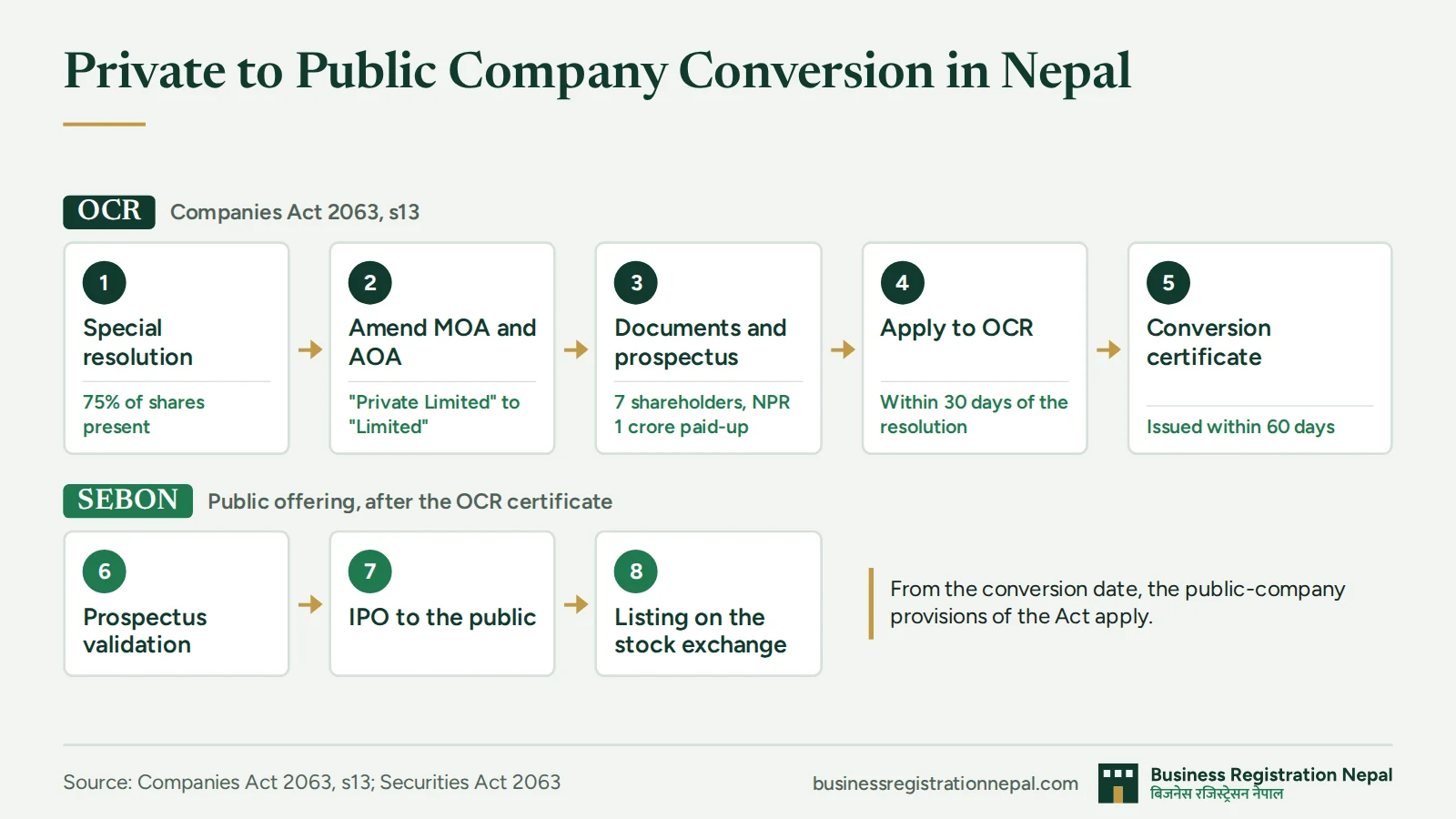
- Step 1: Pass a special resolution at the general meeting. A special resolution passes with 75% approval: shareholders holding 75% of the shares present vote in favour.
- Step 2: Amend the MOA and AOA. The MOA amendment changes the name suffix from "Private Limited" to "Limited". The AOA adopts public-company rules, such as a board of 3 to 11 directors.
- Step 3: Prepare the documents and the prospectus. The file shows that the company meets the public-company minimum of 7 shareholders and NPR 1 crore of paid-up capital.
- Step 4: Apply to the OCR within 30 days of the resolution. The application follows the prescribed format and carries a copy of the resolution and the prescribed fee.
- Step 5: Receive the OCR conversion certificate. The OCR checks that the company meets the public-company requirements. It then records the conversion in the company register and issues the certificate within 60 days.
- Step 6: Obtain SEBON prospectus validation. The Securities Board of Nepal (SEBON), the regulator under the Securities Act 2063, registers public-company securities and approves each public issue. The company registers its securities with SEBON and files a prospectus prepared through a SEBON-licensed issue manager, under the Securities Act 2063 and the Securities Registration and Issue Regulation 2073.
- Step 7: Issue shares to the public through an initial public offering (IPO) under the approved prospectus, following SEBON's Securities Issuance and Allotment Directive 2074.
- Step 8: List the shares on the stock exchange, which operates under a SEBON licence, under the Securities Listing and Trading Bylaws 2075.
A private company sells no shares to the public, so going public through an IPO follows the OCR certificate. From the conversion date, the public-company provisions of the Companies Act 2063 apply, and the company must comply with the ongoing AGM and filing duties.
What Is the Conversion Process (Public to Private)?
A public company converts into a private company in 3 steps when shareholders fall below 7 or paid-up capital drops under NPR 1 crore. Section 14 of the Companies Act 2063 sets each step, and the OCR closes the process with a certificate.
- Step 1: Amend the MOA and AOA within 6 months of the trigger. The general meeting passes the amendment by special resolution, and the name suffix changes from "Limited" to "Private Limited".
- Step 2: Apply to the OCR within 30 days of the amendment. The application carries copies of the amended MOA and AOA and the OCR fee, which is 50% of the registration fee for a new private company of the same capital.
- Step 3: The OCR issues the conversion certificate. The Company Registrar records the change in the company register and gives the company conversion certificate in Nepal, a re-registration certificate under the private type.
All assets and liabilities of the public company devolve on the converted private company. The company then follows the private-company rules, with no more than 101 shareholders.
What Documents Are Required for Conversion?
A company conversion file holds 7 documents, led by the special resolution, the amended MOA and AOA, and the OCR fee. Sections 13 and 14 of the Companies Act 2063 name the resolution, the amended documents and the prescribed fee. The OCR conversion fee is 50% of the registration fee for the new company type.
0 of 7 ready
The shareholder register and audited statements prove the 2 statutory tests of each type: the shareholder count and the minimum paid-up capital. The company submits the file to the OCR within the 30-day window its conversion route sets.
How Long Does Company Conversion Take?
A private to public company conversion takes up to 90 days at the OCR: 30 days to apply, then 60 days for the certificate. A public offering adds months for SEBON approval, the IPO and listing, and its length turns on SEBON's review of the prospectus.
The table sets out the statutory time limits for each conversion route under the Companies Act 2063.
| Conversion stage | Time limit |
|---|---|
| Private to public: application to the OCR | Within 30 days of the special resolution |
| Private to public: OCR conversion certificate | Within 60 days of the application |
| Private to public: SEBON approval, IPO and listing | No fixed statutory limit; set by SEBON review, allotment and listing |
| Public to private: MOA and AOA amendment | Within 6 months of the trigger |
| Public to private: application to the OCR | Within 30 days of the amendment |
| Public to private: OCR conversion certificate | Within 60 days of the application |
The OCR certificate step is the shorter part of a public conversion, and the public offering sets the longer timeline. A public to private conversion has no offering stage, so it ends with the OCR certificate.
Frequently Asked Questions
Does the PAN or registration number change after conversion?
No, the PAN and the company registration number continue after conversion, because conversion changes the company's form, not its identity. The conversion certificate OCR issues records the new type against the existing company. The company then updates its PAN record with the new name through the IRD business PAN amendment process at its IRD tax office.
Can a sole proprietorship convert into a company?
No, a sole proprietorship in Nepal does not convert into a company under the Companies Act 2063. The owner registers a new private company at the OCR and transfers the business into it under a business transfer agreement. A partnership firm takes the same route, and the firm's own registration stays separate from the new company until the owner applies to the registering office to cancel it.
Are there tax or stamp-duty implications when converting?
Yes, conversion carries tax and stamp-duty implications where assets move to a new owner, as when a firm transfers its business into a new company. The Income Tax Act 2058 treats the transfer as a disposal of the firm's assets, and land or buildings moved to the company pay registration fees at the Land Revenue Office. A private-to-public or public-to-private conversion moves no assets to another person, because they devolve on the converted company, which keeps its PAN, so the conversion itself transfers no assets. The tax position is settled before the transfer or the resolution.
Does converting to a public company require SEBON involvement?
Yes, SEBON involvement starts when the converted public company offers shares to the public. SEBON registers public-company securities and approves each public issue, while the OCR alone handles the conversion certificate. Without a public offering, the OCR certificate completes the conversion, and SEBON registration applies once the company plans a public issue.
Do existing contracts and licences remain valid after conversion?
Yes, existing contracts remain valid after conversion, because the Companies Act 2063 devolves all assets and liabilities on the converted company. Licences follow each regulator's own rules, so the company applies to each licensing authority to record the new name suffix. The company notifies counterparties, banks and licensing authorities of its new name suffix.
Is shareholder approval by special resolution required to convert?
Yes, shareholder approval by special resolution is required to convert a company in Nepal. A private company goes public by a special resolution of its general meeting, passed with 75% of the shares present. A public company going private amends its MOA and AOA by special resolution, and each route then files with the Company Registrar within 30 days.