


The memorandum of association MOA amendment process in Nepal runs in 5 steps under section 21 of the Companies Act 2063, the law that governs it:
- Step 1: Pass a board resolution to propose the amendment.
- Step 2: Issue the general-meeting notice (21 days for a public company AGM, 15 for an EGM).
- Step 3: Pass the special resolution at the general meeting.
- Step 4: Prepare the amended MOA and supporting documents.
- Step 5: File the application with the Office of the Company Registrar (OCR) within 30 days.
A company amends its MOA when it changes its name, objectives, capital or registered office. The special resolution needs 75% of the shares present. The AOA changes through the same special resolution and the same 30-day OCR notice.
The OCR file holds 5 documents, led by the certified minutes and 2 signed copies of the amended clause. The OCR records the amendment within 7 days, and a name change costs 25% of the new-registration fee, up to NPR 5,000. A name change takes effect only on the OCR's prior approval, and a court petition keeps an objective change ineffective until the court rules.
The MOA and AOA explained guide sets out the founding clauses that an amendment rewrites. The OCR then records the amended memorandum against the company created through company registration in Nepal.
When Do You Need to Amend the MOA?
A company in Nepal needs an MOA amendment when it changes its name, its objectives, its capital or its registered office. Each of these 4 triggers is an alteration of memorandum clauses fixed at incorporation.
The Office of the Company Registrar (OCR), the government office that registers companies, records each of the 4 triggers for MOA amendment in Nepal:
- Change of company name. A new name needs a special resolution and the OCR's prior approval, and the company name change process follows that approval route.
- Change of objectives. To change company objectives in Nepal, a company rewrites its objective clause, and the add / change company objective steps cover a new business line. The clause lists the business objects.
- Increase of authorized/paid-up capital. A higher authorized capital rewrites the capital clause by special resolution, while issued capital within that ceiling rises by ordinary resolution. The capital increase process adds the OCR fee on the extra authorized capital.
- Change of registered office. The MOA states the registered office address, so a new address changes that clause, by special resolution with notice to the OCR within 30 days.
Each trigger follows one statutory route: a special resolution at the general meeting, then notice to the Company Registrar.
Which Law Governs MOA Amendment in Nepal?
The Companies Act 2063 governs MOA amendment in Nepal, through section 21: the general meeting amends the MOA or AOA by special resolution. The same section sets the OCR notice limit and the extra approval for a name change.
Section 21 gives one route for MOA and AOA amendment in Nepal. The company notifies the OCR within 30 days of the amendment, and the OCR records it and informs the company within 7 days of receipt. A name change adds an application, with the prescribed fee, for the OCR's prior approval.
A public company's change of company objectives carries a shareholder safeguard under section 21. Shareholders holding at least 5% of the shares, who did not consent, petition the court within 21 days of the resolution.
A filed petition keeps the objective amendment ineffective until the court decides. The court declares the amendment valid or void, in whole or in part, or orders the company to buy the dissenting shares at a reasonable value.
A capital change follows section 56 as well, which the OCR handles as its own share capital service. Published summaries that cite section 18 or 22 point to other provisions, and section 21 holds the amendment rule itself.
Which Limits Does Section 6 Place on an MOA Amendment?
Section 6 of the Companies Act 2063 limits every MOA amendment, because section 21(1) makes the general meeting's power subject to it. Section 6 lets the OCR refuse a name identical with, or misleadingly close to, a registered company's name.
Section 6 further lets the OCR refuse a name or an objective that contradicts the prevailing law or the public interest. The amended name and objective clauses face the same test as the clauses filed at incorporation.
What Is the MOA Amendment Process?
The MOA amendment process in Nepal runs in 5 steps, from a board resolution to the OCR record of the amended memorandum. The general meeting alone holds the power to amend memorandum of association clauses under the Companies Act 2063.
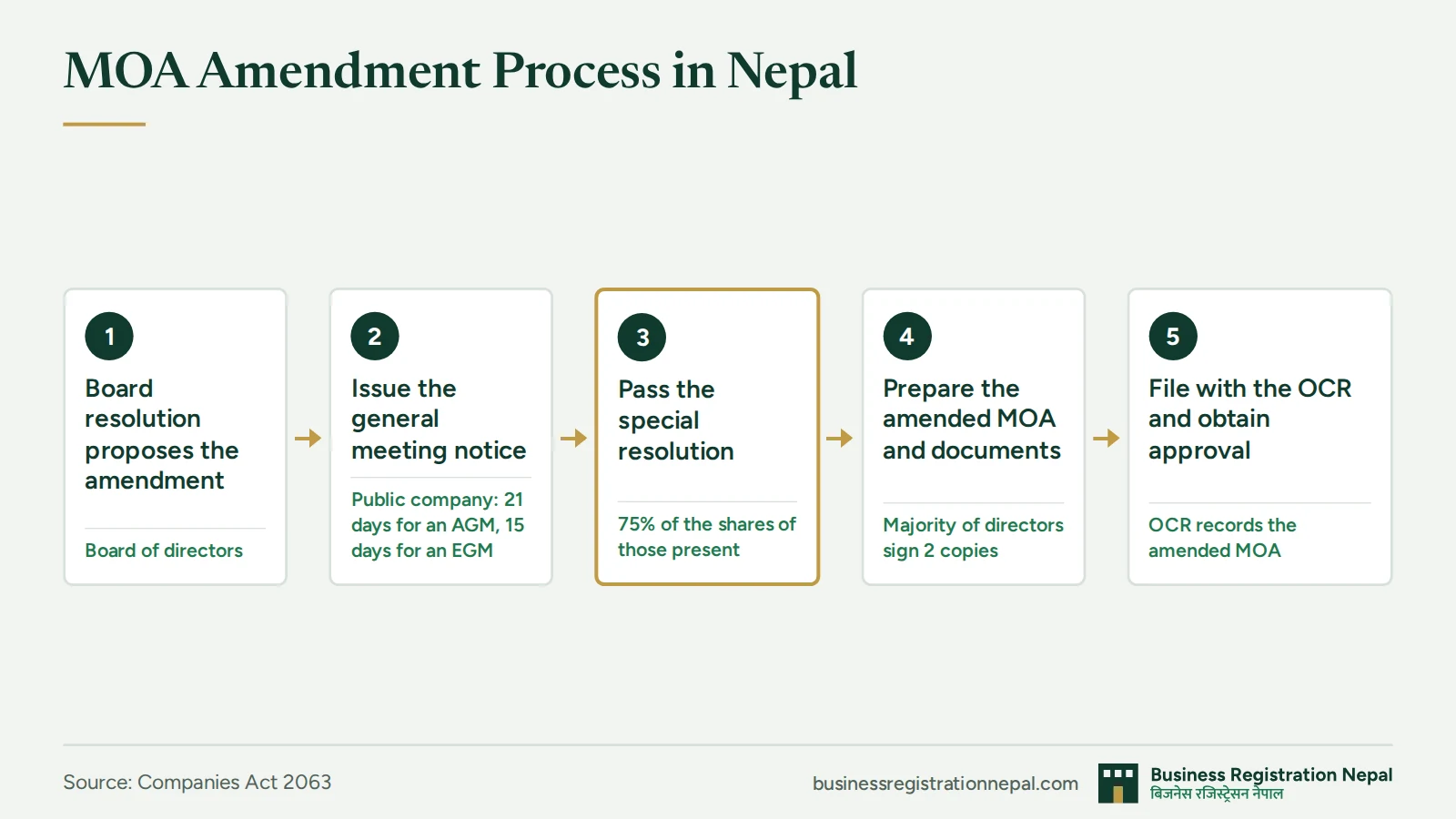
To amend the MOA in Nepal, a company completes these 5 steps in order:
- Step 1: Pass a board resolution to propose the amendment. The board of directors approves the draft wording and calls the general meeting, the shareholders' meeting that decides it.
- Step 2: Issue the general-meeting notice (21 days for an AGM, 15 for an EGM). Under Section 67(2) of the Companies Act 2063, a public company gives at least 21 days' notice before an annual general meeting and 15 days before an extraordinary general meeting. A private company follows the notice period in its articles or consensus agreement.
- Step 3: Pass the special resolution at the general meeting. Under Section 74(3) of the Companies Act 2063, the resolution passes when shareholders holding 75% of the shares of those present vote in favour.
- Step 4: Prepare the amended MOA and supporting documents. The majority of directors sign 2 copies of each amended clause, and the company certifies the meeting minutes.
- Step 5: File the application with OCR (CAMIS) and obtain approval. The company notifies the OCR within 30 days of the amendment, and the OCR records the amendment within 7 days of receipt. The company files through its CAMIS login.
The OCR record closes the MOA amendment process. Nepal's Company Registrar then keeps the amended memorandum on the company file. A name change adds one step: an application, with the prescribed fee, for the OCR's prior approval.
When Does an MOA Amendment Take Effect?
An MOA amendment takes effect at a different point for each type of change under section 21 of the Companies Act 2063. A name change takes effect only after the OCR's prior authorisation, under section 21(3).
An objective change in a public company stays ineffective while a shareholder petition is pending in court, under section 21(6). A court-endorsed or court-ordered alteration takes effect as if the general meeting had approved it, under section 21(9).
How Is the AOA Amended in Nepal?
A company in Nepal amends its AOA by a special resolution of the general meeting under section 21(1) of the Companies Act 2063, then notifies the OCR within 30 days. The AOA amendment follows the MOA route, without the name-change approval.
Section 21(1) lets the general meeting amend the MOA or the AOA, so both documents change through one route. The OCR records and confirms the notice of an AOA amendment within 7 days, under section 21(2).
Section 20(2) of the Companies Act 2063 names the matters that an AOA rule covers. These 4 matters from that list show what an AOA amendment rewrites:
- General meeting procedure and notice
- Number and tenure of directors
- Share transfer provisions
- Alteration of share capital
The director rules connect to the director change process in Nepal, and the transfer rules to the share transfer process in Nepal.
What Documents Are Required for MOA Amendment?
The OCR asks for 5 documents for an MOA amendment, led by the application, the certified meeting minutes and 2 signed copies of the amended clause. A name change adds 2 more documents to the file.
The OCR publishes 5 documents that a company submits to file with OCR for a memorandum or articles amendment:
0 of 5 ready
A name change file adds the company's original registration certificate and a consent letter from the Inland Revenue Office. Nepal Rastra Bank (NRB) issues the letter for a finance company, and the Nepal Insurance Authority for an insurer. A foreign-employment company takes it from the Department of Labour and Employment Promotion.
The current MOA and AOA, the meeting notice, the board authorization and director IDs are not on the OCR's published list, so the company keeps them ready in case OCR staff ask for them. OCR staff review each document against the special resolution before the record.
How Long Does It Take and What Does It Cost?
An MOA amendment takes up to 30 days to reach the OCR after the amendment, plus 7 days for the OCR record. Its cost depends on the change type: a name change costs 25% of the new-registration fee, up to NPR 5,000.
The statutory timeline has 3 fixed parts: the meeting notice period, the 30-day filing limit and the 7-day OCR record. After the amendment, the statutory limit is 37 days in total: up to 30 days to notify the OCR and 7 days for the OCR record. The total time from board resolution to OCR record depends on OCR review and any regulator letter.
The table shows the OCR fee for 4 amendment items, in NPR, under the OCR revenue schedule.
| Amendment item | OCR fee |
|---|---|
| Change of company name | 25% of the prevailing new-registration fee, at most NPR 5,000 |
| Increase of authorized capital | Registration fee on the new authorized capital, less the fee already paid |
| Change of objectives or registered office | No separate fee line in the OCR revenue schedule |
| Late notice to the OCR | NPR 200 a month after one month past the time limit, capped at NPR 1,000 in one fiscal year |
A private company with NPR 1 crore of authorized capital pays NPR 4,000 for a name change. One with NPR 10 crore pays the NPR 5,000 cap.
The new-registration fee behind that name-change charge follows the capital bands in company registration cost and fees. Professional fees for drafting and filing are quoted per engagement after a review of the change.
Frequently Asked Questions
Must a shareholder give the company notice of a court petition against an objective change?
Yes, the court requires proof that the company received notice of the petition before it proceeds, under section 21(5) of the Companies Act 2063. The exception covers a company that refused to acknowledge the notice. The 21-day petition window under section 21(4) runs from the date of the resolution.
Can a company amend its MOA again after a court voids an amendment?
No, the company needs the court's permission before the next amendment. Section 21(8) of the Companies Act 2063 bars a company from amending its memorandum without court permission once a court has voided an earlier amendment. The general meeting's special resolution alone does not clear that bar.
Does a court-ordered MOA change need a new general meeting vote?
No, section 21(9) of the Companies Act 2063 gives a court-endorsed or court-ordered alteration the same effect as an alteration approved at the general meeting. The company holds no fresh vote for that alteration. Section 21(7) lets the court declare an amendment valid or void, or order the company to buy the dissenting shares.
What is the penalty for notifying the OCR late about an MOA amendment?
The OCR charges NPR 200 a month once the notice is one month past the time limit, capped at NPR 1,000 in one fiscal year. The time limit is the 30-day notice period under section 21(2) of the Companies Act 2063. The cost table in this guide lists the fee.
Is an amended AOA rule valid if it conflicts with the Companies Act or the MOA?
No, section 20(3) of the Companies Act 2063 makes an article void to the extent that it conflicts with the Act or the memorandum. The rest of the articles stays in force. A special resolution under section 21(1) therefore amends an AOA rule only within the limits of the Act and the MOA.