


The Companies Act 2063 (2006) is Nepal's primary company law, administered by the Office of the Company Registrar (OCR), governing how companies are formed, run and dissolved. The highlights of Companies Act 2063 span 7 areas, from incorporation and the MOA and AOA to directors, the AGM, audit and liquidation.
The Act recognises 5 company types, and a private company holds 1 to 101 shareholders. A public company keeps 3 to 11 directors, and every company files audited accounts with the OCR within six months of fiscal year end. Amended 4 times up to 2081, the Act governs company registration in Nepal.
What Is the Companies Act 2063?
Nepal's Companies Act 2063 is the governing statute for companies, setting how a company is incorporated, run, audited and dissolved under the Office of the Company Registrar (OCR). The Act replaced the Companies Act 2053 as the law of every Nepali company.
The Law Commission of Nepal lists the statute as the Company Act 2063 (कम्पनी ऐन, २०६३), authenticated on 24 Kartik 2063 (10 November 2006). Under Section 1, its short title is Companies Act, 2063 (2006), so the Companies Act 2006 is the same statute. It is deemed in force from 20 Ashwin 2063 (6 October 2006).
The preamble states the purpose of the Act: to consolidate the law relating to companies and make incorporation and administration simpler and more transparent. The Companies Act 2063 in Nepal runs to 21 chapters and 188 sections. That text is the core of company law in Nepal, the corporate law every private and public company follows.
The OCR is the government office that registers companies and administers the Act. Under Section 5, the OCR registers a company within 15 days of the application and issues its registration certificate. The company counts as incorporated from that registration.
What Are the Key Areas the Companies Act 2063 Covers?
7 key areas make up the Companies Act 2063, from company incorporation and registration to mergers, conversion and liquidation. This companies act 2063 summary follows the chapter order of the Act, with each area tied to its sections.
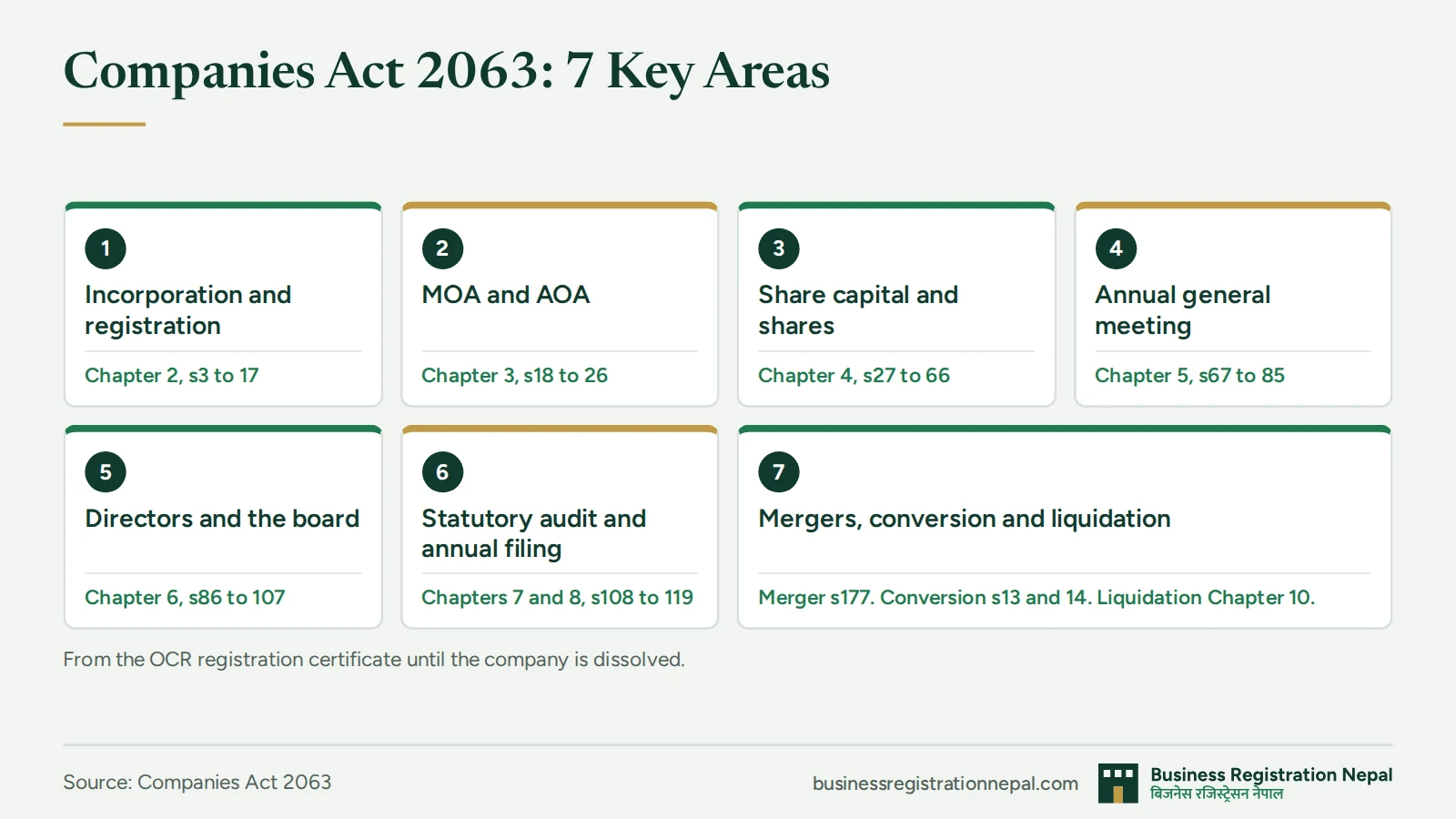
- Company incorporation and registration. Chapter 2 (Sections 3 to 17) lets any person incorporate a company alone or with others. The guide on how to register a company sets out each OCR filing step.
- MOA and AOA. Chapter 3 (Sections 18 to 26) sets the contents of the memorandum of association and the articles of association. MOA and AOA explained reads both company documents clause by clause.
- Share capital and shares. Chapter 4 (Sections 27 to 66) governs shares, debentures and share capital. A company raising its authorized capital under the Act follows the capital increase process.
- Directors and the board. Chapter 6 (Sections 86 to 107) sets the size, appointment and duties of the board of directors. Each board appointment or exit follows the director change process.
- Annual general meeting. Chapter 5 (Sections 67 to 85) governs how a company convenes its general meetings. AGM in Nepal covers the annual general meeting notice, quorum and deadlines.
- Statutory audit and annual filing. Chapters 7 and 8 (Sections 108 to 119) require books of account, annual financial statements and an auditor. Audited accounts under the Companies Act 2063 come from a statutory audit in Nepal each fiscal year.
- Mergers, conversion and liquidation. Section 177 governs a company merger, and Sections 13 and 14 convert a private company to public and back. Chapter 10 covers voluntary liquidation, and a company combining with another follows the merger and acquisition route.
Together, the 7 areas cover a company from its registration certificate at the OCR until the company is dissolved.
What Types of Companies Does the Act Recognise?
The Act recognises 5 types of companies: private limited, public limited, single shareholder (one-person), not distributing profits, and foreign. Each type carries its own member rule under the Companies Act 2063.
The table compares the 5 company types on their member rule and one distinguishing provision.
| Company type | Members under the Act | Distinguishing provision |
|---|---|---|
| Private limited company | 1 to 101 shareholders (Section 9) | Sells no shares or debentures to the public |
| Public limited company | At least 7 promoters and shareholders, no upper limit (Sections 3 and 9) | Minimum paid-up capital of NPR 1 crore (Section 11) |
| Single shareholder (one-person) company | 1 shareholder (Chapter 15) | Needs no board meeting or general meeting (Section 152) |
| Company not distributing profits | At least 5 promoters and 5 members (Section 166) | Pays no dividend; membership is not transferable |
| Foreign company | Registers a branch or liaison office with the OCR (Section 154) | A liaison office earns no income in Nepal |
Section 9 caps a private company at 101 shareholders, and employees holding shares under an employee scheme do not count toward that limit. The company not distributing profits is the not-for-profit form of the Act, set up for professional, academic, social or public-welfare objectives.
Under Section 154, a foreign company registers its branch or liaison office before it does business in Nepal, and the OCR registers a complete application within 30 days. Founders comparing these forms decide with which company type to register, weighing liability, members and compliance.
What Does the Act Say About Directors and the AGM?
The Act gives a public company a board of 3 to 11 directors and lets a private company fix its directors in its articles. A public company holds its AGM within six months of fiscal year end, under Sections 86 and 76.
Under Section 86, every public company keeps a board of directors of at least 3 and at most 11 members. A board of 7 or fewer includes at least 1 independent director, and a larger board includes at least 2. The directors choose a chairperson from among themselves.
A private company sets the number and appointment of its directors in its articles of association, as Section 86 provides. Section 89 bars certain persons from the board, such as a person of unsound mind or one convicted of corruption. A single shareholder company needs no board meeting under Section 152.
Under Section 76, a public company holds its initial annual general meeting within one year of permission to start business. Each later AGM falls within six months of fiscal year end, and Nepal's fiscal year runs from Shrawan to Asar (mid-July to mid-July). The OCR directs a public company to call a missed AGM, and a shareholder petitions the court when the company ignores that directive for 3 months.
A private company follows Section 148 instead: it holds no AGM while a consensus agreement among its shareholders says so. That agreement names who takes the decisions a general meeting otherwise makes.
What Are the Compliance and Audit Requirements Under the Act?
The Act's compliance and audit requirements are an annual audit by a licensed auditor and the filing of audited financial statements with the OCR within six months of fiscal year end. Section 110 requires every company to appoint an auditor, and the Act sets no audit exemption by company size.
A company meets 4 statutory duties each fiscal year to comply with the audit and filing rules:
0 of 4 ready
The auditor holds office until the next AGM, and a public company sends the OCR a report at least 21 days before that meeting (Section 78). The OCR accepts these filings in electronic form, and the company keeps each financial statement for 5 years.
Audit and filing rules form the corporate governance core of the Act, and shareholder rights include inspecting the annual financial statements. Each duty repeats every fiscal year, and the annual compliance checklist orders them by deadline.
Have There Been Amendments to the Companies Act 2063?
Yes, the Companies Act 2063 has been amended 4 times, by amending Acts of 2064, 2074, 2075 and 2081. The Office of the Company Registrar publishes the Nepali text as amended to Chaitra 2081 (2025), and that consolidated text is the version in force.
The table lists the 4 amending Acts in the order the consolidated text records them, with their Bikram Sambat dates.
| Amending Act | Date (BS) |
|---|---|
| Act amending some Nepal Acts | 2064/05/09 |
| कम्पनी (पहिलो संशोधन) ऐन, २०७४, the amending Act for the Companies Act alone (2017) | 2074/01/19 |
| Act amending some Nepal Acts to align them with the Constitution of Nepal | 2075/11/19 |
| Act amending some Nepal Acts on improving the economic and business environment and promoting investment | 2081/12/17 |
Each amendment changed selected sections, and the numbering now includes inserted Sections 136A, on a special arrangement for winding up, and 187A, on money-laundering prevention. A company reads any provision in the latest consolidated text before it acts on it.
Insolvency falls outside the Companies Act 2063. Chapter 10 of the Act governs the voluntary liquidation of a company able to pay its debts. Section 128 then decides creditor status under the prevailing insolvency law, the Insolvency Act 2063, which the OCR lists with the Insolvency Rules 2064.
Frequently Asked Questions
What penalty applies for failing to file annual returns under the Act?
Under Section 81, a director or officer who files annual returns late pays a fine that rises with the company's paid-up capital and the length of the delay. The 2074 text starts the scale at NPR 1,000 for paid-up capital up to NPR 25 lakh in the three months after the deadline. The 2081 amendment added a one-time 90% discount on these fines for overdue documents filed by the end of Ashar 2082 (mid-July 2025). The OCR collects the fine together with the overdue returns, and returns filed by the deadline carry no fine.
Does the Act allow a single-shareholder (one-person) private company?
Yes, the Act allows a private company with a single shareholder, because Section 3 lets a person incorporate a company alone. Chapter 15 sets the rules for this single shareholder company: it needs no board meeting or general meeting (Section 152), and Section 153 governs the transfer of its shares.
How is the Companies Act different from the Industrial Enterprises Act?
Company formation and operation fall under the Companies Act, while the Industrial Enterprises Act deals with industry registration and incentives. A business falls under both when a registered company runs an industry. The company registers with the OCR, and its industry registers under the Industrial Enterprises Act.
What powers does the Office of the Company Registrar have under the Act?
The Office of the Company Registrar administers incorporation, record-keeping, filings and strike-off, and enforces compliance under the Act. Section 5 has the OCR register each company and keep the company register, and Section 81 lets it collect late-filing fines. Section 121 lets the OCR depute an inspector to investigate a company, and Section 136 lets it cancel a registration.
Can a foreign national be a director or shareholder under the Act?
Yes, the Act permits a foreign national to be a director or shareholder of a Nepali company, alongside the foreign-investment approval where relevant. The incorporation application of a foreign-invested company carries that approval and the foreign promoter's identity or registration documents. A foreign shareholder completes FDI and foreign company registration before the OCR incorporates the company.
Can a company be struck off for non-compliance under the Act?
Yes, a company is struck off for non-compliance when the OCR cancels its registration under Section 136 after 3 consecutive financial years of unfiled returns or unpaid fines. The OCR takes the same step when it has reasonable grounds to believe the company no longer carries on business. The company receives a notice with 2 months to respond, and Section 137 lets a court restore the registration on a petition within 5 years.