


The difference between a merger and an acquisition is the result: a merger combines companies into one surviving company; an acquisition gives a buyer control through shares or assets. For every merger and acquisition, Nepal's Companies Act 2063 leads the 5 governing laws. The merger process runs in 5 steps under Section 177:
- Step 1: Negotiate and conduct due diligence and valuation.
- Step 2: Draft the merger scheme / agreement.
- Step 3: Obtain shareholder approval by special resolution and creditor consent.
- Step 4: File the application with the Office of the Company Registrar (OCR) within 30 days and obtain approval within three months.
- Step 5: Transfer assets and liabilities to the surviving entity and integrate.
An acquisition works through a share purchase of the whole company or an asset purchase of selected assets and liabilities. Banks add Nepal Rastra Bank (NRB) approval, and listed companies add the Securities Board of Nepal (SEBON). Foreign buyers add Department of Industry (DOI) or Investment Board Nepal (IBN) approval, and every merger meets a competition test.
Each merger and acquisition of company in Nepal ends in the OCR records that begin with company registration in Nepal.
What Is the Difference Between a Merger and an Acquisition?
A merger joins two or more companies into one continuing company; an acquisition buys shares or assets to take control of a company. A merger ends with one surviving company. An acquisition leaves the target company in place under a new controller.
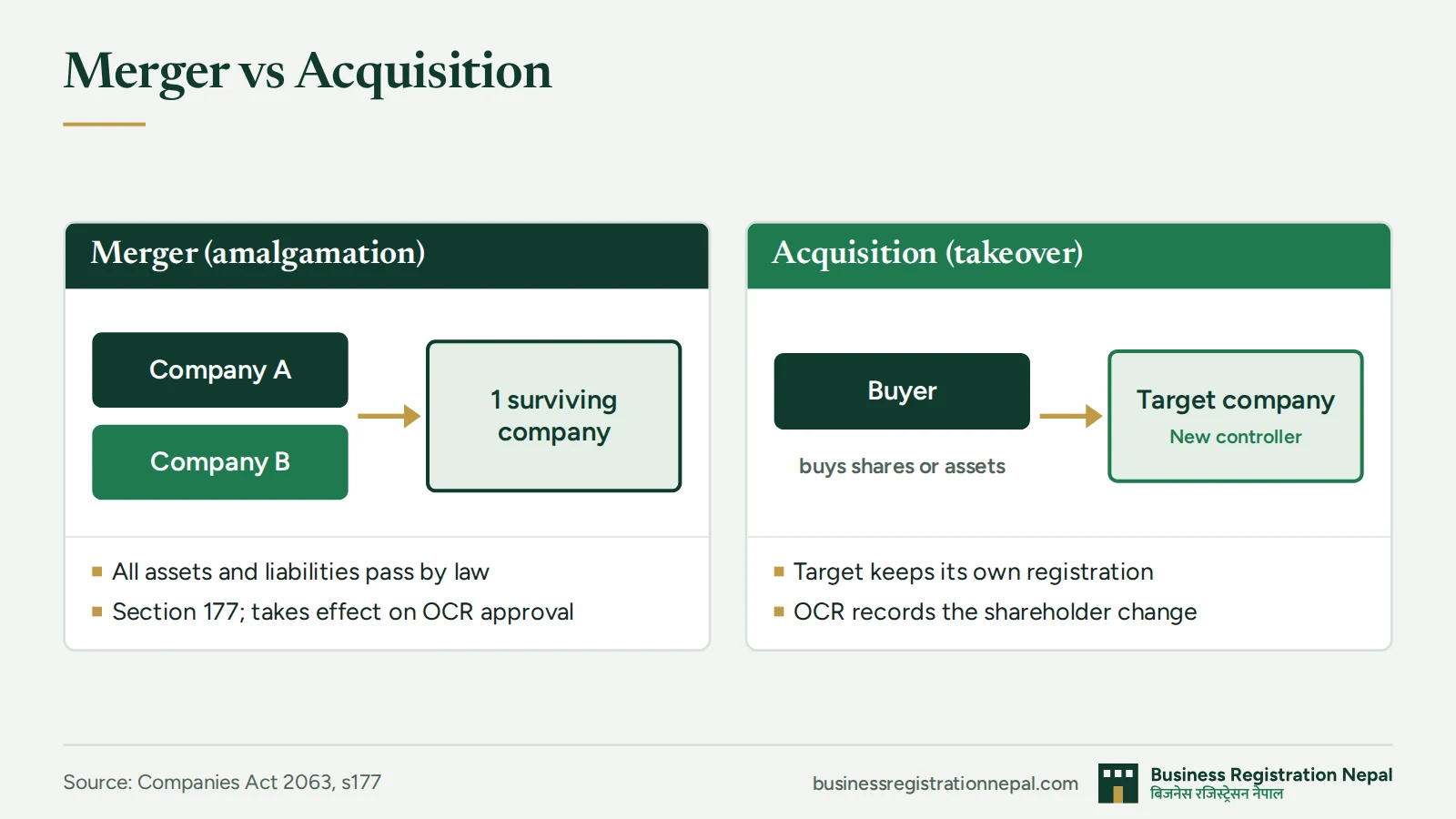
A company merger in Nepal, known in law as an amalgamation, follows Section 177 of the Companies Act 2063, Nepal's company law. The merging company passes all its assets and liabilities to the merged company, the surviving company. That transfer takes effect once the Office of the Company Registrar (OCR) approves the merger.
An acquisition, known as a takeover or buyout, changes who controls a company without joining it to another. The buyer acquires control through a share purchase or an asset purchase.
The table compares a merger and an acquisition on 5 attributes.
| Attribute | Merger (amalgamation) | Acquisition (takeover) |
|---|---|---|
| Result | One continuing company in place of two or more | The target company continues under the buyer's control |
| Legal route | Section 177 of the Companies Act 2063 | Share transfer rules of the Companies Act 2063, or an asset purchase agreement |
| Company decision | Public company: special resolution of the general meeting. Private company: its memorandum of association (MOA), articles of association (AOA) or consensus agreement | Selling shareholders agree the sale of their shares with the buyer |
| Role of the OCR | Approves the merger within three months of the application | Records the change in the company's shareholders |
| Assets and liabilities | All pass to the surviving company by law | Stay with the target company in a share purchase; only the selected items move in an asset purchase |
A merger suits two companies that want one business combination, known as a consolidation. An acquisition suits a buyer that wants control while the target company keeps its own registration.
Which Laws Govern Mergers and Acquisitions in Nepal?
5 laws govern mergers and acquisitions in Nepal, led by the Companies Act 2063 and joined by the securities, banking, competition and foreign-investment laws. The Companies Act 2063 applies to every company, and each other law adds rules for one type of deal.
The 5 laws divide the statutory ground by company type, sector and investor origin:
- Companies Act 2063: Section 177 sets the general merger route, from the special resolution to the OCR decision. Sections 178 to 180 cover directives, bonus shares and void acts, so they add no merger rule.
- Securities Act 2063: the Securities Board of Nepal (SEBON) is the capital-market regulator. It regulates and makes transparent any acquisition of control of a company through share purchases, in one lot or more.
- Bank and Financial Institution Act 2073: Chapter 10 governs mergers of banks and financial institutions (BFIs). Nepal Rastra Bank (NRB), the central bank, issued the NRB merger bylaw for BFIs, the Merger and Acquisition Bylaw 2073, which sets 2 NRB approval stages: a letter of intent after preliminary discussion, then final approval.
- Competition Promotion and Market Protection Act 2063: Section 5 bars an anti-competitive merger or takeover between enterprises dealing in similar goods or services. A deal giving more than 40% of their production or distribution in Nepal is deemed to control competition.
- Foreign Investment and Technology Transfer Act 2019 (FITTA): governs cross-border deals where a foreign investor buys into a Nepali company. The Department of Industry (DOI) or Investment Board Nepal (IBN) approves that investment.
The Companies Act 2063 sets the base merger route. The other 4 laws add rules by sector, listing, market share or investor origin.
What Is the Merger Process in Nepal?
The merger process in Nepal runs in 5 steps, from due diligence to the transfer of assets and liabilities to the surviving company. Section 177 of the Companies Act 2063 sets the shareholder, creditor and OCR stages, and the parties own the steps before them.
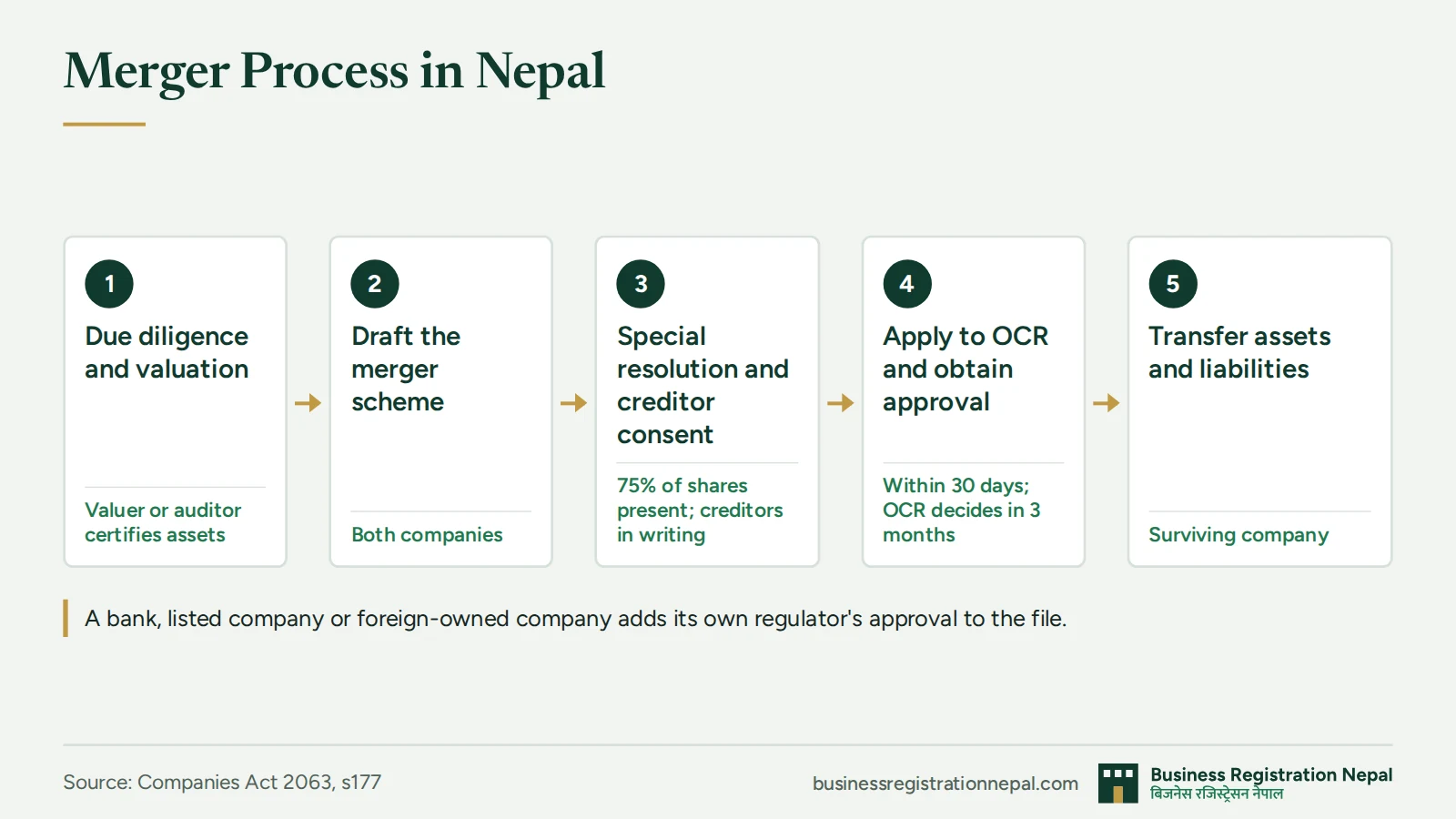
- Step 1: Negotiate and conduct due diligence and valuation. The companies negotiate the terms and review each other's accounts, contracts and liabilities from their disclosure. A valuer or auditor certifies the valuation of the merging company's movable and immovable property and the actual details of its assets and liabilities.
- Step 2: Draft the merger scheme / agreement. The scheme of arrangement, known as the merger scheme, records how the companies merge. It sets out any decision on the creditors, employees and workers of the merging company.
- Step 3: Obtain shareholder approval by special resolution and creditor consent. A public company adopts a special resolution at its general meeting, passed when shareholders holding 75% of the shares present vote in favour. A private company follows its MOA, AOA or consensus agreement, and the creditors of both companies give written consent.
- Step 4: File the application with OCR (within 30 days) and obtain approval. The companies file a joint application within thirty days of the resolution, and this OCR merger filing carries 10 documents. The OCR decides within three months and refuses a merger that creates a monopoly or unfair trade restriction or goes against public interest.
- Step 5: Transfer assets and liabilities to the surviving entity and integrate. On the OCR approval, all assets and liabilities of the merging company pass to the surviving company by law. The OCR keeps separate records of the merging company, and the surviving company consolidates the two operations.
The OCR lists 10 documents for the merger file, led by the resolution, the balance sheet and the creditors' consent:
- Application, filed jointly within 30 days of the merger resolution
- Copy of the general-meeting special resolution (public company), or of the MOA, AOA or consensus-agreement clause that allows the merger (private company)
- Balance sheet and audit report of the merging company, the latest issued
- Consent letters from the creditors of both companies, in writing
- Valuation and actual details of assets and liabilities, certified by a valuer or auditor
- Decision on creditors, workers and employees, as a certified copy where one exists
- Merger agreement signed between the companies
- Tax clearance or consent for the merging company from its Inland Revenue Office, the local tax office of the Inland Revenue Department
- Certificates of both companies, in original
- Recommendation or approval of the relevant regulator, where the sector needs one
The M&A process in Nepal's Companies Act 2063 ends with that OCR approval. A bank, a listed company or a foreign-owned company adds its own regulator's approval to the same file.
How Does an Acquisition Work in Nepal?
An acquisition in Nepal works through 2 routes: a share purchase that transfers control of the whole company, or an asset purchase of selected assets and liabilities. The route decides what a company acquisition in Nepal hands over: the whole company or only the items named in the agreement.
In a share purchase, the buyer acquires the target company's shares from its existing shareholders. The company keeps all its assets and liabilities and stays the same legal entity, so the acquisition does not dissolve it. The buyer carries those liabilities indirectly, because they stay inside the company it now controls.
The company enters the buyer in its shareholder register within fifteen days of the transfer application, and the OCR records the change in shareholders. Each share purchase follows the share transfer process, from the transfer deed and board approval to the register update.
In an asset purchase, the buyer acquires only the assets and liabilities named in the purchase agreement, and the seller company keeps the rest.
Section 177 of the Companies Act 2063 protects a seller-company shareholder who withholds written consent to a sale of the entire assets. That shareholder has the assets valued before the sale and receives an amount in proportion to the shares held. The MOA, AOA or consensus agreement of the company sets a different rule where it provides one.
An acquisition of a company in Nepal adds a regulator's approval to either route in 3 cases: a bank target, a listed target or a foreign buyer.
What Regulatory Approvals Are Needed for M&A?
M&A in Nepal adds up to 4 regulatory approvals and checks to the OCR decision: NRB, SEBON, the competition test and DOI or IBN. NRB covers banks, SEBON covers listed companies, and DOI or IBN covers foreign buyers, so the type of target and the buyer's origin decide which ones apply.
The 4 regulatory approvals and checks follow the deal type:
- NRB for banks and financial institutions: a BFI merger or acquisition follows Chapter 10 of the Bank and Financial Institution Act 2073 and the NRB merger bylaw, with a letter of intent before NRB's final approval.
- SEBON for listed companies: under the Securities Act 2063, SEBON regulates any acquisition of control through share purchases. Listed shares trade on the Nepal Stock Exchange (NEPSE), so the deal also follows the current SEBON and NEPSE rules for listed companies.
- Competition test: the OCR refuses a merger that creates a monopoly or unfair trade restriction. The Competition Promotion and Market Protection Act 2063 treats a deal above 40% of a product's production or distribution in Nepal as controlling competition.
- FITTA with DOI or IBN approval for foreign acquisitions: the DOI signs off a change of owner and foreign investment in an existing industry through a share purchase agreement. The DOI approves up to NPR 6 billion, and the IBN approves larger amounts.
Nepal Rastra Bank gives prior approval before foreign currency buys shares that change a company's ownership, with a chartered accountant's valuation report at fair market value. NRB decides within fifteen working days, and a listed company is exempt from that prior approval. A cross-border acquisition of a Nepali company runs through FDI and foreign company registration, where DOI or IBN approval comes before the NRB inflow.
Frequently Asked Questions
Do mergers require competition or anti-monopoly clearance?
No, the Competition Promotion and Market Protection Act 2063 sets no separate pre-merger clearance filing in Nepal. The OCR applies the anti-monopoly test itself and refuses a merger that creates a monopoly or unfair trade restriction. Section 5 of the competition law treats a merger giving more than 40% of a product's production or distribution in Nepal as anti-competitive.
Which sectors need special regulator approval for M&A?
Banking, insurance and telecom need their sector regulator's approval for M&A as well as the Company Registrar's. Nepal Rastra Bank approves bank and financial institution deals under the NRB merger bylaw. The Nepal Insurance Authority regulates insurers under the Insurance Act 2079, and the telecom regulator covers telecom operators, and each applies its own merger approval rules.
What happens to employees and licences of the merged company?
Employees, contracts and licences pass to the surviving company under the merger scheme, with the authorities notified. Under Section 177 of the Companies Act 2063, OCR approval transfers every asset and liability of the merging company. The merger file records any decision on its employees and workers, and each licensing authority receives notice of the transfer. Section 14 of the Labour Act 2074 keeps each worker's employment relationship in force after a merger, and the merged entity takes on the employer's obligations.
Do dissenting shareholders get exit or buyout rights?
Yes, a shareholder who does not consent in writing to a merger holds an exit right under Section 177 of the Companies Act 2063. That shareholder has the company's assets valued before the merger and receives an amount in proportion to the shares held. The MOA, AOA or consensus agreement sets a different rule where it provides one.
Does acquiring a listed company trigger a mandatory takeover offer?
No, the Securities Act 2063 sets no mandatory takeover offer or shareholding threshold for acquiring a listed company. The Act gives SEBON the power to regulate and make transparent any acquisition of control through share purchases. A buyer checks the current SEBON rules before it buys a controlling stake.
Is court or registrar approval of the merger scheme required?
Yes, registrar approval is required: the Office of the Company Registrar approves or refuses the merger within three months of the application. Section 177 of the Companies Act 2063 names no court step for a company merger. A bank or financial institution adds NRB approval to the registrar's decision.