

The company name change process in Nepal runs in 5 steps under the Companies Act 2063:
- Step 1: Check and reserve the new name on OCR CAMIS.
- Step 2: Pass a board resolution, then a special resolution at the general meeting.
- Step 3: Amend the MOA (and AOA) name clause.
- Step 4: File the application with OCR and obtain the new certificate.
- Step 5: Update PAN/VAT, bank accounts, licences and stationery.
A company needs a new name when it rebrands, merges, changes its objectives or holds a misleading or similar name. The OCR file holds 7 documents, led by the certified special resolution minutes and the IRO consent letter. The change costs 25% of the OCR new-registration fee, capped at NPR 5,000. Its timing turns on the meeting notice periods and the OCR review.
Applications fail on name similarity, restricted words, incomplete resolutions or missing updates. The PAN update at the IRD follows the OCR approval, and the renamed company keeps the identity it gained at company registration in Nepal.
When Do You Need to Change a Company Name?
A company changes its name when it rebrands, merges, changes its objectives or holds a name that misleads or resembles another registered name. Each rename in Nepal follows the same special resolution and OCR approval route under the Companies Act 2063.
The Office of the Company Registrar (OCR) is the government office that registers companies and approves every name. 4 situations lead owners to change a company name in Nepal:
- Brand change (rebranding): the owners adopt a new trading identity, and the registered name follows the brand.
- Merger: 2 companies combine, and the continuing company takes a name that reflects the combined business.
- Change of objectives: the company leaves the business its name describes. The OCR Company Directive 2072 bars a name that gives false information about the objective, such as "insurance" in the name of a trading company.
- Name conflict: the name misleads or resembles a registered company name or trademark. Section 6 of the Act lets the OCR refuse a name that matches or confuses with a registered one.
Prior OCR approval is mandatory in all 4 situations. Section 21(3) of the Companies Act 2063 amends a company's name only after the Office approves the application.
What Is the Company Name Change Process?
Under section 21(3), the company name change process has 5 steps, from the CAMIS name availability check to updated tax, bank and licence records. Its core, set by the Companies Act 2063, is a special resolution and then the OCR's prior approval.
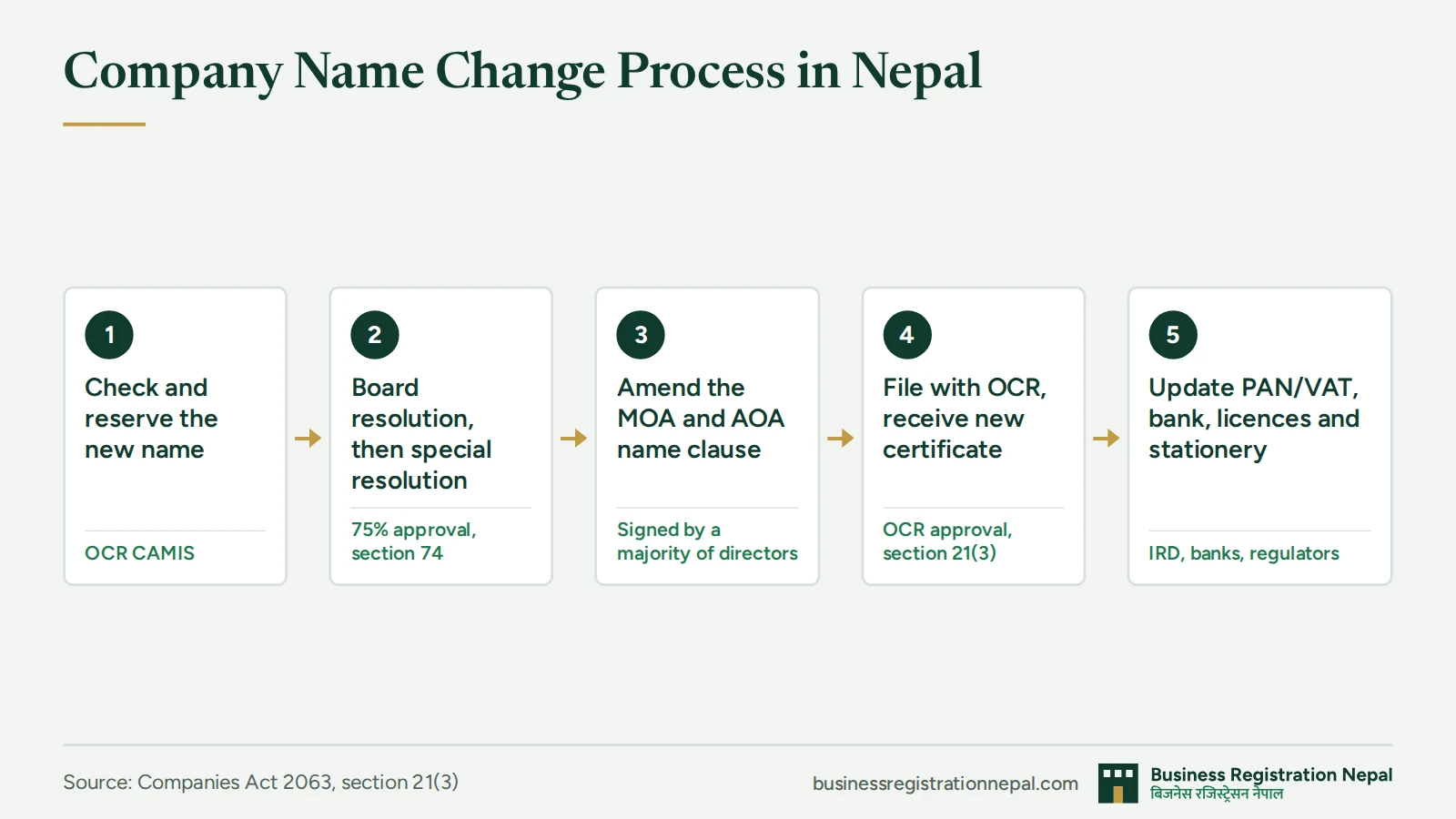
- Step 1: Check and reserve the new name on OCR CAMIS. CAMIS, the Company Administration Management Information System, is the OCR online portal where a name availability check runs against registered names. A new name passes the same company name check and reservation rules that apply at incorporation.
- Step 2: Pass a board resolution, then a special resolution at the general meeting. The board of directors records its board resolution in the minute book and calls the meeting. A public company publishes the meeting notice twice in a national daily. Under section 74, a special resolution passes with 75% approval, counted on the shares of the shareholders present.
- Step 3: Amend the MOA (and AOA) name clause. The memorandum of association (MOA) states the company name, and the articles of association (AOA) repeat it where they name the company. Each amended clause follows the MOA amendment process, with 2 copies signed by a majority of directors.
- Step 4: File the application with OCR and obtain the new certificate. The Office of the Company Registrar approves the name amendment under section 21(3). The company then receives its new registration certificate under the new name.
- Step 5: Update PAN/VAT, bank accounts, licences and stationery. The Inland Revenue Department (IRD) updates the PAN record through its business PAN registration and amendment form. Banks, sector regulators, letterheads, seals and signboards then carry the new name.
Section 21(3) fixes how to change company name records lawfully: the special resolution comes before the OCR approval. The IRD, bank and licence updates follow the new certificate.
What Documents Are Required for a Name Change?
A name change requires 7 documents at the OCR, led by the application letter, the certified special resolution minutes and the amended MOA clause. The Office of the Company Registrar lists them for a name amendment under section 21(3) of the Companies Act 2063.
The company name change documents in Nepal, as the OCR company administration page lists them, are these 7 items:
0 of 7 ready
The certified minutes prove that shareholders passed the special resolution. General meeting approval and the 2 signed copies then let the company amend MOA and AOA wording on the OCR record.
The OCR list names no separate tax clearance certificate, shareholder ID copies or name approval letter, though the OCR can ask for further papers during its review. The IRO consent letter is the tax-office document in the file.
How Long Does a Company Name Change Take and What Does It Cost?
A company name change has no fixed statutory duration, and the OCR fee is 25% of the new-registration fee, capped at NPR 5,000. The Office of the Company Registrar sets that fee on its revenue page.
The timeline runs through 3 stages: the board and general meetings, the IRO consent letter and the OCR approval. A public company gives at least 15 days' notice for an extraordinary general meeting, or 21 days for an annual one. Section 21(3) of the Companies Act 2063 sets no fixed period for the OCR decision.
The company name change fee in Nepal rises with the registration fee band, so the NPR 5,000 cap governs larger companies. The table applies the 25% rule to the OCR new-registration fee bands.
| Company type and authorized capital (NPR) | New-registration fee (NPR) | Name change fee at 25% (NPR) |
|---|---|---|
| Private, up to 100,000 | 1,000 | 250 |
| Private, 100,001 to 500,000 | 4,500 | 1,125 |
| Private, 500,001 to 2,500,000 | 9,500 | 2,375 |
| Private, 2,500,001 to 10,000,000 | 16,000 | 4,000 |
| Private, 10,000,001 to 20,000,000 | 19,000 | 4,750 |
| Private, above 20,000,000 | 22,000 or more | 5,000 (cap) |
| Public, up to 10,000,000 | 15,000 | 3,750 |
| Public, above 10,000,000 | 40,000 or more | 5,000 (cap) |
The OCR schedule dates from the Nepal Gazette of 2064/02/14. The name change fee follows the same capital bands that company registration cost and fees lists in full. A professional firm quotes its own fee for drafting the resolutions and filing the application.
Why Do Name Change Applications Get Rejected?
Name change applications get rejected for 4 faults: a name similar to an existing one, restricted words, incomplete resolutions and missing updates in the file. Section 21(1) of the Companies Act 2063 makes a memorandum amendment subject to section 6, the OCR's power to refuse names.
Each rejection traces to one of these 4 causes:
- Names close to an existing name: the new name matches or confuses with a registered company name or trademark. Section 6 extends the bar to the name of a company cancelled within the past 5 years. Under the Company Directive 2072, adding "The", "New" or "Shree" leaves a name similar, not unique.
- Words that are restricted: a name linked to the Government of Nepal or a public body arrives without written consent. A misleading name, or one contrary to law, public interest or morality, fails the same test.
- Defects in the resolutions: the certified minutes show no special resolution with 75% of the shares present. An amended clause without the signatures of a majority of directors fails the same check.
- Omission of required updates: the file lacks the IRO consent letter, the original certificate or the regulator's approval for a regulated company.
A company whose new name is refused returns to the CAMIS name search with an alternative. A fresh name reservation, or name approval, then restarts the OCR review.
Frequently Asked Questions
After a name change, do I need a new PAN or VAT registration?
No, a renamed company keeps its existing PAN, and any VAT registration, and updates the name on the IRD record. The PAN is a permanent number, and a VAT-registered company uses that same number for VAT. The IRD's business PAN registration and amendment form carries the new name. That business PAN record is the one PAN explained compares with a personal PAN.
Is a fresh registration certificate issued or the old one amended?
Yes, the OCR issues an amended registration certificate under the new name, and the company's identity and registration number continue. The company hands in its original certificate with the application. Section 21(3) of the Companies Act 2063 amends the name of the existing company rather than registering a new one.
Does a name change affect existing contracts and bank accounts?
No, existing contracts and bank accounts continue, because the same legal entity carries on under the new name. The company notifies its bank and each counterparty so that the name on file matches the new registration certificate.
Do I need to update sector licences after the name change?
Yes, each sector licence or permit that carries the old name is updated separately with the authority that issued it. The licence holder applies to each issuing authority with the new registration certificate.
Is a special resolution and MOA amendment required for a name change?
Yes, section 21(3) of the Companies Act 2063 requires a special resolution at the general meeting, and an MOA amendment updates the name clause. The resolution and the amended memorandum then go to the Company Registrar, which must approve the new name before it takes effect.
Can I check a proposed name for availability before applying?
Yes, the proposed name is checked for availability on OCR CAMIS before the name change is filed. The check follows the same name reservation route as a new company name. Under the Company Directive 2072, a reserved name stays valid for three months from approval.