

The director change process in Nepal runs in 4 steps under the Companies Act 2063:
- Step 1: Pass the board resolution, with shareholder approval for an appointment or a removal.
- Step 2: Collect the outgoing director's resignation letter and the incoming director's consent letter.
- Step 3: Prepare the director particulars and update the company records.
- Step 4: File the change with the Office of the Company Registrar (OCR) on its CAMIS portal and receive confirmation.
The general meeting appoints and removes directors, and a resignation takes effect once the board accepts it. A public company needs 3 to 11 directors, and a private company sets its director count in its articles.
The filing takes about 2 weeks and carries 5 documents, led by the certified resolution and the director particulars in the format the OCR prescribes on CAMIS. A foreign-owned company follows the same 4 steps, with passport details matching its Department of Industry (DOI) file.
Each change keeps the OCR record from company registration in Nepal current.
Who Is a Director and How Many Does a Company Need?
A director is a person appointed to the board of directors, the body that runs a company in Nepal. A public company needs 3 to 11 directors, and a private company sets its number of directors in its articles of association.
Under Section 86 of the Companies Act 2063, every public company keeps a board of at least 3 and at most 11 directors. A board of 7 or fewer includes at least 1 independent director, and a larger board includes at least 2. The directors select a chairperson from among themselves.
The articles of association (AOA), a company's internal rulebook, fix the number and appointment of private company directors under Section 86. The Act sets no statutory minimum for a private company, so its articles decide whether 1 director or a larger board runs it.
Section 89 lists 12 grounds that make a person ineligible for the board. Examples are age below 21 in a public company, unsound mind, insolvency declared within 5 years and a conviction for corruption, theft or fraud. A person who already directs a company with similar objectives, or a company that has not submitted its required returns, is not eligible either.
Under Section 88, a director holds the qualification shares the articles specify, and at least 100 shares when the articles are silent. Independent directors and directors nominated by a corporate shareholder hold no qualification shares.
How Are Directors Appointed, Removed or Resigned?
To appoint or remove a director in Nepal, the general meeting passes a resolution, and a resignation takes effect once the board accepts it. The Companies Act 2063 sets these 3 routes, and each company's articles add its own rules.
Under Section 87, the general meeting (the shareholders' meeting) appoints directors subject to Section 89 and the articles. Promoters appoint the initial directors until the initial annual general meeting (AGM). Each later appointment of director falls to the general meeting, where shareholders elect the candidate by resolution.
A private company adds a director through its general meeting and any appointment rule in its articles. A corporate shareholder appoints directors in proportion to its shareholding, with alternate directors, under Section 87. The board fills a casual vacancy, and that director serves the remainder of the term under Section 90.
Section 90 caps a public company director's term at 4 years, and a private company's articles set its own term. A director whose term ends is eligible for reappointment.
Under Section 89, a director is removed when the general meeting passes a resolution to remove him or her. The office ends on a Section 89 disqualification, a court finding of dishonesty or breach of the Act, or a blacklisting for bank loan default. The company informs the person and gives a reasonable opportunity to defend before holding the person disqualified.
The resignation of director starts with a resignation letter to the board of directors. The resignation takes effect when the board accepts it under Section 89, and the board records that acceptance in its minutes.
What Is the Director Change Process in Nepal?
Changing a director in Nepal takes 4 steps, from the board resolution to the OCR confirmation on CAMIS. The same steps apply to an appointment, a removal and a resignation under the Companies Act 2063.
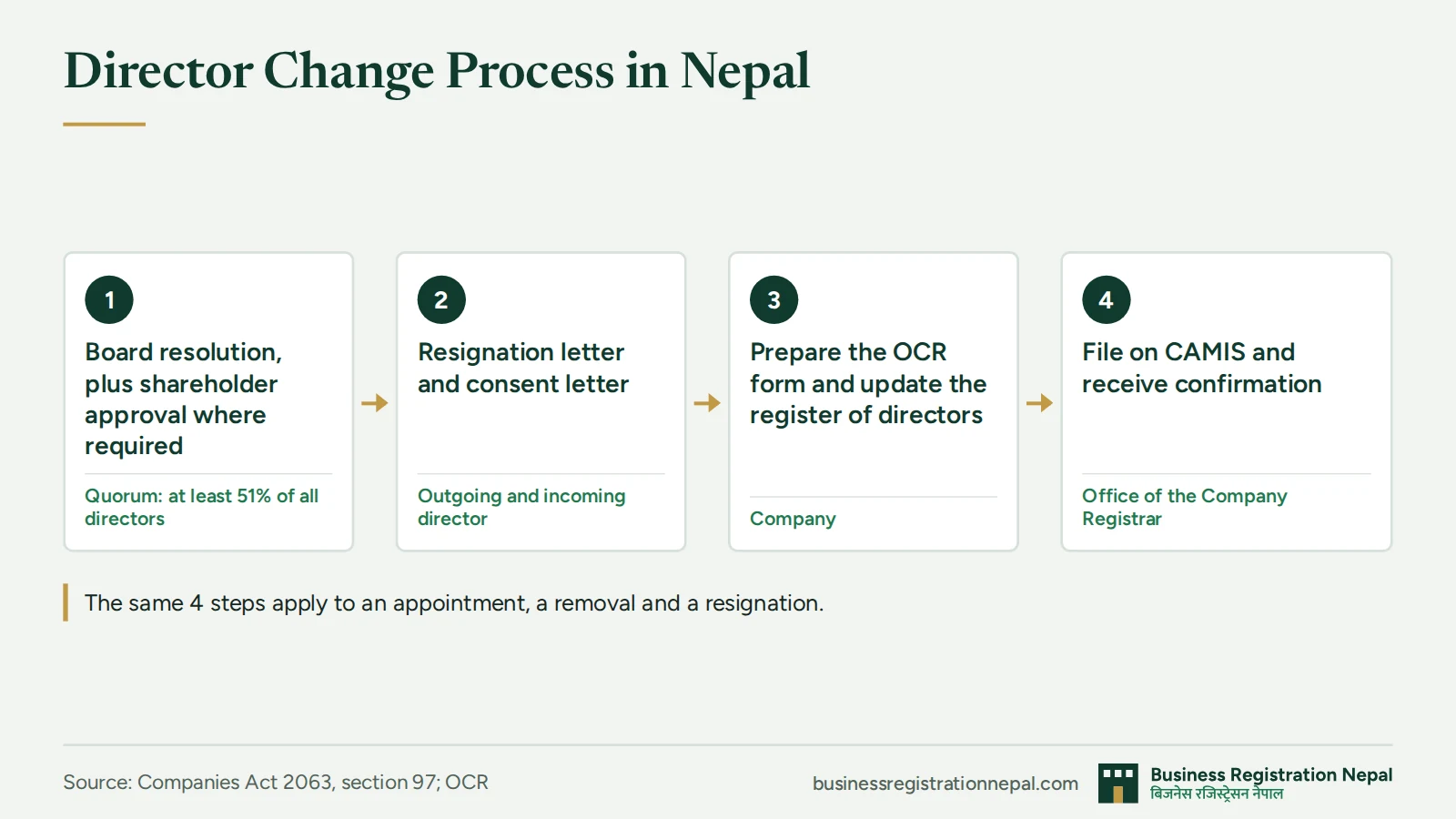
- Step 1: Pass the board resolution (and obtain shareholder approval where required). The BOD minutes record the resolution, and under Section 97 a board meeting needs a quorum of at least 51% of all directors. A general meeting resolution is added for an appointment or a removal.
- Step 2: Collect the resignation letter (outgoing) and consent letter (incoming). The outgoing director signs the resignation letter. The incoming director signs a consent letter, known as an acceptance letter, agreeing to serve on the board.
- Step 3: Prepare the director particulars and update the company records. The OCR prescribes the format on CAMIS. The form carries the details of each incoming and outgoing director, and the company updates its register of directors to match.
- Step 4: File the change with OCR on the CAMIS portal and receive confirmation. The Office of the Company Registrar (OCR), the government office that registers companies, runs CAMIS (Company Administration Management Information System) as its online portal.
To change a director in Nepal, a company completes the 4 steps in order, and each change of directorship ends with the Company Registrar's confirmation. Companies file with OCR on CAMIS and receive the updated director record on the same portal, where the company details show the new board.
What Documents Are Required for a Director Change?
The OCR file for a director change requires 5 documents, led by the certified resolution and the director particulars. The company uploads all 5 with its CAMIS filing to the OCR, and each document names the same outgoing and incoming directors.
0 of 5 ready
The certified resolution proves the company's decision, and the 2 letters prove each director's own act. Every name, address and ID number on the form matches the resolution and the identity document.
How Long Does It Take and When Must You File?
A director change in Nepal takes about 2 weeks, from the board resolution to the updated OCR record. The company files the change with the OCR soon after the decision, since a late notice draws a fine under Section 81 of the Companies Act 2063.
An appointment or a removal adds the time to call and hold a general meeting before the filing. A resignation needs no general meeting, because the board accepts it under Section 89 and the filing follows.
Under Section 92, a new director makes a written disclosure to the company within 15 days of assuming office. It covers any personal interest in company transactions, other directorships and share dealings. The company submits that disclosure to the OCR within 7 days of receiving it.
Can a Foreign-Owned Company Change Directors?
Yes, a foreign-owned company in Nepal changes directors through the same resolution and OCR filing as any other company. The passport and visa details of each foreign director match every document in the file, from the resolution to the consent letter.
Section 89 of the Companies Act 2063 lists no nationality bar, so a foreign national is eligible for the board. A foreign parent company holding shares appoints directors in proportion to its shareholding under Section 87, with alternate directors for meetings its nominees miss.
The Department of Industry (DOI), the authority that approves foreign investment, keeps the foreign party's passport or incorporation certificate in its approval file. The passport details on the OCR filing match that DOI file.
A foreign-owned company and its initial directors enter the OCR record through FDI and foreign company registration, with DOI approval before incorporation.
Frequently Asked Questions
Can a foreigner be a director in a Nepali company?
Yes, a foreign national serves as a director of a Nepali company, because Section 89 of the Companies Act 2063 sets no nationality bar. An FDI company names its foreign directors alongside the investment approval from the DOI.
What is the penalty for filing a director change late?
A late director change notice draws a fine under Section 81 of the Companies Act 2063, payable by the defaulting director or officer. For a notice outside the returns listed in Section 81, the 2074 text sets NPR 200 per month after one month past the deadline, and the OCR applies the rate in force on the filing date. The person pays the fine to the OCR and submits the overdue notice.
Does removing a director need shareholder approval?
Yes, removing a director needs a general meeting resolution of the shareholders under Section 89 of the Companies Act 2063. A resignation differs, because it takes effect when the board accepts it. The company then files either change with the Company Registrar.
Do I need to notify the bank after a director change?
Yes, the company notifies its bank after a director change, so the signatory mandate and the bank's records name the current board. A bank identifies a company through its registration document and director details, the same file built when opening a company bank account. The business record of the Inland Revenue Department (IRD) lists the Permanent Account Number (PAN) of every director, so the company asks its Inland Revenue Office to update the tax record as well.
What happens if a sole director resigns with no replacement?
A company whose sole director resigns appoints a replacement at a general meeting, so its board keeps the director count its articles require. Under Section 97, a board meeting needs at least 51% of all directors, so a company with no director passes no board resolution. That gap stalls the OCR returns and the bank mandate until the new director joins.
Is a resigned director still liable for acts during their tenure?
Yes, a resigned director remains answerable for decisions taken while in office. Resignation ends the office for the future and leaves earlier board decisions on the record. Under Section 97, the minute book records the directors present and each decision, so every resolution stays traceable to the directors who took it.