

An annual general meeting (AGM, वार्षिक साधारण सभा) is the mandatory yearly shareholders' meeting under the Companies Act 2063 where a company presents its audited accounts and takes key decisions. The annual general meeting process in Nepal binds every public company, and a private company follows its articles.
A public company holds each AGM within six months of fiscal year end, after 21 days' notice and with a quorum present. The shareholders approve the accounts and decide the dividend, auditor and directors. The AGM process runs in 6 steps:
- Step 1: Pass a board resolution to call the AGM.
- Step 2: Issue the notice and publish it.
- Step 3: Circulate the documents.
- Step 4: Convene the meeting and confirm the quorum.
- Step 5: Present the accounts and pass the resolutions.
- Step 6: Record the minutes.
The company files the AGM return with the Office of the Company Registrar (OCR) within 30 days. A missed AGM brings an OCR directive, a court petition and fines. Each AGM continues the compliance cycle that starts with company registration in Nepal.
What Is an Annual General Meeting (AGM) in Nepal?
Under the Companies Act 2063, an annual general meeting (AGM) is the yearly general meeting where a company's shareholders receive the audited accounts and decide its ordinary business. The AGM in Nepal carries the Nepali name Barshik Sadharan Sabha and the English name general body meeting.
The Act names 2 types of general meeting: the AGM and the extraordinary general meeting. Every shareholders' meeting is a general meeting, and the AGM is the one a company holds each year.
The AGM is where the board of directors accounts to the owners. The directors present the financial statements and reports, and the shareholders vote on the dividend, the directors and the auditor by resolution.
Is an AGM Mandatory in Nepal?
Yes, an AGM is mandatory for every public company in Nepal, every year, under the Companies Act 2063. A private company holds its general meetings in the way its articles of association or its consensus agreement provides.
The Office of the Company Registrar (OCR), the government office that registers companies, confirms that a private company runs its general meeting under its articles. The articles of association (AOA) are the company's internal rulebook, and a consensus agreement is the written agreement among a private company's shareholders.
The AGM for a private company in Nepal falls back on the Act's general-meeting provisions where neither document covers a matter. The private company still decides its own quorum, because the Act leaves that figure to the articles.
When Must a Company Hold Its AGM?
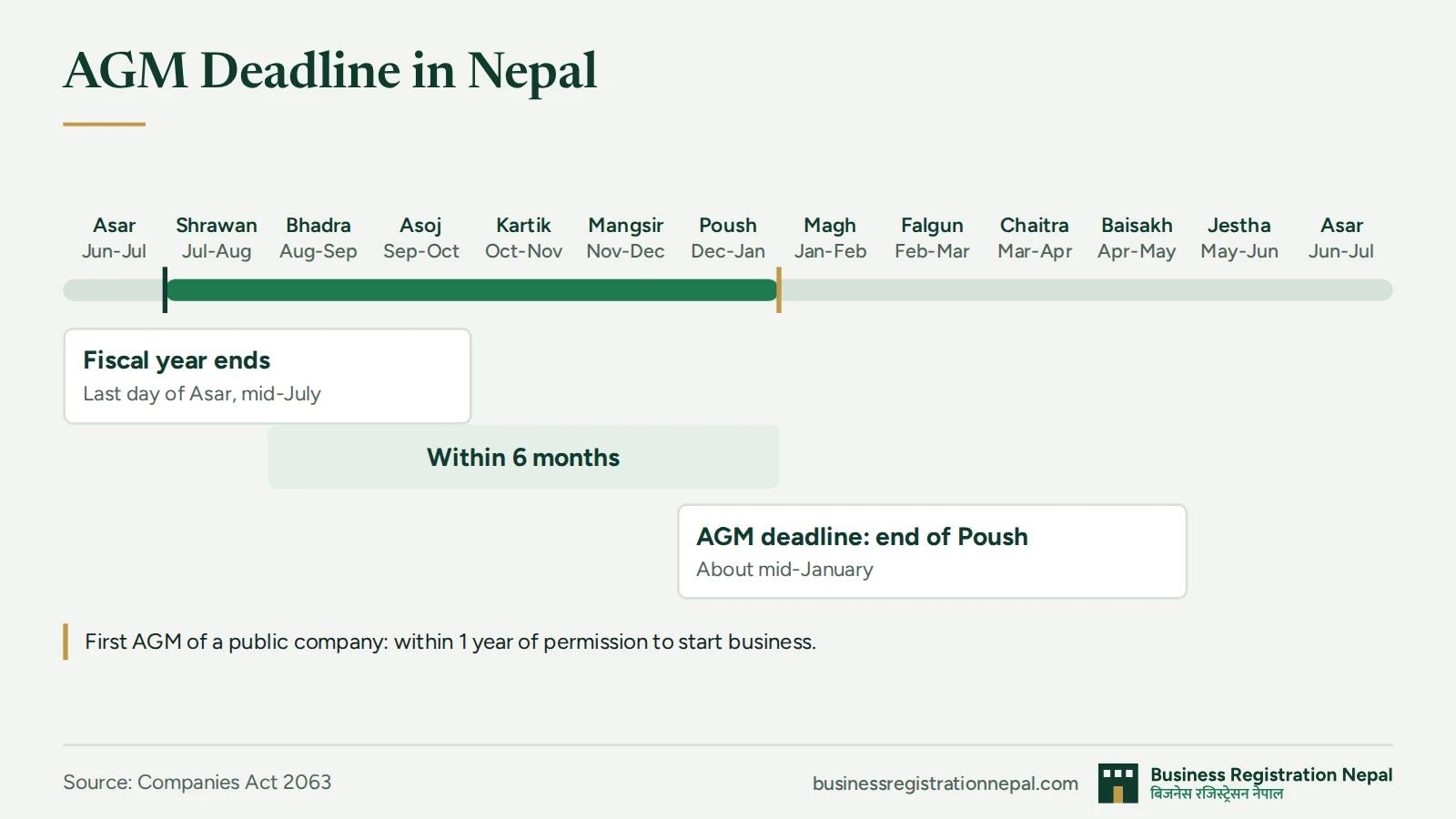
A public company holds its initial AGM within one year of receiving permission to start business, then each AGM within six months of fiscal year end. This AGM deadline in Nepal comes from the Companies Act 2063, and the OCR applies it to every public company.
The permission to start business is the certificate to commence business, which the OCR grants once shareholders pay the share capital. The one-year clock for the initial AGM runs from that certificate, not from incorporation.
Nepal's fiscal year, or financial year, runs from Shrawan to Asar and ends in mid-July. A fiscal year that ends on the last day of Asar gives an AGM deadline at the end of Poush, in mid-January. A private company follows the timing its articles or consensus agreement set.
What Are the Notice and Quorum Rules for an AGM?
Every public company gives shareholders at least 21 days' written notice of an AGM, published twice in a national daily, and opens the meeting only with a quorum present. A private company sets both rules in its articles.
Under the Companies Act 2063, the meeting notice states the place, date and agenda of the AGM. That 21 days notice period is the AGM notice period in Nepal for a public company, and an extraordinary general meeting needs 15 days. A quorum is the minimum attendance a general meeting needs before it decides anything.
The table compares the AGM rules in Nepal's Companies Act for public and private companies on 5 points.
| Rule | Public company | Private company |
|---|---|---|
| AGM notice | Written notice at least 21 days before the meeting | As the articles or consensus agreement provide |
| Extraordinary general meeting notice | At least 15 days before the meeting | As the articles or consensus agreement provide |
| Newspaper publication | At least twice in a national daily | As the articles or consensus agreement provide |
| Quorum | At least 3 shareholders holding more than 50% of the allotted shares, in person or by proxy, unless the articles set more | As the articles specify |
| Meeting called again after a failed quorum | At least 7 days' notice; 3 shareholders holding 25% of the allotted shares form the quorum | As the articles specify |
A private company records these rules in its articles, and the Companies Act 2063 governs any point its articles leave open.
What Is Decided at an AGM?
An AGM decides 5 standard agenda items, from the audited accounts to the election of directors. Under the Companies Act 2063, the directors present the accounts and reports, and the shareholders approve each item by resolution.
- Adoption of the audited financial statements and directors' report
- The auditor's report, which the statutory audit in Nepal produces before the AGM
- Appointment of the auditor and fixing remuneration
- Declaration of dividend
- Election of directors
Shareholders holding at least 5% of the votes add an item by applying to the directors before the notice goes out. The dividend declaration never exceeds the rate the board of directors proposes. The minutes record every decision, from the appointment of auditor to the director election.
What Is the AGM Process Step by Step?
The AGM process in Nepal runs in 6 steps, from the board resolution that calls the meeting to the minutes that record its decisions. The board of directors drives each step under the Companies Act 2063 until the shareholders vote.
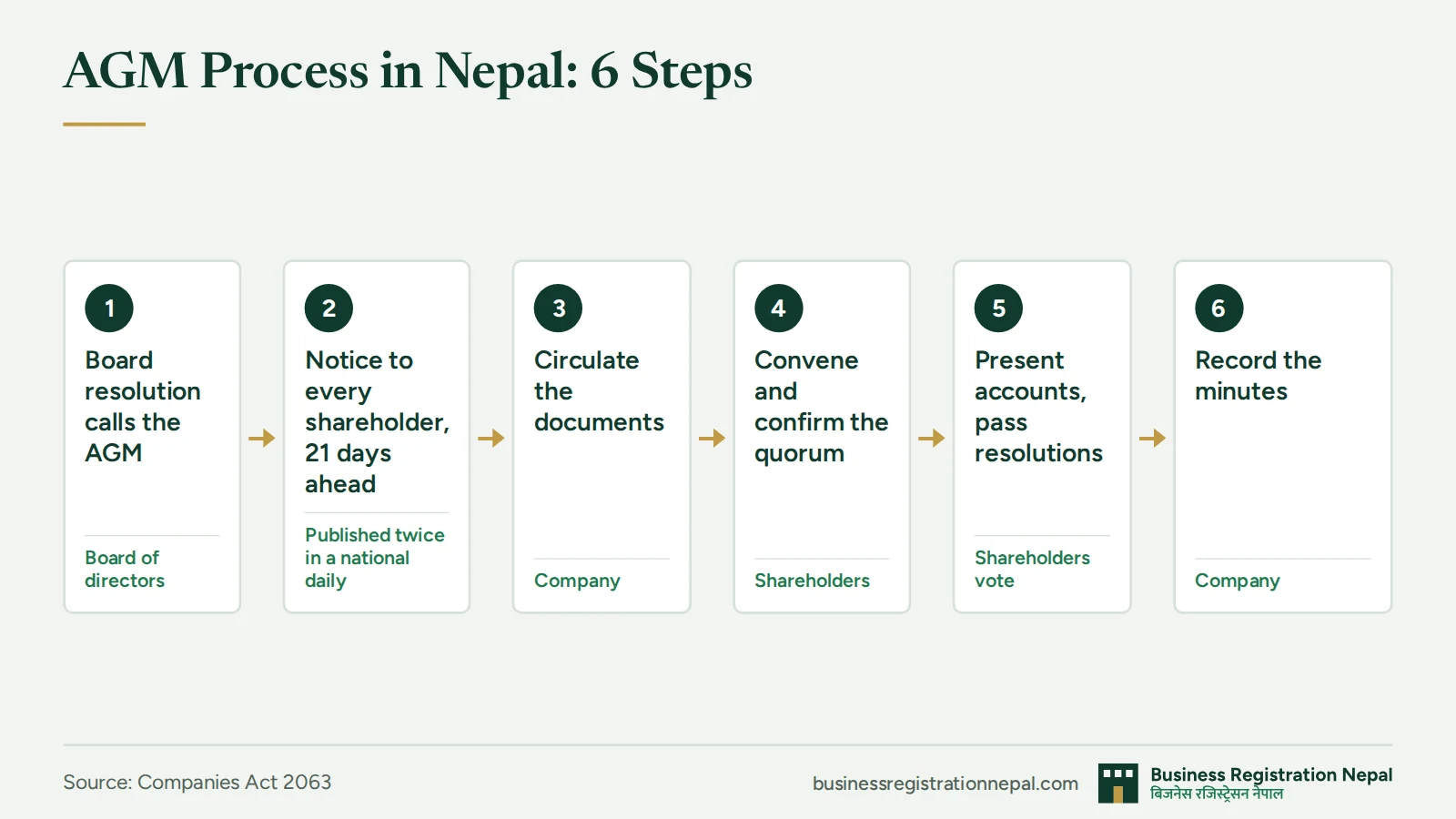
- Step 1: Pass a board resolution to call the AGM. The board of directors fixes the date, venue and agenda. It approves the report a public company submits to the OCR at least 21 days before the meeting.
- Step 2: Issue the notice and publish it. A public company uses the notice to notify every shareholder in writing at least 21 days ahead, and publishes it twice in a national daily.
- Step 3: Circulate the documents. A public company keeps the audited financial statements, directors' report, auditor's report and proposed resolutions open for inspection at its registered office for 21 days. Special resolutions travel with the notice.
- Step 4: Convene the meeting and confirm the quorum. The chairperson opens business only after the required shareholders are present in person or by proxy.
- Step 5: Present the accounts and pass the resolutions. The shareholders approve the accounts, declare any dividend, appoint the auditor and elect directors, with one vote for each share.
- Step 6: Record the minutes. The minutes, the formal meeting record, capture each resolution the AGM passes.
The annual general meeting, Nepal's yearly shareholders' meeting, closes with these minutes. The resolutions and attendance figures then feed the filing the Office of the Company Registrar receives after the AGM.
What Must Be Filed After the AGM?
After the AGM, the company submits an AGM return to the OCR within 30 days, carrying the attendance, the accounts, the reports and the resolutions. Section 80 of the Companies Act 2063 sets this deadline for every company that holds an AGM.
Under section 80(1) of the Act, the AGM return carries 5 items:
- Number of shareholders present at the meeting
- Number of directors who attended by video conference or similar technology
- Annual financial statements
- Board of directors' report and auditor's report
- Copy of the resolutions the AGM passed
Under section 80(3), a company uploads these returns to the OCR computer system, and the OCR keeps them in the company's electronic record. Section 80(2) adds a separate duty: every company files audited annual financial statements with the auditor's report within six months of fiscal year end.
The AGM filing comes before the yearly company renewal (Adyawadik), the annual update of the company's details at the OCR.
What Happens If a Company Does Not Hold an AGM?
A company that does not hold its AGM faces 3 escalating consequences: an OCR directive, a shareholder petition to the court and fines. The fines rise with the company's paid-up capital and with the length of the delay.
The OCR directs the company to hold the overdue meeting. A shareholder then petitions the court to order the AGM when the company still does not act.
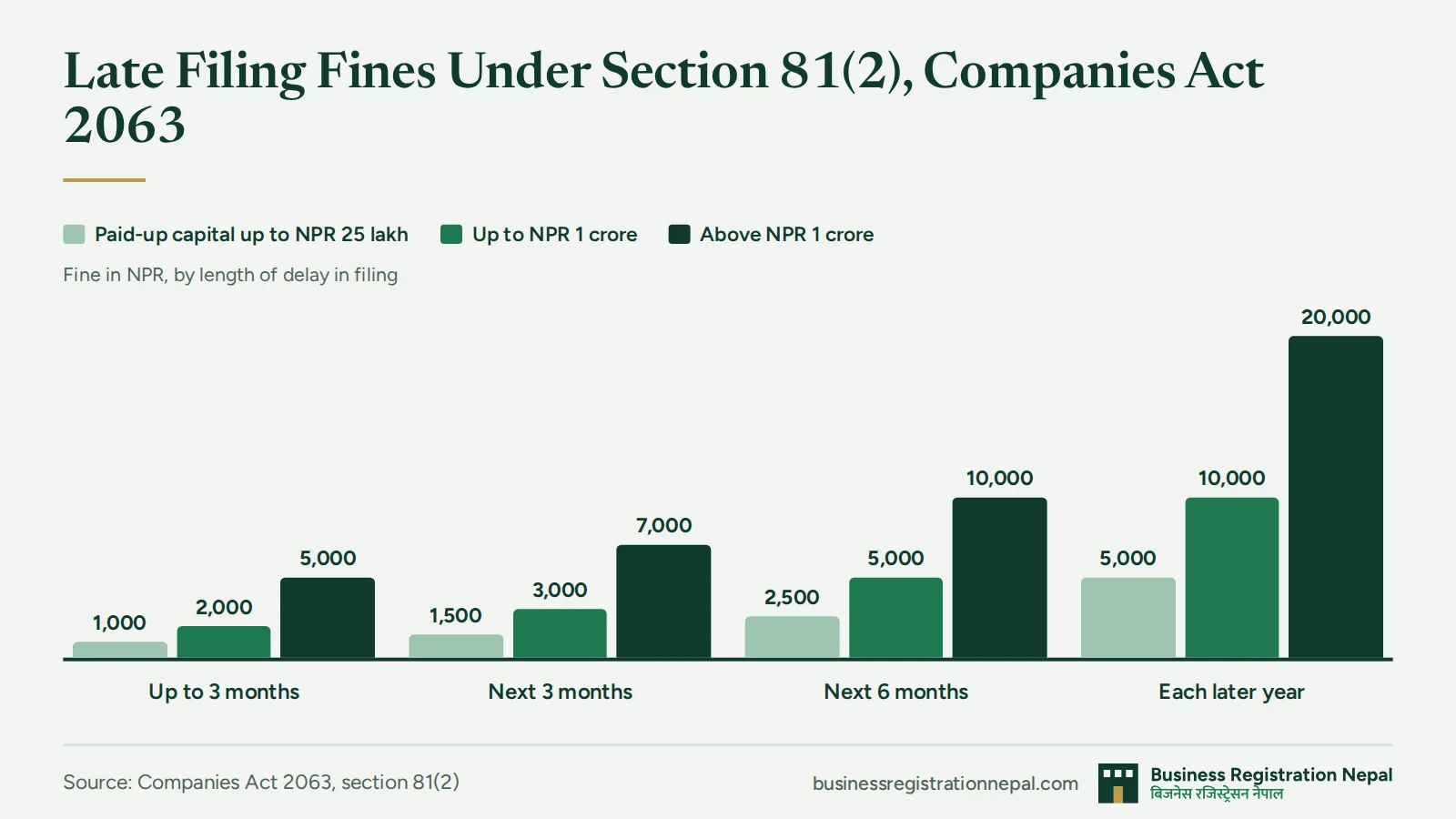
Under section 81(2) of the Companies Act 2063, the directors or officers responsible for a late return pay a fine. The OCR applies that section to late AGM filings.
The table shows the section 81(2) fine in NPR by length of delay and paid-up capital.
| Delay in filing | Paid-up capital up to NPR 25 lakh | Up to NPR 1 crore | Above NPR 1 crore |
|---|---|---|---|
| Up to 3 months | NPR 1,000 | NPR 2,000 | NPR 5,000 |
| The next 3 months | NPR 1,500 | NPR 3,000 | NPR 7,000 |
| The next 6 months | NPR 2,500 | NPR 5,000 | NPR 10,000 |
| Each year after that | NPR 5,000 per year | NPR 10,000 per year | NPR 20,000 per year |
A profit-not-distributing company pays the rate for paid-up capital up to NPR 1 crore. The fine goes to the OCR together with the overdue return.
Frequently Asked Questions
Can an AGM be held virtually or online in Nepal?
Yes, directors attend an AGM in Nepal by video conference or similar technology under the Companies Act 2063, as amended in 2074. The AGM return filed with the OCR states the director attendance by video conference. Online attendance and voting by shareholders follows the company's articles and current OCR rules, so a company confirms the OCR's position before it holds a fully virtual meeting.
What is the difference between an AGM and an extraordinary general meeting?
An AGM is the yearly general meeting for routine business, and an extraordinary general meeting (EGM) meets as needed for a special matter between AGMs. The board of directors calls an EGM, and shareholders holding 10% of the paid-up capital or 25% of all shareholders requisition one. A public company gives 15 days' notice of an EGM against 21 days for an AGM.
When must a newly registered company hold its first AGM?
A newly registered public company holds its initial AGM within one year of receiving the OCR's permission to start business. The clock runs from that certificate to commence business, not from the incorporation date. A private company follows the timing in its articles of association or consensus agreement.
Is the auditor appointed or reappointed at the AGM?
Yes, the AGM appoints or reappoints the auditor for the year and fixes the auditor's remuneration under the Companies Act 2063. A private company appoints its auditor as its MOA, AOA or consensus agreement provides, and otherwise through the general meeting. The company reports the auditor appointment to the OCR within 15 days, and the audit explained guide for Nepal describes the audit that follows.
Can a shareholder vote at an AGM by proxy?
Yes, a shareholder appoints a proxy to attend and vote at an AGM unless the company's articles of association prohibit proxies. Under the Companies Act 2063, the shareholder signs an instrument of proxy in the prescribed format. The proxy casts one vote for each share and counts toward the quorum.
Can the AGM deadline be extended?
Yes, the OCR extends a public company's AGM deadline by up to 3 months when the company applies with a reasonable cause. The application explains why the meeting cannot take place within six months of fiscal year end. The company files it with the company registrar before that limit passes.