

Auditing is the independent examination of a company's financial statements to confirm that they give a true and fair view. Auditing in Nepal has 3 headline types: the statutory audit, the internal audit and the tax audit.
The difference lies in the reader: shareholders, management or the IRD. An annual audit is mandatory under the Companies Act 2063 for every company, whatever its size or turnover. The audit process runs in 7 steps, from auditor appointment to filing with the OCR and the IRD, and requires 8 sets of documents.
The audit report carries 1 of 4 opinions: unmodified, qualified, adverse or disclaimer. Only an ICAN member with a Certificate of Practice performs the audit. The fee follows the ICAN Minimum Fee Guidelines 2078 and depends on size, turnover, complexity and time.
The Companies Act 2063, the Income Tax Act 2058, the Nepal Chartered Accountants Act 2053, the NSA and the NFRS govern auditing. Each company audit follows company registration in Nepal, the step that creates the company and its books of account. Chartered accountants (Member, ICAN) reviewed this explanation.
What Is an Audit in Nepal?
An audit in Nepal is an independent examination of a company's financial statements that gives an opinion on whether they show a true and fair view. Auditing serves 2 aims: its objectives for readers of the accounts and its advantages for the company.
Under the Companies Act 2063, the board approves the annual financial statements and an auditor audits them. The auditor follows the Nepal Standards on Auditing (NSA) and tests the accounts against the Nepal Financial Reporting Standards (NFRS).
Auditing is about checking records, while accounting and bookkeeping services maintain the ledgers that the independent auditor examines each fiscal year.
What Are the Objectives of an Audit?
An audit pursues 4 objectives, each tied to the reliability of the financial statements:
- Confirm that the financial statements give a true and fair view.
- Detect and prevent error and fraud in the accounts.
- Check compliance with the Companies Act 2063, tax law and the accounting standards.
- Add credibility for lenders, investors and the Inland Revenue Department (IRD).
Under Section 115 of the Companies Act 2063, the audit report states whether the books were properly kept and whether any accounting fraud took place. Those statements put the 4 objectives in writing.
What Are the Advantages of Auditing for a Company?
The advantages of auditing for a company are 6, and each grows from the independent opinion on its accounts:
- Credibility with banks and investors, who rely on transparent, audited accounts before they commit funds.
- Access to loans, since lenders assess audited financial statements.
- Tax assessment on a reliable basis, as the IRD examines audited figures.
- Fraud deterrence, because staff know an auditor examines transactions.
- Control improvements, as the management letter, the auditor's written list of control weaknesses, strengthens internal controls.
- Annual compliance that runs smoother with the Office of the Company Registrar (OCR) and the IRD.
Every advantage rests on the auditor's independence from the management that prepared the accounts.
Types of Audit in Nepal
A Nepali company meets 3 headline types of audit: the statutory audit, the internal audit and the tax audit. The 3 types differ by who orders the audit, who performs it and which law governs it.
Seven specialised types of company audit serve narrower purposes, from fraud investigation to stock verification.
Statutory Audit
A statutory audit is the mandatory annual external audit of a company's financial statements under the Companies Act 2063. Accountants in Nepal call it the external audit, the annual audit or the final audit.
The auditor is an independent ICAN-licensed chartered accountant, meaning a member of the Institute of Chartered Accountants of Nepal (ICAN) who holds a Certificate of Practice. The general meeting, or a private company's articles, appoint the auditor, who reports to the shareholders.
The company files the audited financial statements with the OCR and the IRD. Each fiscal year's audited accounts come from the statutory audit in Nepal, which ends with the auditor's signed report.
Internal Audit
An internal audit is an ongoing review of a company's internal controls, risk management and operations that management or the board appoints. It reports to the board, its audit committee or management, not to the shareholders.
Internal audit is not mandatory for every company, unlike the external statutory audit. Section 164 of the Companies Act 2063 requires an audit committee in 2 kinds of company.
A listed company with paid-up capital of NPR 30 million or more forms one, and so does a company fully or partly owned by the Government of Nepal. A director outside day-to-day operations chairs that committee of at least 3 members.
Tax Audit
A tax audit is an examination of a taxpayer's income and records for compliance with the Income Tax Act 2058, carried out for the Inland Revenue Department. It stands apart from the statutory audit, which reports to shareholders under the Companies Act 2063.
Under Section 96 of the Income Tax Act 2058, the income-tax return reaches the IRD within three months of the end of the income year. A company files that return on the audited figures from its statutory audit, which applies whatever the turnover. Accurate, audited figures keep the return compliant with the law.
Besides the 3 headline types, a Nepali business meets 7 specialised audit types, each with one purpose:
- Compliance audit - adherence to specific laws, regulations and industry standards
- Performance audit - efficiency, effectiveness and resource use of operations
- Forensic audit - investigation of fraud or financial irregularities
- Information system (IS) audit - IT systems, data security and information management
- Stock (inventory) audit - physical verification of stock and inventory
- Due diligence audit - review before investment or acquisition
- Management and cost audit - operational and cost controls
A company orders a specialised audit for one need, such as a due diligence audit before an acquisition or a forensic audit after suspected fraud.
Statutory Audit vs Internal Audit vs Tax Audit: What Is the Difference?
The difference lies in purpose and reader: a statutory audit serves shareholders, an internal audit serves management, and a tax audit serves the IRD. Only the statutory audit is a mandatory external audit under the Companies Act 2063.
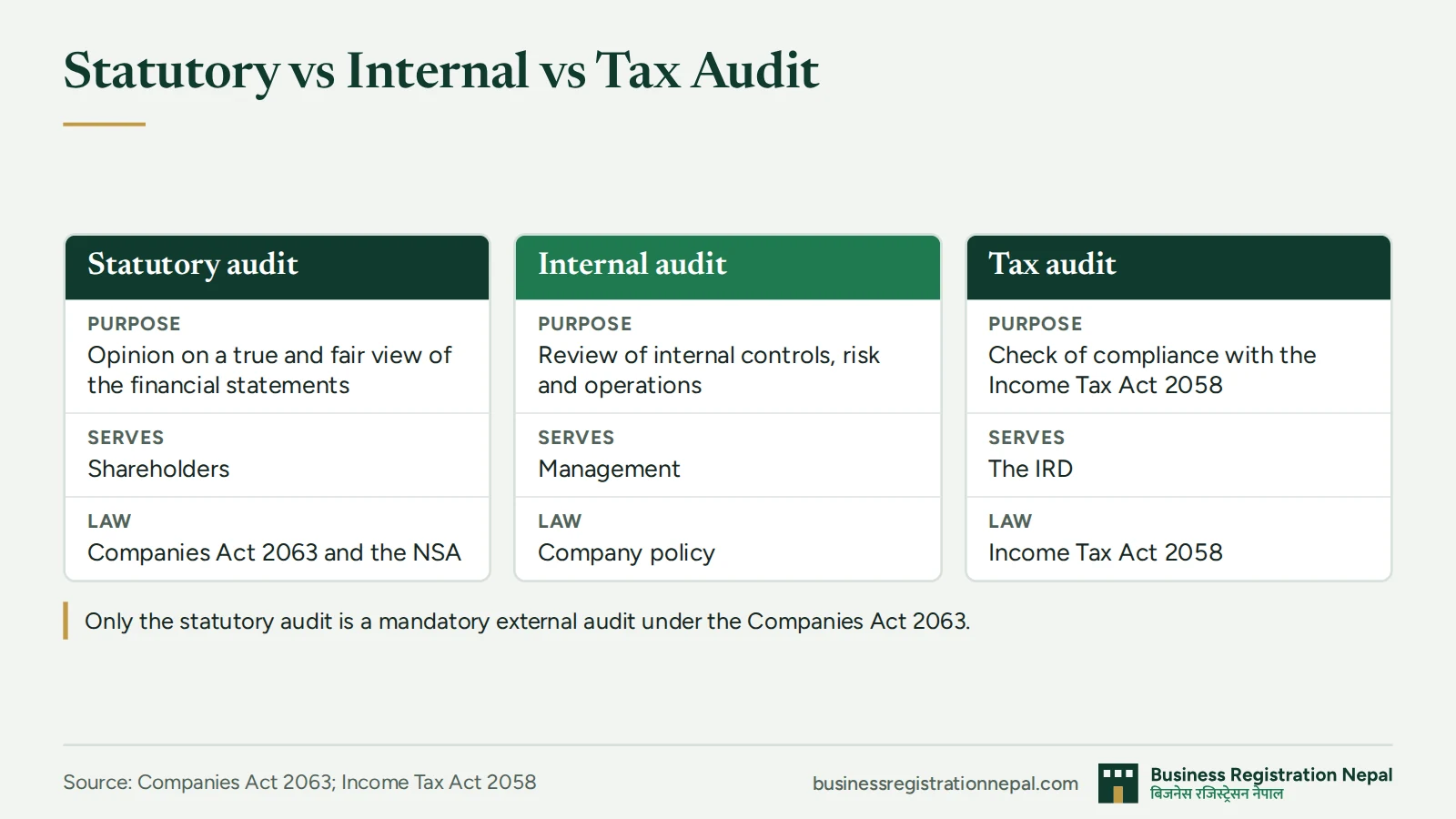
The difference between internal and external audit starts with independence, since the external auditor reports to the owners. The table compares the 3 audits on 8 attributes.
| Attribute | Statutory audit | Internal audit | Tax audit |
|---|---|---|---|
| Purpose | Opinion on whether the financial statements give a true and fair view | Review of internal controls, risk and operations | Check of compliance with the Income Tax Act 2058 |
| Mandatory | Yes, under the Companies Act 2063 | Not for every company | Only when the IRD selects the taxpayer for examination |
| Who performs it | Independent ICAN-licensed auditor | Reviewer appointed by management or the board | Tax officers of the IRD |
| Who appoints it | General meeting, or the board before the initial annual general meeting (AGM) | Management or the board | The IRD selects the taxpayer on risk-based criteria, such as return discrepancies, sector risk and compliance history |
| Frequency | Every fiscal year | Ongoing through the year | Per income year, when the IRD examines a return |
| Report goes to | Shareholders, then the OCR and the IRD | Board, audit committee or management | IRD |
| Governing law | Companies Act 2063 and the NSA | Company policy; Section 164 audit committee rule for listed companies | Income Tax Act 2058 |
| Output | Independent auditor's report with an audit opinion | Internal audit report with recommendations | Findings on the tax return |
In the internal vs external audit split, the statutory audit is the external audit the Companies Act 2063 requires, while internal audit and tax audit answer to management and the IRD.
Is an Audit Mandatory for Companies in Nepal?
Yes, an audit is mandatory for companies in Nepal, because the Companies Act 2063 requires the board-approved annual financial statements to be audited. A licensed auditor conducts that audit each fiscal year.
A company registered in Nepal meets these company audit requirements from its opening fiscal year onward. No small-company exemption applies: Nepali law does not free a company from the audit by turnover or staff numbers.
The statutory mandate stands apart from the Income Tax Act 2058, whose tax audit and turnover rules serve the IRD.
Which Companies Must Be Audited in Nepal?
The companies and bodies that must be audited in Nepal fall into 6 groups, which answers who needs a statutory audit:
- Private limited companies - every fiscal year
- Public limited and listed companies
- FDI / foreign-investment companies. A company formed through FDI and foreign company registration audits its accounts under the same Companies Act 2063 rule.
- NGOs and INGOs, which submit audited accounts to their registering office, and to the Social Welfare Council for foreign-funded work. An organisation formed through NGO registration in Nepal follows the audit rules of its registering office.
- Banks and financial institutions (NRB-regulated). Nepal Rastra Bank (NRB), the central bank, licenses and regulates them.
- Cooperatives, audited each year under the Cooperative Act 2074
Private and public companies take the audit rule from the Companies Act 2063, while banks, NGOs and cooperatives add rules from their own regulators.
Is There an Audit Turnover Threshold in Nepal?
No, not for a company: Nepali law sets no turnover point below which a company skips the audit. The Companies Act 2063 audit rule applies to every company each fiscal year, and the company files its income-tax return on the audited figures.
Turnover limits in Nepali law serve other purposes, such as the choice of accounting standards, and do not decide whether a company is audited.
Section 109 of the Companies Act 2063 names paid-up capital of NPR 10 million or annual turnover of NPR 100 million. That figure decides which private companies prepare the detailed board report, not which companies skip the audit.
How Does the Company Audit Process Work in Nepal?
To audit a company in Nepal, the company and its auditor complete 7 steps, from auditor appointment to filing with the OCR and the IRD. The company audit process in Nepal follows the Companies Act 2063 and the NSA.
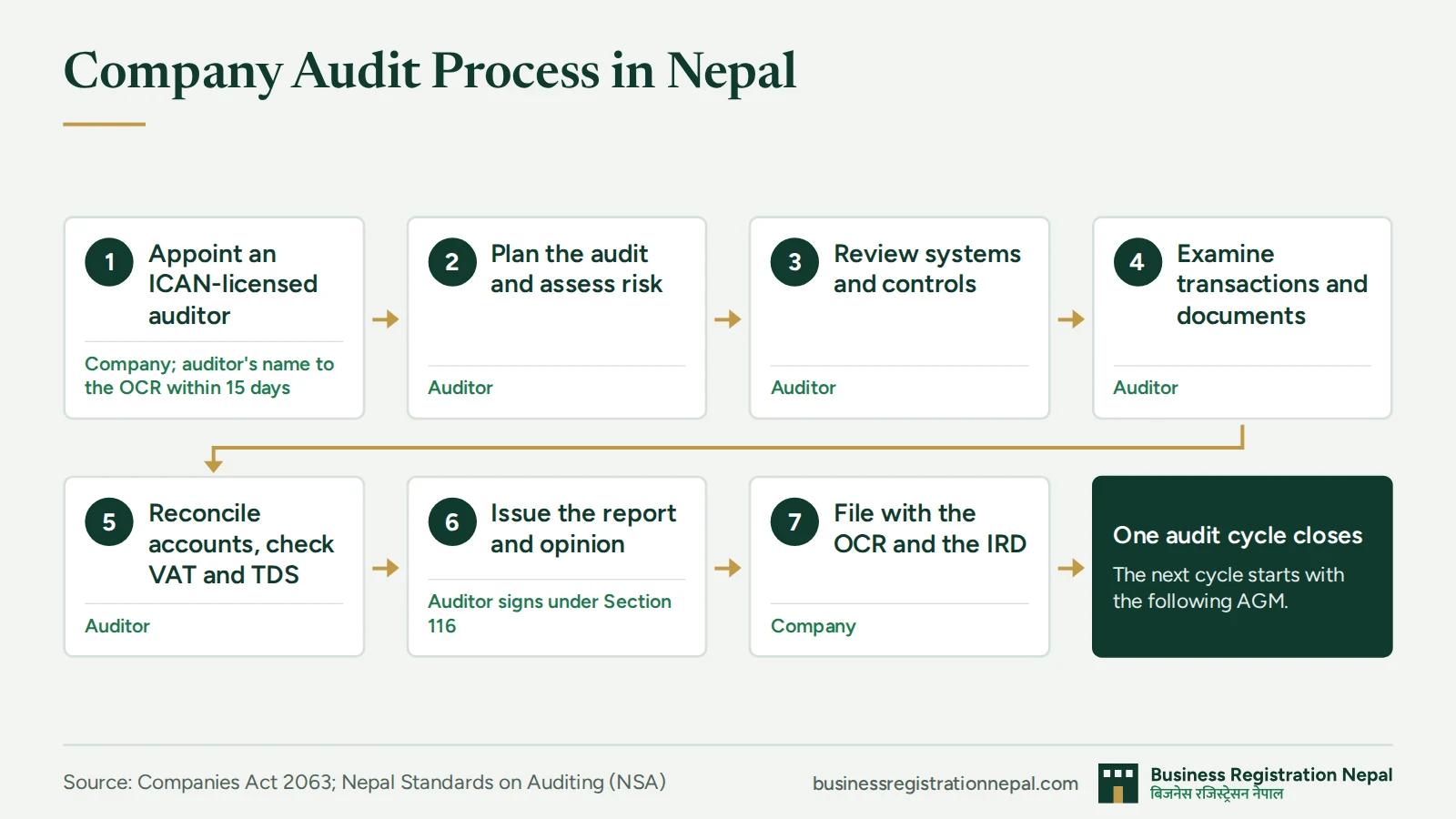
- Step 1: Appoint an independent ICAN-licensed auditor (at the AGM, or by the board before the initial AGM under Section 111 of the Companies Act 2063). The company reports the auditor's name to the OCR within 15 days. Each audit appointment runs until the next annual general meeting, the shareholders' yearly meeting covered in AGM in Nepal.
- Step 2: Plan the audit and assess risk. The auditor agrees the engagement terms, sets materiality, meaning the size of error that would change a reader's decision, and plans the fieldwork.
- Step 3: Review accounting systems and internal controls. The auditor evaluates how transactions are recorded and approved, scrutinizes each control and notes every weakness for the management letter.
- Step 4: Examine transactions and verify supporting documents. The auditor's inspection covers the invoices, contracts and bank records behind sample entries. The evidence goes into the working papers, the auditor's file of audit evidence.
- Step 5: Reconcile accounts and check tax compliance (VAT and TDS). The auditor matches the ledger, the trial balance and bank balances. Value added tax (VAT) and tax deducted at source (TDS) records are checked against the returns filed.
- Step 6: Issue the audit report and opinion (true and fair view). Under Section 116 of the Companies Act 2063, the auditor signs and dates the report that expresses the opinion.
- Step 7: File audited financial statements with OCR and IRD. A private company submits them to the OCR within six months of fiscal year end. The audited accounts then form part of annual compliance and filings each year.
The signed report and the filed statements close one audit cycle, and the next cycle starts with the following AGM. Under Section 81 of the Companies Act 2063, a return or notice that reaches the OCR late draws a penalty, and the fine rises with paid-up capital and the length of the delay.
What Documents Are Required for a Company Audit?
A company audit requires 8 sets of records, from the financial statements to the board and AGM minutes. The company hands them to its auditor before fieldwork starts, and the auditor tests each entry against them.
The 8 sets of documents required for a company audit are:
0 of 8 ready
Under Section 108 of the Companies Act 2063, the company keeps its books in Nepali or English, on the double-entry system, at its registered office. The directors hold final responsibility for maintaining those books.
What Is an Audit Report and What Do the Opinions Mean?
An audit report, or independent auditor's report, is the auditor's signed opinion on whether the financial statements show a true and fair view. Its opinion falls into 4 types, and its contents follow a set structure.
In Nepali, the audit report is the लेखापरीक्षण प्रतिवेदन (Lekhaparikshan Pratibedan). Under Section 115 of the Companies Act 2063, the auditor addresses it to the shareholders. The report covers the balance sheet, the profit and loss account and the cash flow statement.
What Are the Types of Audit Opinion?
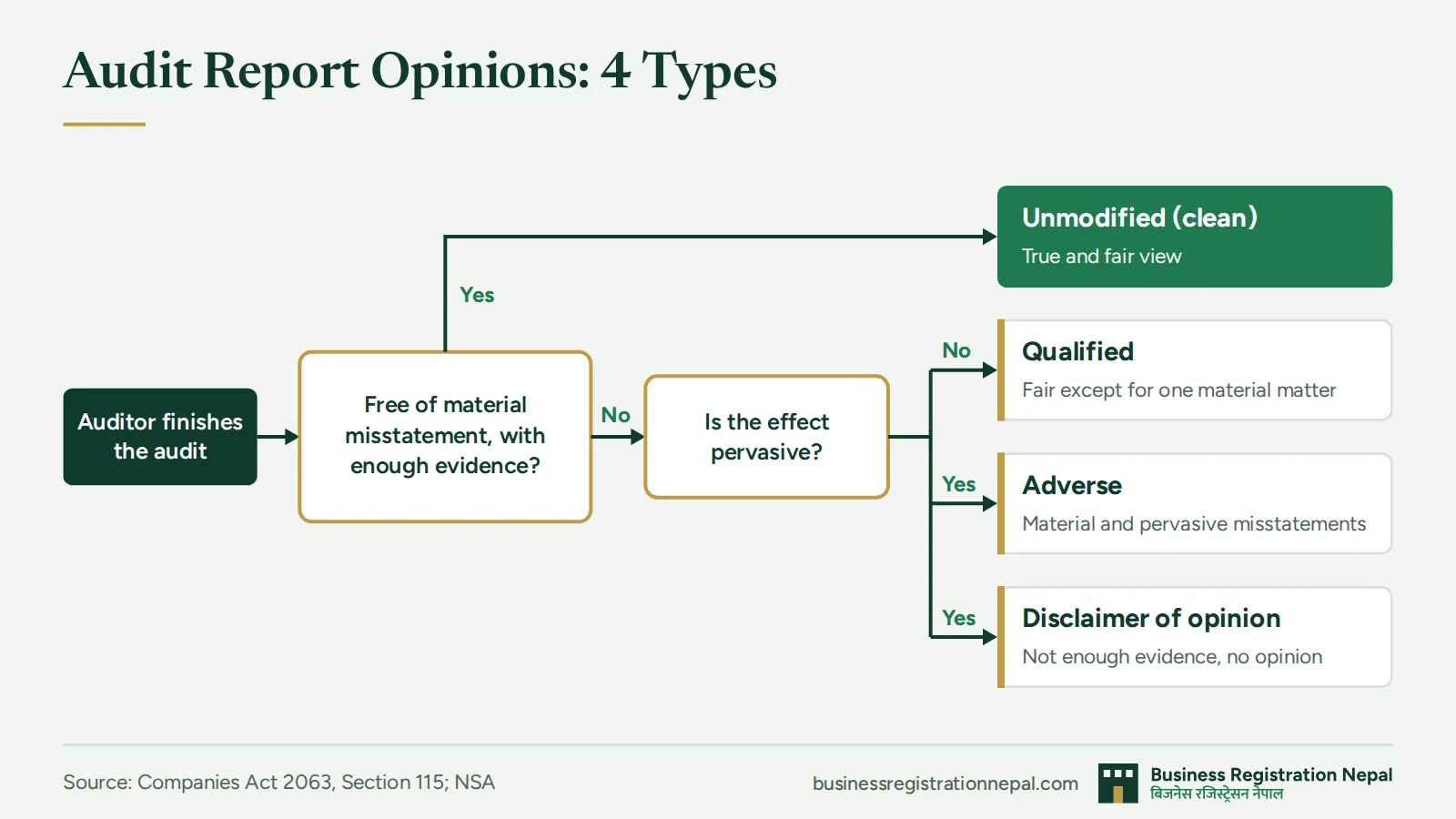
An auditor issues one of 4 types of audit opinion, and each tells a reader how far the financial statements are reliable:
- Unmodified (clean) opinion: an unmodified opinion states that the financial statements give a true and fair view in all material respects. Accountants call it a clean opinion or an unqualified opinion.
- Qualified opinion: the statements are fair except for one material matter, which the auditor names in the basis for opinion.
- Adverse opinion: the misstatements are material and pervasive, so the statements do not give a true and fair view.
- Disclaimer of opinion: the auditor lacks enough evidence and expresses no opinion.
Qualified, adverse and disclaimer opinions are modified audit opinions. Each tells banks, investors and the IRD to weigh the named issue before relying on the accounts.
What Does an Audit Report Include?
10 elements make up an audit report under the Nepal Standards on Auditing and Section 115 of the Companies Act 2063:
- Title, such as "Independent Auditor's Report"
- Addressee, the shareholders of the company
- Opinion, stating the opinion type
- Basis for opinion, citing the NSA and the auditor's independence
- Management's responsibilities for the financial statements
- Auditor's responsibilities for the audit
- Signature of the auditor, or of the audit firm's authorised member under Section 116
- Date of the report
- UDIN, the Unique Document Identification Number that ICAN issues under its UDIN By-Laws
- Attached audited financial statements: the balance sheet, profit and loss account, cash flow statement and notes
Section 115 adds 7 statements to the report. They cover the information obtained, proper books, compliance with accounting standards, the financial position, unlawful acts or loss by officers, accounting fraud and the auditor's suggestions.
The audited financial statements, or audited accounts, travel with the report to the OCR.
The official audit report sample is the illustrative auditor's report in the Nepal Standards on Auditing, which ICAN publishes on its website: NSA 700 (Revised), Forming an Opinion and Reporting on Financial Statements. An audited financial statements sample follows the presentation formats in the standards the Accounting Standards Board publishes on asbnepal.gov.np.
Who Can Perform an Audit in Nepal?
Only an independent ICAN member holding a Certificate of Practice, either a chartered accountant or a registered auditor, can audit a company in Nepal. The auditor works alone or through a registered audit firm.
Section 29 of the Nepal Chartered Accountants Act 2053 settles who can perform audit in Nepal: no one undertakes audit business without a Certificate of Practice. Section 16 of that Act divides ICAN membership into 2 classes: the chartered accountant and the registered auditor with a class B, C or D licence.
An audit firm in Nepal is a firm that Certificate of Practice holders register with ICAN under Section 28a. ICAN then issues a Certificate of Firm Registration. Under Section 116 of the Companies Act 2063, an individual practitioner signs audit reports personally, and a firm's authorised member signs for the audit firm.
Section 112 of the Companies Act 2063 keeps the auditor independent. The disqualified group includes the company's managers and their relatives, its debtors, holders of 1% or more of its shares and people with audit-related convictions within 5 years.
An audit by a disqualified auditor is invalid, and each auditor declares in writing that they qualify before appointment. A public company rotates its auditor after 3 consecutive terms under Section 111, and the bar extends to the auditor's partners and employees.
How Are Audit Fees Determined in Nepal?
The appointing authority sets the audit fee, within the ICAN Minimum Fee Guidelines 2078, and the fee rises with the entity's size, turnover, complexity and audit time. Under Section 118 of the Companies Act 2063, the company bears the auditor's remuneration.
ICAN's directive, formally the Directive Regarding Audit Firm Quality Guideline and Minimum Audit Fee, 2078, sets the minimum audit fee ICAN members charge. The directive took effect on 16 July 2021. Commentators differ on whether it binds members or only recommends a floor, since an earlier Supreme Court decision treated ICAN-prescribed minimum fees as against competition and freedom of contract.
Each audit fee in Nepal reflects 4 factors: entity size, turnover, the complexity of transactions and the hours the engagement takes. ICAN's Guidelines on Marketing Professional Services bar members from displaying fees, so an auditor quotes the fee after reviewing the company's records.
Which Laws Govern Auditing in Nepal?
Auditing in Nepal follows 3 Acts and 2 sets of standards: the Companies Act 2063, the Income Tax Act 2058, the Nepal Chartered Accountants Act 2053, the NSA and the NFRS. Each one governs a different part of the audit.
The 5 sources divide the audit rules as follows:
- Companies Act 2063: the company statutory audit, auditor appointment, disqualification, removal and the audit report.
- Income Tax Act 2058: the tax audit and the income-tax return filed with the IRD.
- Nepal Chartered Accountants Act 2053: ICAN, its membership classes and the Certificate of Practice that decides who audits.
- Nepal Standards on Auditing (NSA): how the auditor plans, performs and reports, issued by the Standards on Auditing Board.
- Nepal Financial Reporting Standards (NFRS): how the company prepares the statements, issued by the Accounting Standards Board.
The Audit Act 2075 governs a different audit, carried out by the Auditor General. It covers government offices and corporate bodies wholly owned by the federal, provincial or local government, not a private company.
The audit and accounts provisions form one part of the Act outlined in Companies Act 2063 key highlights.
Frequently Asked Questions
What is the difference between an audit, a review and an assurance engagement?
An audit gives reasonable assurance through detailed testing, a review gives limited assurance through analysis and enquiry, and an assurance engagement is the wider family both belong to. An audit ends in a positive opinion on the true and fair view. A review ends only in a statement that nothing suggests a material misstatement.
Are there auditor rotation or tenure limits in Nepal?
Yes, a public company in Nepal cannot appoint the same auditor for more than 3 consecutive terms, under Section 111 of the Companies Act 2063. The bar covers the auditor's partners and employees, unless they left the auditor at least 3 years earlier. Each term runs only until the next AGM, and Section 111 sets no rotation limit for a private company. A sector regulator can add its own rotation rule for the entities it licenses.
How is an auditor appointed and removed?
The general meeting appoints the auditor, or a private company follows its articles or consensus agreement, and the board appoints the auditor before the initial AGM. Under Section 119 of the Companies Act 2063, no auditor is removed before finishing that fiscal year's audit.
Removal after that needs a breach of the code of conduct, action against the company's interest or a violation of law. It follows the appointment process, with notice to ICAN, approval of the regulator or the OCR, and a fair chance for the auditor to defend.
How do I check whether an auditor is a registered ICAN member?
To check an auditor, enter the membership number, in the format CA-XXXX or RA-XXXX, in the Member Search on the ICAN website. The result shows the membership details and the certificate of practice (COP) status. ICAN publishes a list of renewed firms for checking an audit firm.
Is a tax audit under the Income Tax Act separate from the statutory audit?
Yes, a tax audit under the Income Tax Act 2058 is separate from the statutory audit under the Companies Act 2063. The statutory audit reports to shareholders, and the tax audit serves the IRD. The same audited accounts feed both, so one set of records lets a company comply with each law.
Which accounting standards apply to a Nepali company's audit?
NFRS, NFRS for SMEs or NAS for Micro Entities, all issued by the Accounting Standards Board, govern a Nepali company's accounts, and the auditor applies the NSA. NFRS applies to entities with public accountability, such as listed companies, banks and insurers. Other entities use NFRS for SMEs, and an entity that stays within the Accounting Standards Board limits on turnover, borrowings, balance sheet total and fiduciary assets for two consecutive years uses NAS for Micro Entities. NAS for Micro Entities 2018 became mandatory from 2080 Shrawan 01.
Does a newly registered company need an audit in its first year?
Yes, a newly registered company has the accounts of its opening fiscal year audited, because the Companies Act 2063 requires each annual financial statement to be audited, with no exemption for a small or new company. The board appoints the auditor before the initial AGM. A private company then submits the audited statements to the OCR within six months of fiscal year end.