The share transfer process in Nepal, from deed to new certificate
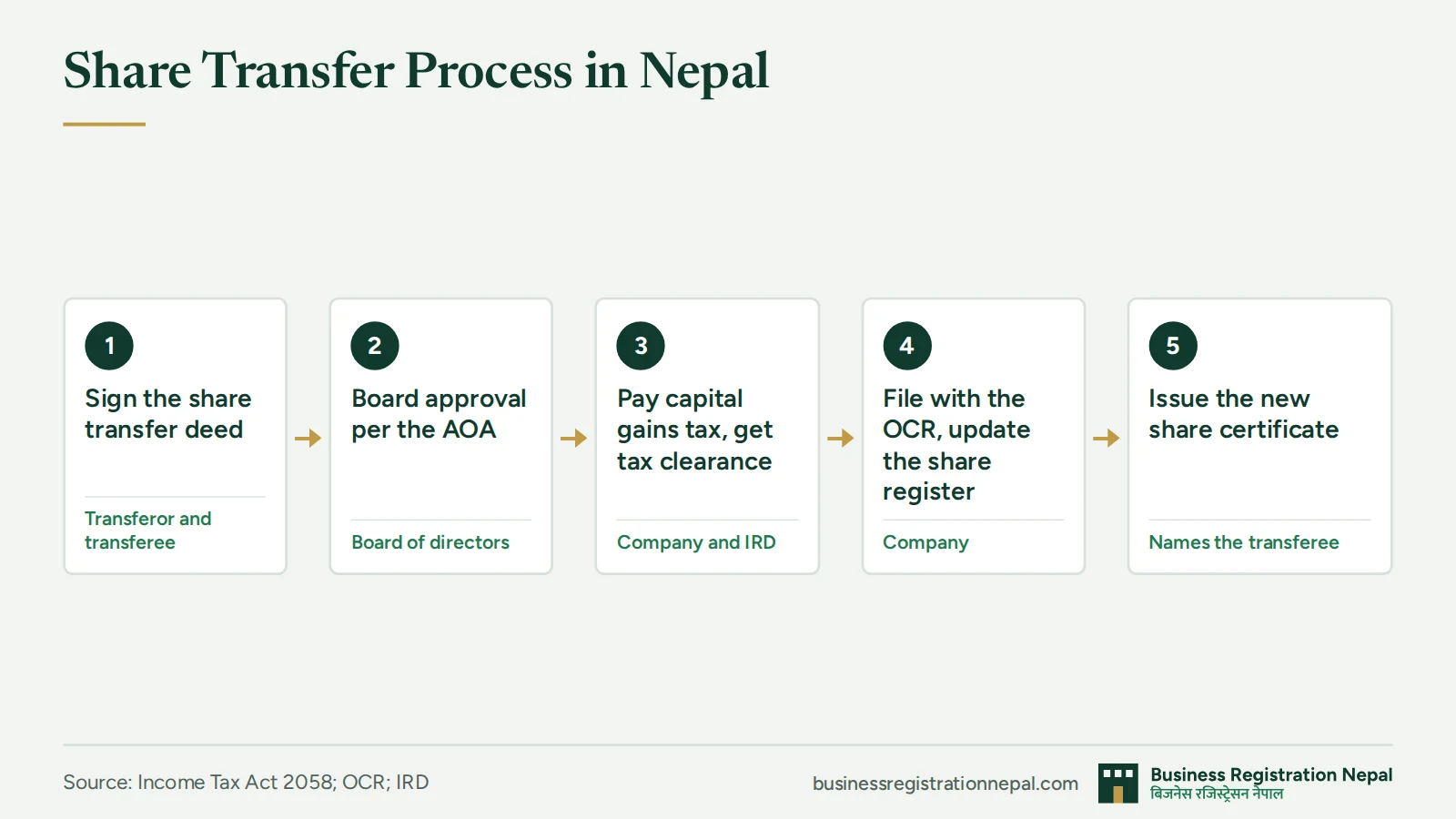
The share transfer process in Nepal moves a company's shares from a transferor to a transferee in 5 steps, subject to the articles of association (AOA) and the Companies Act 2063:
Step 1: Sign the share transfer deed.
Step 2: Obtain board approval per the AOA.
Step 3: Pay capital gains tax and obtain tax clearance.
Step 4: File the transfer with the Office of the Company Registrar (OCR) and update the share register.
Step 5: Issue the new share certificate.
A private company restricts transfers through its articles, its shareholders' agreement and board approval. The file holds 6 documents, led by the deed, the board resolution and the original share certificate.
Capital gains tax falls on the seller's gain, collected as advance tax by the company. A company with foreign direct investment (FDI) adds Department of Industry (DOI) approval and Nepal Rastra Bank (NRB) compliance. Every share transfer process Nepal's Companies Act 2063 governs updates the shareholder register that began with company registration in Nepal.
What Is a Share Transfer?
A share transfer is the sale of a company's existing shares by a transferor to a transferee, recorded in the company's shareholder register. The Companies Act 2063 treats a share as movable property, sold subject to the Act, the memorandum of association (MOA) and the articles of association (AOA).
A share transfer, known as an equity transfer, changes who owns the shares and leaves the company's issued share capital unchanged. The transferor is the selling shareholder. The transferee is the buyer, who takes the transferor's place in the register.
A company share transfer follows one of 2 routes, and the table compares a private company transfer with a listed company transfer on 5 attributes.
Attribute
Private company transfer
Listed company transfer (NEPSE)
Transfer document
Share transfer deed signed by the parties
No deed where securities law provides for transfer without one
Where the trade happens
Between the transferor and the transferee directly
On the Nepal Stock Exchange (NEPSE)
Ownership record
The company's shareholder register
The buyer's Demat account
Proof of holding
Share certificate
Securities deposit passbook or other certificate
Advance tax on the gain collected by
The company whose shares are sold
The securities exchange operating entity
A private company never sells its shares to the public, so each change of its shareholders runs through a deed, the board and the register.
What Are the Restrictions on Share Transfer in a Private Company?
A private company in Nepal restricts share transfer through its articles of association, its shareholders' agreement and board approval. Under the Companies Act 2063, the company refuses to register a transfer contrary to its articles or to that agreement.
A share transfer in a private company in Nepal meets 5 restrictions:
Articles pre-emption clause: existing shareholders receive the offer of the shares before any outside buyer, where the articles contain this clause
Board approval: the board of directors approves the transfer in the way the articles set out
Payment of calls: the company refuses to register a transfer while a call on the shares stays unpaid
Payment of the transfer fee: the company refuses to register a transfer submitted without the transfer fee
Shareholder cap: a private company holds at most 101 shareholders, so a transfer to new buyers keeps within that limit
The Companies Act 2063 lets a company write share-transfer restrictions into its articles, and an article that conflicts with the Act is void. A company that refuses a transfer notifies the transferor and the transferee within fifteen days of the application.
A promoter of a public company, and of a private company that has borrowed from another company, holds a further restriction. That promoter cannot sell or pledge shares until the company holds its initial general meeting and the call on those shares is fully paid.
What Is the Share Transfer Process in Nepal?
Nepal's share transfer process runs in 5 steps, from signing the share transfer deed to issuing the new share certificate. The transferor, the transferee, the board of directors and the Office of the Company Registrar (OCR) each act at a set step.
Tax clearance comes before the OCR records the share transfer.
Step 1: Sign the share transfer deed / agreement between the parties. The share transfer deed, known as the share transfer agreement, records the sale of the shares from the transferor to the transferee.
Step 2: Obtain board approval per the AOA. The board of directors passes a resolution approving the transfer, and the company confirms that any pre-emption right of existing shareholders is cleared.
Step 3: Compute and pay capital-gains tax and obtain tax clearance. The company whose shares are sold collects advance tax on the gain under the Income Tax Act 2058. A share transfer settles the seller's tax before registration, and the tax clearance certificate from the Inland Revenue Department (IRD) records that clearance.
Step 4: File the transfer with OCR and update the share register. The buyer submits an application to the company in the prescribed format with the fee, a copy of the deed and the share certificate. The company uses it to update share register entries within fifteen days, then files the change with the OCR through CAMIS after that register entry.
Step 5: Issue the new share certificate. The certificate names the transferee and carries the signatures that the articles prescribe for a private company.
To transfer shares in Nepal, the parties finish all 5 steps in order. The transferor files the application instead when the deed carries the purchaser's signature. The updated register then shows the transferee as the owner.
What Documents Are Required for a Share Transfer?
The documents required for a share transfer in Nepal are 6 items, led by the deed, the board resolution and the original share certificate. The buyer submits them with the application to the company, and the company keeps them as the record behind each register entry.
The 6 share transfer documents form one file:
0 of 6 ready
The Companies Act 2063 names the deed, the share certificate, the application in the prescribed format and the transfer fee. The other items follow OCR and IRD practice, and a foreign-invested company adds its DOI and NRB approvals.
What Tax Applies to a Share Transfer in Nepal?
Capital gains tax applies to a share transfer in Nepal on the seller's gain, collected as advance tax by the company whose shares are sold. The Income Tax Act 2058, Nepal's income tax law, governs the rate and the collection.
The advance tax is a percentage of the gain, not of the full sale price. The rate differs for a resident natural person and for other persons, such as a company. For shares of a non-listed company, Section 95A sets 10% of the gain for a resident natural person, 15% for a resident entity and 25% for a non-resident.
Under Section 95A of the Income Tax Act 2058, the collector depends on the share type. The company itself collects the tax on shares of a non-listed company, and the securities exchange operating entity collects it on listed shares. The collector deposits the tax with the Inland Revenue Department.
The capital gains tax share transfer sellers pay rests on 3 records: the purchase cost, the sale price and the dated transfer deed. Lawful tax planning on a share sale means complete records, a price the parties can support, and the applicable tax paid before the register changes.
How Are Shares Transferred in FDI Companies?
To transfer shares in an FDI company, the parties add Department of Industry (DOI) approval and Nepal Rastra Bank (NRB) compliance to the standard company steps. The Foreign Investment and Technology Transfer Act 2019 (FITTA) governs each change in a foreign investor's shareholding.
The DOI approves a change of the owner or investor of a company. It approves foreign investment in an existing industry through a share purchase agreement. The DOI approves foreign investment up to NPR 6 billion, and the Investment Board Nepal (IBN) approves larger amounts.
Under Section 19 of FITTA 2019, the company reports a sale or transfer of title to foreign-investment shares to the approving body. The report goes within thirty days of the transaction taking effect, with documentary evidence, and the body records it.
NRB compliance covers 2 money flows:
Inflow: NRB gives prior approval before foreign currency buys shares that change ownership. Exceptions include a listed company and a purchase that does not lower the Nepali shareholders' ratio. The application carries the approved share purchase agreement and a chartered accountant's share valuation report at fair market value.
Outflow: a foreign investor selling its shares applies to NRB to repatriate the sale amount. The file carries the approving body's approval, proof of tax clearance or tax returns and, for an unlisted company, a chartered accountant's valuation report.
NRB decides each application within fifteen working days. A foreign buyer entering a Nepali company by share purchase follows FDI and foreign company registration, with DOI approval before the NRB inflow.
Frequently Asked Questions
What capital-gains tax applies when selling shares in Nepal?
Selling shares in Nepal brings capital gains tax on the gain, at the Income Tax Act 2058 rate for each seller type: 10% of the gain for a resident natural person and 15% for a resident entity on shares of a non-listed company. A seller confirms the current rate for a private company with the IRD before completing the transfer.
How are shares transferred to heirs after a shareholder's death?
Shares pass to the legal heirs by transmission, a route separate from an ordinary sale. Under the Companies Act 2063, the heir applies to the company with evidence of entitlement, such as succession documents, and the prescribed fee. The company then enters the heir in the shareholder register, which records a nominee after a shareholder's death.
Do other shareholders have a right of first refusal?
Yes, other shareholders hold a pre-emption right when the private company's articles or shareholders' agreement grant one. The Companies Act 2063 lets the company refuse a transfer that breaches its articles or that agreement. Existing shareholders check the articles before the shares go to an outside buyer.
Is share valuation required, and who sets the price?
No, a domestic share transfer needs no valuation: the transferor and the transferee agree the price between themselves. A valuation supports the transfer and the tax assessment, especially between related parties. Nepal Rastra Bank requires a chartered accountant's valuation report at fair market value when a foreign investor buys shares that change ownership.
Must the transfer be recorded in the share register?
Yes, the transfer is entered in the company's share register, the share lagat (lagat khata), and filed with the Company Registrar to take effect. The company records it within fifteen days of the application. The updated register supports the transferee's new share certificate, the document that proves the holding.
Can shares that are not fully paid be transferred?
Yes, partly paid shares transfer subject to the articles of association. The company refuses to register the transfer while a call on them stays unpaid, and its register records the amount outstanding on each share. The seller and buyer settle in the transfer deed who pays the amount still outstanding.
A chartered accountant confirms your AOA restrictions, documents, tax and filing route. Call +977 9817373909, message us on WhatsApp at +977 9817373909 or book online.
Business Registration NepalKapan Akasedhara, Suryodaya Colony, Kathmandu, Nepal+977 9817373909businessregistrationnepal.com
Need help with a share transfer? Chartered accountants handle it end to end.