

MOA and AOA are a Nepali company's founding documents: the Memorandum of Association (MOA) is its charter, the Articles of Association (AOA) its internal rulebook. MOA and AOA in Nepali are Prabandhapatra and Niyamawali. Founders file both with the Office of the Company Registrar (OCR) to incorporate under the Companies Act 2063.
The difference between MOA and AOA is scope: MOA clauses define name, office, objectives, capital and liability, and AOA articles govern shares, each director and meetings. The MOA prevails, and amending either needs a special resolution. The MOA and AOA feed company registration in Nepal, ending in the Certificate of Incorporation.
What Is a Memorandum of Association (MOA)?
A memorandum of association (MOA) is the company charter that fixes a company's identity and external scope: its name, office, objectives, capital and liability. Under the Companies Act 2063, section 18 sets the clauses every MOA contains.
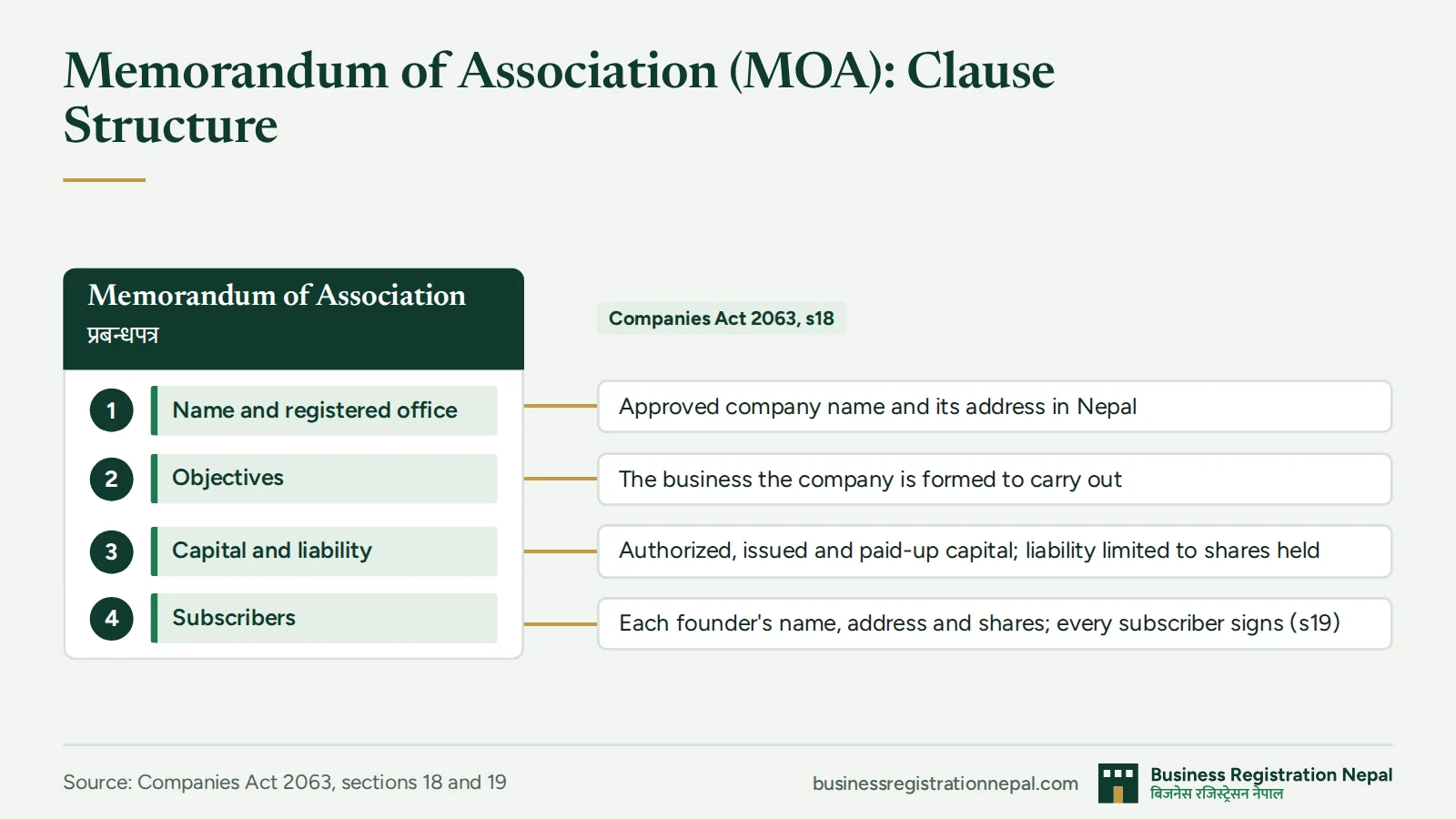
The MOA full form is Memorandum of Association, and the MOA in Nepali is Prabandhapatra (प्रबन्धपत्र). In Nepal company law, the MOA is the charter document, or constitution of company, that defines what the company is toward outsiders.
A sample MOA filed with the Office of the Company Registrar (OCR), the government office that registers companies, contains 4 groups of clauses:
- Company name and registered office. The name clause states the approved company name, and the registered office clause gives its address in Nepal.
- Objectives (business objects). The objective clause states the business the company is formed to carry out and the main activities that reach those objectives.
- Authorized/share capital and liability clause. The capital clause states the authorized, issued and paid-up share capital, and the liability clause limits each shareholder's liability to the shares held.
- Subscriber (association) clause. The subscriber clause records each founder's name, address and shares taken, and under section 19 every subscriber signs the MOA.
Authorized capital is the maximum share capital the MOA lets the company issue. A private company's MOA states its maximum number of shareholders, up to 101. The MOA meaning follows from these clauses: they fix the company's identity at incorporation, and a change to any of them requires an amendment.
What Is an Articles of Association (AOA)?
An articles of association (AOA) is the internal rulebook that governs how a company is managed and how its shareholders and directors act. Under section 20 of the Companies Act 2063, a company makes its articles to reach the objectives its MOA states.
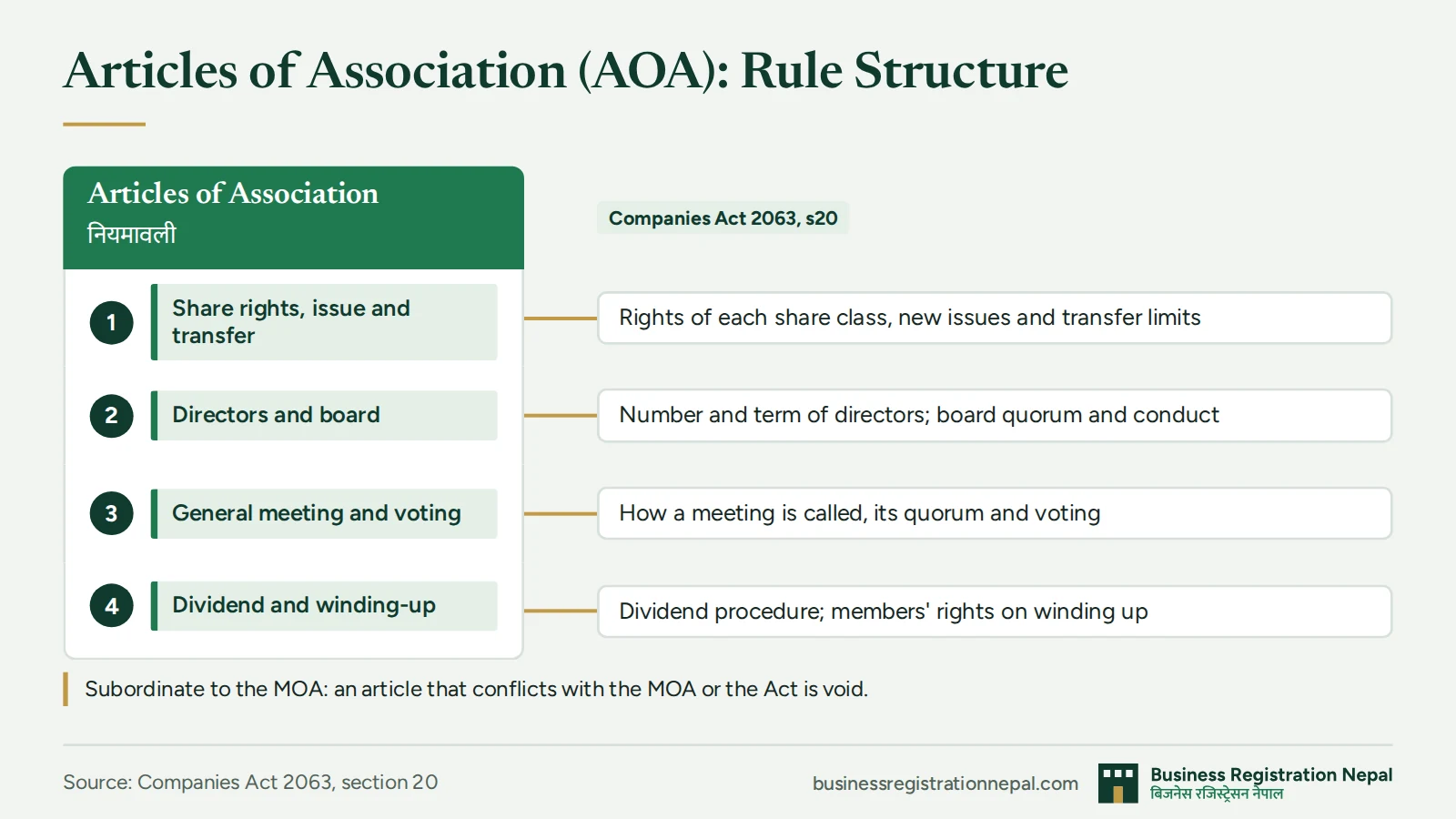
The AOA full form is Articles of Association, and the AOA in Nepali is Niyamawali (नियमावली). The full form of AOA names a set of internal rules subordinate to the MOA. The Act voids any article that conflicts with the Act or the memorandum.
Articles of association in Nepal contain 4 groups of internal rules:
- Share rights, issue and transfer rules. The share articles set the rights of each share class, the issue of new shares and any restriction on share transfer.
- Directors and board procedures. The board articles fix the number and term of directors and the quorum and conduct of board meetings.
- General-meeting and voting rules. The meeting articles state how a general meeting is called, its quorum and how shareholders vote on each resolution.
- Dividend and winding-up provisions. The final articles set the procedure for declaring a dividend and the members' rights when the company is wound up.
Shareholders and directors follow the AOA in every internal decision, from a board meeting to a share transfer. Under section 4 of the Act, a single-promoter company that adopts the prescribed standard articles need not submit its own articles at incorporation.
What Is the Difference Between MOA and AOA?
The difference between MOA and AOA is scope: the MOA defines the company toward outsiders, and the AOA governs how it runs inside. The MOA is the supreme document, and the AOA stays subordinate to it.
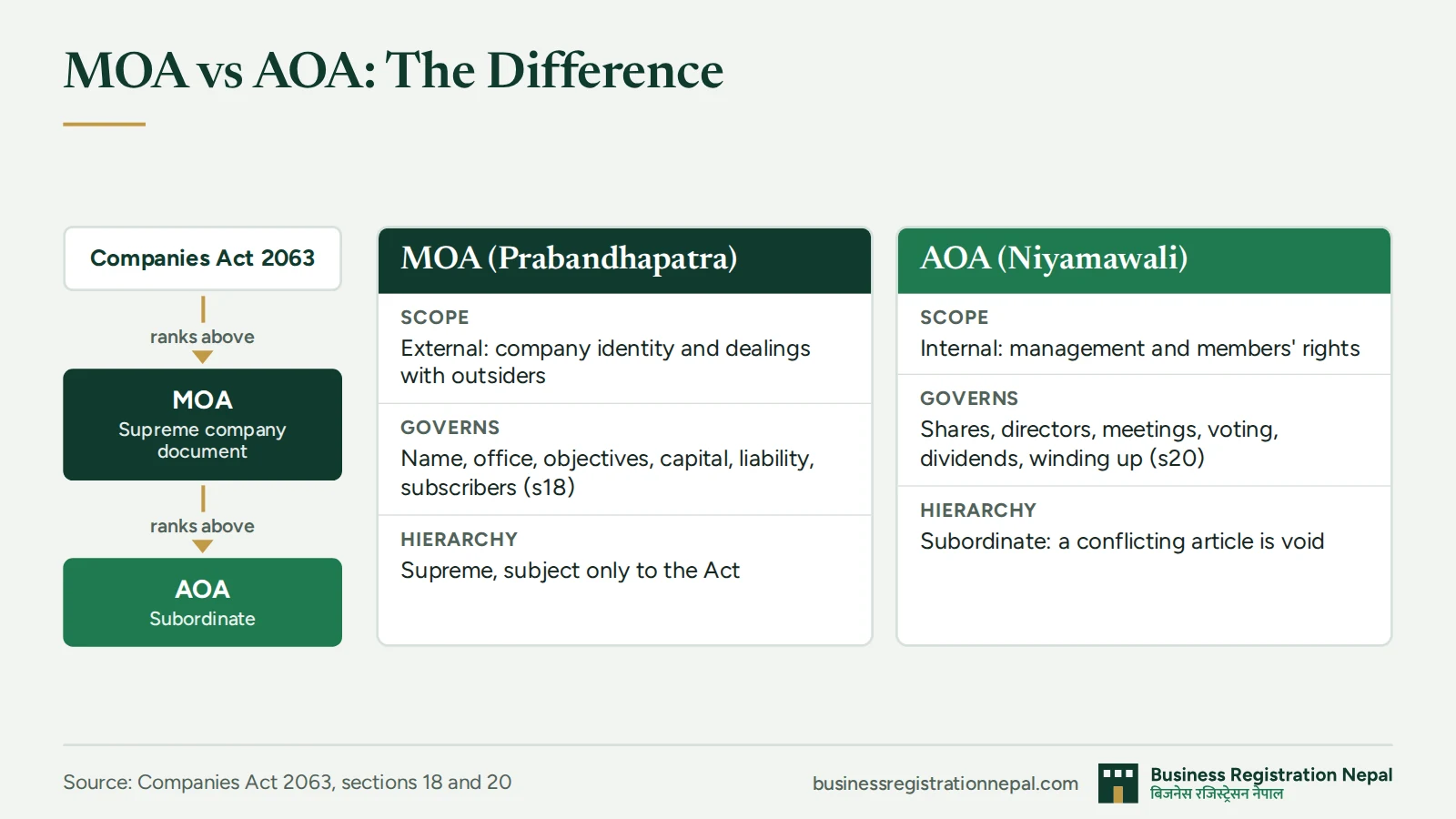
The table compares the MOA and the AOA on 6 attributes under the Companies Act 2063.
| Attribute | MOA (Prabandhapatra) | AOA (Niyamawali) |
|---|---|---|
| Scope | External: the company's identity and its dealings with outsiders | Internal: the management of the company and the rights of its members |
| What it governs | Name, registered office, objectives, share capital, liability and subscribers (section 18) | Shares, directors, board and general meetings, voting, dividends and winding up (section 20) |
| Supremacy | Supreme company document, subject only to the Act | Subordinate: an article that conflicts with the MOA or the Act is void to that extent (Companies Act 2063) |
| How it is amended | Special resolution of the general meeting, then notice to the OCR within 30 days (section 21) | Special resolution of the general meeting, then notice to the OCR within 30 days (section 21) |
| Filed at registration | Filed with the OCR by every company | Filed with the OCR, except by a single-promoter company that adopts the prescribed standard articles (section 4) |
| Signed by | Every subscriber (section 19) | Adopted with the MOA at incorporation |
The MOA answers what the company is and does. The AOA answers how its directors and shareholders decide. A limited company that wants to alter its business scope amends the MOA, while a change to board or meeting rules touches only the AOA.
Can the MOA and AOA Be Amended in Nepal?
Yes, a company in Nepal amends its MOA and AOA by special resolution at a general meeting, then informs the OCR within 30 days. Section 21 of the Companies Act 2063 sets this rule for both documents.
A special resolution passes only with the higher shareholder majority the Act sets: the votes of shareholders holding more than 75% of the shares represented at the general meeting, in person or by proxy. The same section 21 route applies to the articles, so an AOA change also needs a special resolution.
A company name change passes as a special resolution and then needs the OCR's approval before the new name takes effect. Each change to the objective clause, name or authorized capital follows the MOA amendment process, from the special resolution to the OCR filing.
Frequently Asked Questions
Can anyone inspect a company's MOA and AOA?
The MOA and AOA are filed with the Office of Company Registrar (OCR), and copies can be requested from the OCR under its own procedure and fee. For a private company there is no open online register where anyone can view them freely. The company also gives a shareholder a copy for the fee its articles set.
Who drafts the MOA and AOA?
The promoters, or founders, draft the MOA and AOA and file them with the OCR at registration. Most founders prepare them with a chartered accountant or a lawyer, and every subscriber signs the memorandum under section 19. The drafts are uploaded on CAMIS, the OCR's online system, as part of company registration in Nepal.
What happens if a clause in the AOA conflicts with the Companies Act?
The Companies Act prevails, and the conflicting clause is void to the extent of the conflict under the Companies Act 2063. The same rule voids an article that conflicts with the MOA, so the articles stay within the law and the memorandum. Each article follows the wider company rules summarised in the Companies Act 2063 highlights, from incorporation to winding up.
What is the object clause in the MOA and why does it matter?
The object clause is the MOA clause that states what the company is formed to do, and it frames the scope of its permitted activities. Section 18 requires it in every memorandum, together with the main activities that reach each objective. The company's business stays inside that stated scope, so the clause decides which activities the company carries out lawfully.
Can a company act outside the objectives in its MOA?
No, a company in Nepal acts within the objectives in its MOA, and an act beyond the stated objects is open to challenge. The company amends the memorandum by special resolution when its business scope changes, before it starts the new activity.
In what language must the MOA and AOA be submitted?
The MOA and AOA are submitted in Nepali, the language the OCR requires for registration, and an English version serves only as a reference copy. Founders confirm the current requirement with the OCR before they upload the two documents.