


A Pvt Ltd company in Nepal is a separate legal entity with perpetual succession, 1 to 101 shareholders and liability limited to shares. Restricted share transfer and MOA and AOA governance complete its 5 features. The Office of the Company Registrar (OCR, कम्पनी रजिष्ट्रारको कार्यालय) registers it under the Companies Act 2063.
Pvt Ltd company registration in Nepal runs in 5 steps:
- Step 1: Reserve the company name on CAMIS.
- Step 2: Prepare the MOA and AOA.
- Step 3: Submit the application online.
- Step 4: Receive the certificate of incorporation.
- Step 5: Register for PAN and VAT at the Inland Revenue Department (IRD).
Founders meet 6 requirements, from IDs to NPR 1 lakh of authorized capital, and file 5 documents led by the MOA and AOA. The cost is the OCR fee on authorized capital, from NPR 1,000, plus a professional fee.
The form suits growth-stage businesses, founders who want limited liability, and owners seeking investors or bank credit. Private limited company registration, Nepal's common incorporation route, forms part of company registration in Nepal.
What Is a Private Limited Company in Nepal?
In Nepal, a private limited company is a separate legal entity owned by 1 to 101 shareholders, with liability limited to their shares. The Office of the Company Registrar (OCR) registers it under the Companies Act 2063, and it offers no shares to the public.
The private limited company meaning in Nepal law rests on 3 attributes: separate legal personality, limited liability and perpetual succession. The Act makes each incorporated company an autonomous corporate body with perpetual succession, so the company continues when a shareholder dies or sells out. The company holds property and enters contracts in its own name.
Each shareholder's liability stops at the amount of the shares bought or agreed to be bought. This liability limited to shares keeps the personal assets of every member outside the company's debts.
A sole proprietorship has no separate legal personality, so its single owner carries unlimited liability for business debts. A public limited company starts with 7 or more promoters and sells shares to the public. Founders weighing a private limited company against a sole proprietorship or partnership follow which company type to register for the liability and tax comparison.
What Are the Features of a Private Limited Company?
The 5 features of private limited company status are limited liability, perpetual succession, 1 to 101 shareholders, restricted share transfer and MOA and AOA governance. The Companies Act 2063 sets each feature for every Pvt Ltd in Nepal, and together they separate it from a sole proprietorship.
- Limited liability - owners liable only up to their shares
- Separate legal entity with perpetual succession
- 1 to 101 shareholders
- Restricted share transfer (shares not offered to the public)
- Governed by its MOA and AOA under the Companies Act 2063
The share transfer restriction keeps ownership inside a closed group, because the Act bars a private company from selling shares or debentures to the public. The Memorandum of Association (MOA) fixes the objectives and authorized capital. The Articles of Association (AOA) set the rules for the board, shareholder meetings and each share transfer.
A Pvt Ltd is therefore a limited liability company with a fixed legal form. Its registration asks for a set list of people, papers and capital.
What Are the Requirements to Register a Private Limited Company?
The requirements for private limited company registration in Nepal are 6 items: shareholders and directors with ID, an approved name, a registered office, objectives, authorized capital, and the MOA and AOA. The OCR checks each item before incorporation.
0 of 6 ready
A foreign investor holds shares only after approval from the Department of Industry (DOI), the body that approves foreign investment before incorporation. A company that meets all 6 requirements files its application with the OCR.
How Do You Register a Private Limited Company in Nepal?
To register a private limited company in Nepal, founders complete 5 steps: name reservation, MOA and AOA, online filing, incorporation and PAN and VAT registration. The OCR handles steps 1 to 4 on its online system, and the tax office handles step 5.
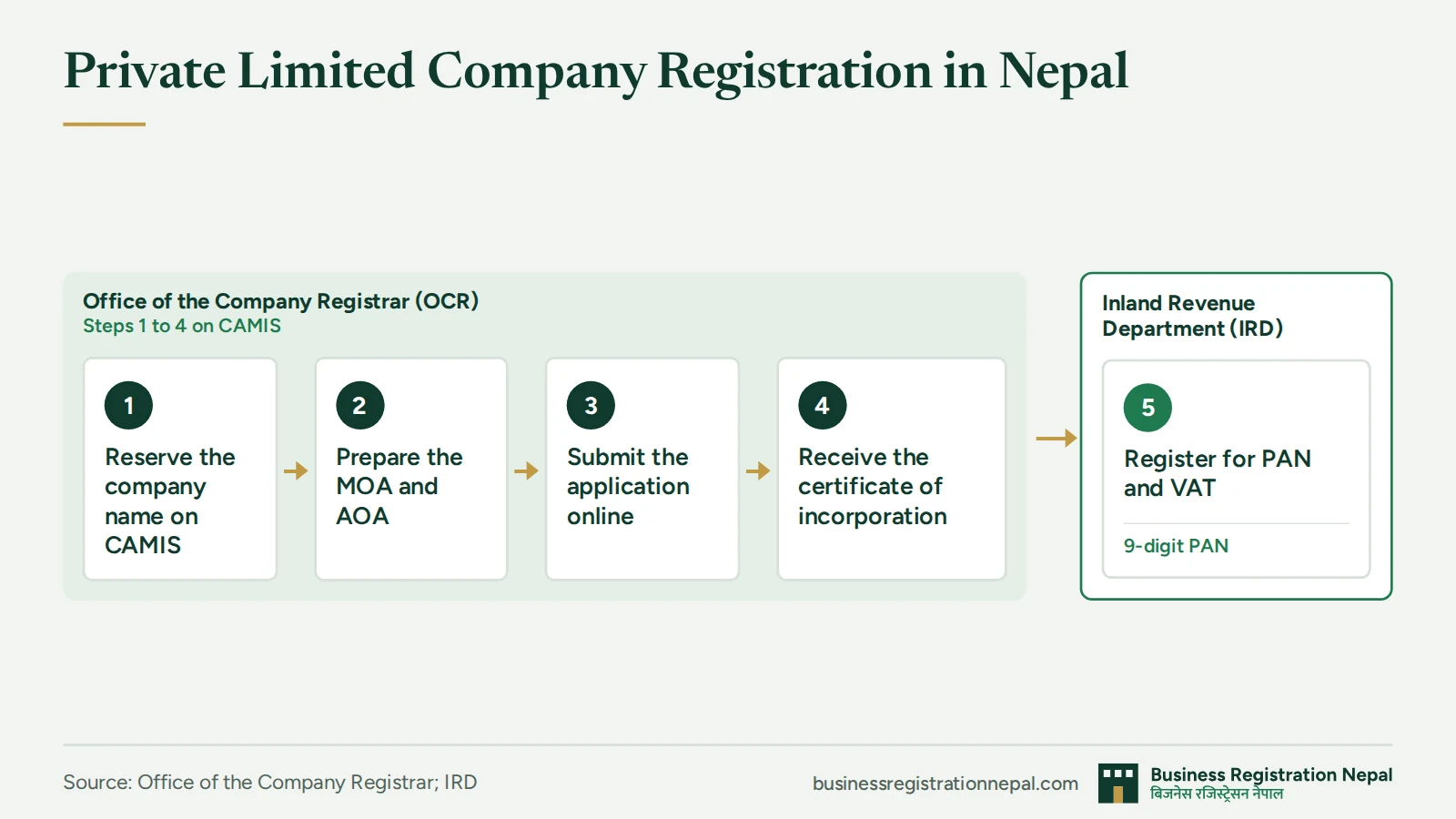
- Step 1: Reserve the company name on CAMIS, the Company Administration Management Information System of the OCR. The OCR approves a name that matches no registered company, together with the proposed objectives.
- Step 2: Prepare the MOA and AOA. The drafts state the objectives, authorized capital, share structure and board rules.
- Step 3: Submit the application online. The founders upload the MOA, AOA, shareholder IDs and any shareholder agreement on CAMIS.
- Step 4: Receive the certificate of incorporation. The OCR examines the file and issues the certificate, and the company exists as a separate legal entity from that date.
- Step 5: Register for PAN and VAT at the Inland Revenue Department (IRD). The IRD issues a 9-digit PAN to the company. VAT registration applies above NPR 50 lakh turnover for goods or NPR 30 lakh for services.
The private company registration process in Nepal ends with a Pvt Ltd that holds a certificate of incorporation and a PAN. The OCR stage closes at Step 4, and how to register a company (step-by-step) details all 6 filing steps, including ward registration.
What Documents Are Required for a Private Limited Company?
A private limited company files 5 documents with the OCR: shareholder and director IDs, MOA and AOA, name approval, the office address and any shareholder agreement. Founders upload the set on CAMIS with the registration application.
0 of 5 ready
The Companies Act 2063 lists the MOA, the AOA, any shareholder agreement and each promoter's citizenship or registration proof for the application. A corporate shareholder adds its own registration certificate, and a foreign investor adds the DOI approval.
The MOA and AOA form the legal core of the file, and MOA and AOA explained breaks down their objectives, capital and board clauses.
How Much Does It Cost to Register a Private Limited Company?
The cost to register a private limited company is the OCR registration fee, set by authorized capital, plus the professional fee a firm quotes. The OCR fee starts at NPR 1,000 for authorized capital up to NPR 1 lakh and reaches NPR 43,000 at NPR 10 crore.
Authorized capital is the maximum share capital the MOA lets the company issue, and paid-up capital is the part shareholders have paid. The OCR fee follows the authorized figure, so a founder who plans a later capital increase pays the fee difference then.
The professional fee covers drafting the MOA and AOA, filing on CAMIS and the PAN application, and firms quote it per engagement. The full band table for a private company appears in company registration cost and fees, with the ward and DOI charges. A founder enters the planned authorized capital in the cost calculator to get the OCR fee before filing.
Who Should Register a Private Limited Company?
Growth-stage businesses, founders who want limited liability, and owners seeking investors or bank credit register a private limited company. The form fits a business that plans to hire, borrow or add shareholders over the coming years.
A growth-stage business, for example a trading firm or an IT company, adds shareholders up to the 101 limit without changing its legal form. A founder with a house or savings at stake keeps them outside business debts, because liability stays limited to the shares held.
A Pvt Ltd company, Nepal's common form for growing businesses, gives investors shares to own and banks a borrower with its own balance sheet. The board signs for the company, and the OCR record shows its capital and objectives.
Each Pvt Ltd files yearly returns at the OCR and the IRD to comply with the Companies Act 2063 and the Income Tax Act 2058. A single trader who wants minimal filings keeps a sole proprietorship instead.
Frequently Asked Questions
How many shareholders can a private limited company have in Nepal?
The Companies Act 2063 allows a private limited company in Nepal 1 to 101 shareholders. One person incorporates a private company alone, and a business that plans more than 101 members registers as a public limited company.
What is the minimum capital for a private limited company in Nepal?
The minimum authorized capital for a private limited company in Nepal is NPR 1 lakh, with an NPR 1,000 OCR registration fee. The MOA states the authorized capital the founders choose above that floor.
Is a private limited company a separate legal entity?
Yes, a private limited company is a separate legal entity, distinct from its shareholders under the Companies Act 2063. The company carries limited liability and perpetual succession, so it continues through every change of ownership.
How long does it take to register a private limited company?
Registration of a private limited company takes about two weeks on OCR CAMIS, from name approval to the certificate of incorporation. Once the application is complete, the Companies Act 2063 gives the OCR 7 days to register the company, or 3 days to give notice of a refusal. A rejected name or a document correction adds days to that period.