

SSF enrollment in Nepal for companies is the mandatory registration of an employer and its employees with the Social Security Fund (SSF). The SSF is the government contributory scheme under the Contribution Based Social Security Act 2074, and both sides pay into it monthly.
A company enrols in 4 steps on the SSF online portal:
- Step 1: Register the employer account.
- Step 2: Complete document verification.
- Step 3: Enrol the employees and generate their SSF IDs.
- Step 4: Set up the monthly contribution and reporting.
The rate is 31% of basic salary, 20% from the employer and 11% from the employee, and it funds 4 schemes. Registration needs company records and each employee's ID, photo and bank details. The deposit deadline is 25 days after month end, and a late deposit carries 10% interest, with fines and penalties for offences.
SSF enrollment is a payroll duty that follows company registration in Nepal for every company that hires staff.
Is SSF Enrollment Mandatory for Companies in Nepal?
Yes, SSF enrollment is mandatory for a company in Nepal that employs workers: the employer lists itself with the fund and enrols each employee. The Contribution Based Social Security Act 2074 places this duty on the employers the Government of Nepal names by Nepal Gazette notice. The notice published on 12 November 2018 required employers to list with the fund by regional deadlines, and to enrol their employees within 3 months of listing.
The Act defines an employer as any person or institution that employs workers, so a company or any other establishment with staff falls within it. An employee whose employer does not enrol them applies to the fund directly.
The SSF online portal registers 5 categories of participant:
- Employers, which list themselves and their employees
- Migrants in foreign employment
- Workers abroad under the Employment Permit System (EPS)
- Workers in the informal sector
- Persons in self-employment
A company uses the employer category, which is the route to SSF for employers in Nepal. The employer then enrols every employee on its payroll through the same portal.
What Is the SSF Contribution Rate?
The SSF contribution rate is 31% of basic salary: 11% deducted from the employee and 20% added by the employer. The Social Security Scheme Operating Procedure 2075 of the SSF sets this split, and the employer deposits both shares in the fund each month.
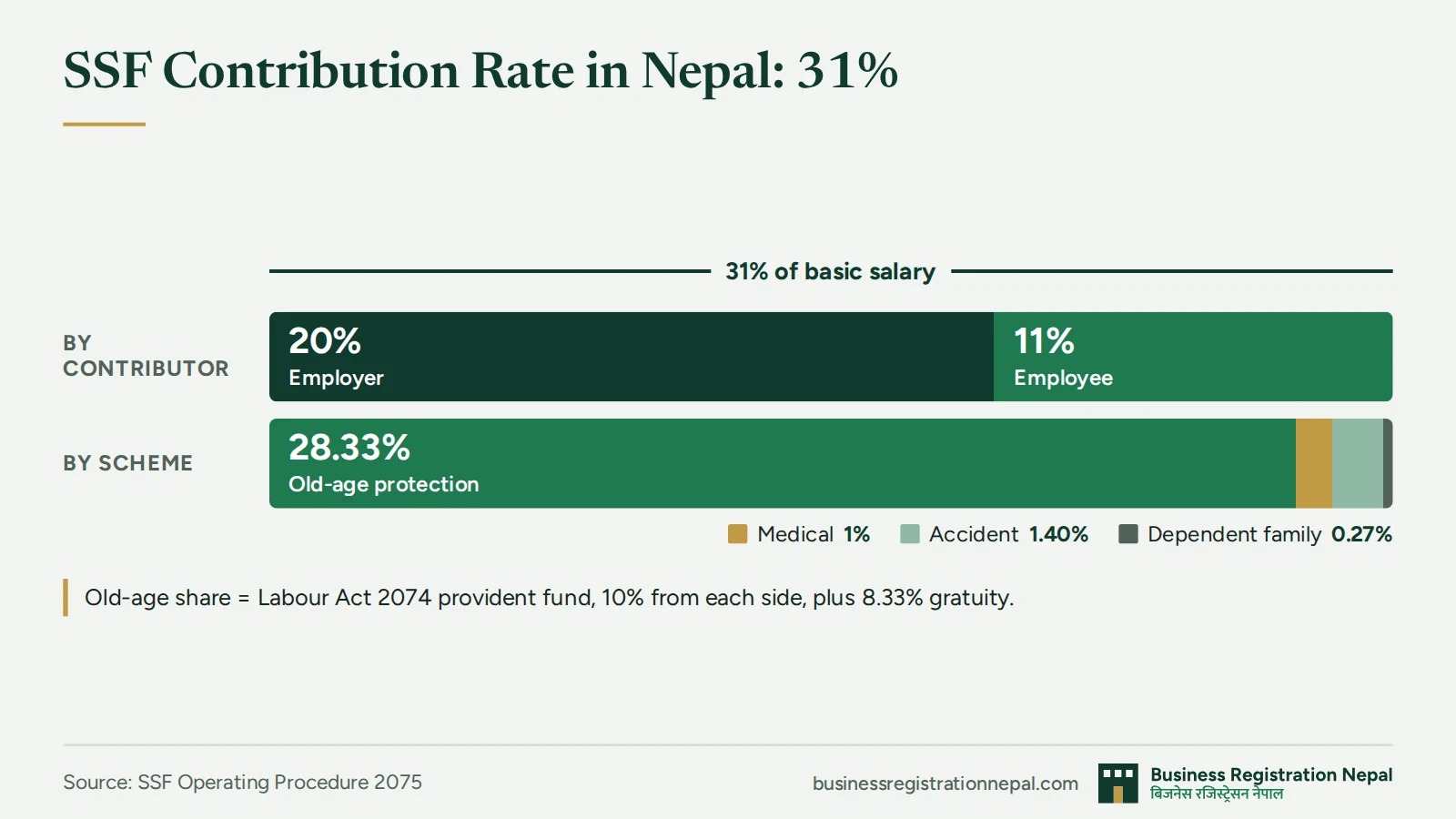
Under the Contribution Based Social Security Act 2074, the labour ministry fixes the rate by a notice in the Nepal Gazette. The table shows how each party in Nepal contributes to the 31 percent contribution rate.
| Contributor | Share of basic salary (%) |
|---|---|
| Employer | 20 |
| Employee | 11 |
| Total | 31 |
The fund divides the 31% among 4 schemes: 28.33% to old-age protection, 1% to the medical scheme, 1.40% to the accident scheme and 0.27% to dependent family protection. The old-age share equals the Labour Act 2074 provident fund and gratuity: 10% of basic salary from each side plus 8.33% for gratuity.
The remaining 2.67 points of the 31% fund the medical, accident and dependent family schemes. Each party's share splits into pension, gratuity and social security tax. The employee's 11% is 10% provident fund plus 1% in place of the social security tax, and the employer's 20% is 10% provident fund, 8.33% gratuity and a 1.67% additional contribution. An SSF contributor therefore pays no separate 1% social security tax on employment income.
What Schemes Does the SSF Cover?
SSF benefits come through 4 schemes: medical, health and maternity; accident and disability; dependent family; and old-age protection. The Social Security Scheme Operating Procedure 2075 runs each scheme from the monthly contributions that employers deposit for their employees.
- Medical, health and maternity protection
- Accident and disability protection
- Dependent family protection
- Old-age (pension) protection
Every enrolled employee is covered by all 4 schemes through one contribution. The Contribution Based Social Security Act 2074 names 8 scheme types, including unemployment assistance, and the procedure runs these 4.
How Do You Enrol a Company in the SSF?
To enrol a company in the SSF, the employer completes 4 steps on the SSF online portal, from its own registration to the monthly contribution. The portal runs at sosys.ssf.gov.np, and the fund verifies each record before the next step opens.
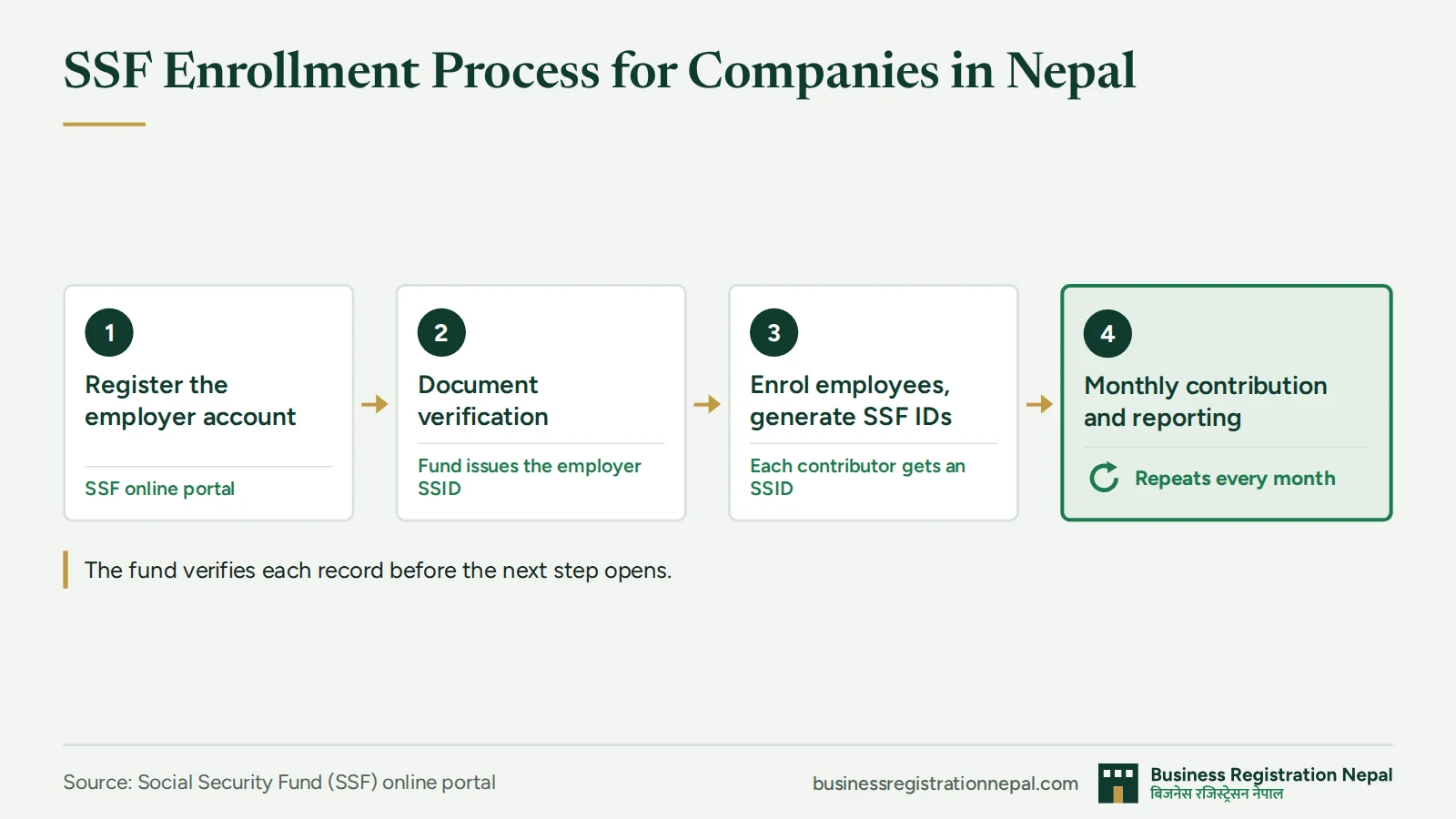
- Step 1: Register the employer account on the SSF online portal. The employer opens New Registration in the employer section, submits the request for a submission number and then fills in the company's details.
- Step 2: Complete document verification. SSF staff verify the employer record and uploaded documents. The fund then issues a username, a password and an SSID, its identification number for the employer.
- Step 3: Enrol the employees and generate their SSF IDs. The employer registers each employee as a contributor in the employer portal. The fund verifies each contributor and issues a username, a password and an SSID.
- Step 4: Set up the monthly contribution and reporting. The employer logs in to the employer portal and deposits each month's contribution. Payroll data drives every monthly SSF filing, and accounting & bookkeeping services keep those salary records ready for the deposit.
The SSF process in Nepal runs through digital portal accounts, and the employer repeats Step 4 every month for as long as it has employees. Each employee logs in to the contributor portal with that username, password and SSID.
What Documents Are Required for SSF Registration?
SSF registration requires 2 sets of details: the employer's registration documents and contact data, and each employee's identity, photo and payment details. For SSF registration, Nepal's Social Security Fund takes both sets through the SSF portal.
The employer form on the SSF portal asks for 6 items:
0 of 6 ready
Each employee's contributor record carries 4 items:
0 of 4 ready
The employer files both sets online, and SSF staff check them before the fund issues any SSID.
What Are the SSF Deadlines and Penalties?
An employer deposits each month's SSF contribution within 25 days after the month ends, and a late deposit carries 10% interest on the contribution. The Contribution Based Social Security Act 2074 sets both rules, and the fund recovers the unpaid amount with that interest from the employer.
A company with staff works to 3 SSF deadlines:
- Registration of the employer with the fund, within the period the Act and Government notices set; the regional deadlines in the November 2018 notice have passed, so a new employer lists before it enrols staff, and enrols each employee within 3 months of the employment starting
- Contributions from the date each employee started work, under the Labour Act 2074
- Payment of each month's contribution within 25 days after that month ends
The 25-day deadline repeats every month, so a company with employees meets 12 deposit deadlines a year. Companies comply by depositing both shares within that deadline every month.
The Act names 4 offences: late or no deposit of contributions, false or incomplete details, improper benefit claims and irregularities in a scheme. An employer that deducts the employee's share and does not deposit it commits the non-deposit offence. The penalty is a fine of up to the amount involved, or up to NPR 1 lakh where that amount cannot be determined, imprisonment of up to one year, or both. An accomplice receives half that penalty.
Frequently Asked Questions
Does the SSF replace the old provident fund and gratuity obligations?
Yes, an SSF employer makes no separate Labour Act 2074 provident fund, gratuity or medical insurance contribution, to the extent the SSF covers those benefits. The Labour Act routes the 10% provident fund and the 8.33% gratuity into the SSF in each employee's name. Balances built up in earlier provident fund or gratuity accounts move under SSF rules.
What is the difference between the SSF and the Citizen Investment Trust?
The SSF is the contribution-based social security fund for employees, and the Citizen Investment Trust is a separate savings and retirement fund. The SSF pays scheme benefits for health, accidents, dependants and old age from the 31% contribution. The Trust operates under the Citizen Investment Trust Act 2047 and runs savings products such as an employee retirement fund, a gratuity and pension fund and unit schemes.
Are foreign or expatriate employees required to join the SSF?
Yes, foreign employees working in Nepal fall within SSF rules: the fund draws no distinction by nationality, and participation is compulsory for every category of employee under the Labour Act 2074. The SSF operating procedure pays a foreign citizen the old-age scheme balance in one lump sum after the employment ends. A company employs a foreign citizen only with a work permit under the Labour Act 2074, which sets minimum benefit standards for foreign staff.
Is there a minimum number of employees before a company must register?
No, the Contribution Based Social Security Act 2074 sets no minimum headcount: it defines an employer as any person or institution that employs workers. A company with a single employee therefore registers with the fund, and the SSF grants no exemption based on headcount.
Does the SSF apply to contract or part-time workers?
Yes, part-time workers are covered: under the Labour Act 2074, each employer of a part-time worker with 2 or more employers contributes on the salary it pays. That Act lists 5 employment types: regular, work-based, time-based, casual and part-time. Contract staff on work-based or time-based terms count as labour under it, and SSF participation is compulsory for every employment type the Labour Act 2074 lists.
Can SSF contributions be withdrawn, and when?
No, SSF contributions are not withdrawn at will; the old-age scheme pays out at 60 years of age after 180 months of contributions. A contributor who meets both conditions becomes eligible for the pension. A foreign citizen takes the old-age balance in one lump sum after the employment ends. A contributor who reaches 60 with fewer than 180 months of contributions takes the deposited old-age amount with its investment return as a lump sum, or opts for a monthly pension.
What Is the Social Security Fund (SSF) in Nepal?
Nepal's Social Security Fund (SSF) is the government contributory scheme that collects monthly contributions from employers and employees and pays health, accident, family and old-age benefits. It operates under the Contribution Based Social Security Act 2074.
The fund, known in Nepali as the Samajik Suraksha Kosh (सामाजिक सुरक्षा कोष), gives formal-sector employees social protection that the employer and the employee pay for together. A listed employer deducts the employee's share from the basic salary, adds its own share and deposits both in the fund.
Informal-sector workers and self-employed persons join the fund voluntarily, as the Ministry of Labour, Employment and Social Security notifies in the Nepal Gazette. For a company, the SSF is a payroll duty that starts with the employer's own registration.