


The annual compliance checklist in Nepal holds 8 duties for every registered company:
- Statutory audit: within six months of fiscal year end.
- Income tax return: with the IRD within three months.
- OCR annual return (Adyawadik): within six months for a private company.
- AGM: within six months for a public company.
- VAT return: monthly, by the 25th.
- TDS return and deposit: monthly, by the 25th.
- SSF contributions: monthly, within 15 days after month end.
- Tax clearance certificate: where needed.
Every company registered with the OCR must complete the things all companies need every year in Nepal. The key deadlines fall three or six months after fiscal year end, and the fiscal year runs from Shrawan to Asar, ending mid-July.
Late filing brings OCR fines from NPR 1,000 by paid-up capital, IRD late fees with interest, and SSF interest. The 4 common mistakes are a tax return before the audit, a late OCR filing, missed monthly returns and unreconciled accounts.
The yearly cycle follows company registration in Nepal and repeats every year the company stays on the OCR register.
Who Must Complete Annual Compliance in Nepal?
Every company registered with the Office of the Company Registrar (OCR) completes annual compliance in Nepal, whether private, public or profit-not-distributing. The Companies Act 2063 governs all 3 types, and each files with the OCR and the tax office.
The OCR is the company registrar, the government office that registers companies and receives their annual filings. The OCR states that every company has a registered auditor audit its annual accounts. The Inland Revenue Department (IRD), the tax authority, receives an income tax return from every company under the Income Tax Act 2058.
Annual compliance of a company in Nepal reaches 3 groups of registered companies:
- Operating companies: every trading company files its audited accounts, tax return and OCR details each fiscal year.
- Dormant or non-operating companies: a company with no business keeps its registration, and its annual filings continue, including the audit, the tax return and the OCR annual return.
- Larger and regulated companies: a listed company with NPR 3 crore or more paid-up capital forms an audit committee of at least 3 members. Section 164 of the Companies Act 2063 applies the same rule to a company the Government of Nepal fully or partly owns. A bank, insurer or other regulated company adds the reporting rules of its sector regulator, such as Nepal Rastra Bank directives for banks and financial institutions and Nepal Insurance Authority directives for insurers.
Company compliance requirements in Nepal start from one core yearly cycle, and size or sector adds extra duties to that cycle. The fiscal year sets the timing of that cycle for every group.
What Must a Company Do Every Year in Nepal?
A company in Nepal completes 8 duties every year: the statutory audit, income tax return, OCR annual return, AGM, VAT and TDS returns, SSF contributions and any tax clearance. Each duty carries its own deadline and authority.
The things all companies need every year in Nepal follow the fiscal year: 4 annual items, 3 monthly items and 1 item on demand. This yearly compliance checklist for companies lists all 8 duties with their deadlines:
- Complete the statutory audit within six months of fiscal-year end. The statutory audit, or financial audit, is the external audit of the annual accounts by an auditor licensed by the Institute of Chartered Accountants of Nepal (ICAN). The audited annual accounts feed every later filing, and statutory audit in Nepal covers the auditor's appointment and report.
- File the income-tax return with the IRD within three months of fiscal-year end. Under the Income Tax Act 2058, the return declares the company's assessable income and tax. On a written application with reasonable grounds, the IRD extends the deadline by up to three months. The tax return and the OCR filing together form annual compliance and filings for a registered company.
- File the OCR annual return / Adyawadik within six months. A private company submits its audited financial statements to the OCR within six months of fiscal year end. A public company files within 30 days of its AGM. Adyawadik, the Nepali term for this yearly update, keeps the company's record current through company renewal (Adyawadik) at the registrar.
- Hold the AGM and file the return. A public company holds its annual general meeting (AGM) within six months of fiscal year end on 21 days' notice. A private company follows its articles of association. Shareholders adopt the audited accounts at the meeting, and AGM in Nepal sets out the notice, quorum and minutes.
- File VAT returns monthly (by the 25th) if VAT-registered. A company registers for VAT once turnover crosses NPR 50 lakh for goods or NPR 30 lakh for services, and it files a return for each month. The monthly VAT return deadline applies from the date of VAT registration at the IRD.
- File TDS returns and deposit monthly (by the 25th). TDS (tax deducted at source) is the tax a company withholds from salaries and other specified payments under the Income Tax Act 2058. The company deposits the withheld tax with the IRD and files the TDS return for the month.
- Deposit SSF contributions monthly, within 15 days after each month ends, under the Contribution Based Social Security Act 2074. The Social Security Fund (SSF) collects employer and employee contributions under the Contribution Based Social Security Act 2074. SSF enrolment registers the company as an employer before its monthly SSF contribution starts.
- Obtain the tax clearance certificate where needed. The tax clearance certificate is the IRD document confirming that a company has filed its returns and paid its tax for the fiscal year. The income tax return comes before the tax clearance certificate, which a bank or public office asks for case by case.
The ward office renews the company's local business registration each fiscal year as a separate local duty, at the fee the municipality sets in its annual finance act. The audit comes before the tax return and the OCR filing, so the audited accounts set the order of the yearly filings.
What Are the Key Compliance Deadlines at a Glance?
The key compliance deadlines in Nepal run on 2 cycles: monthly VAT, TDS and SSF payments, and yearly filings due three or six months after fiscal year end. The fiscal year ends on the last day of Asar, in mid-July.
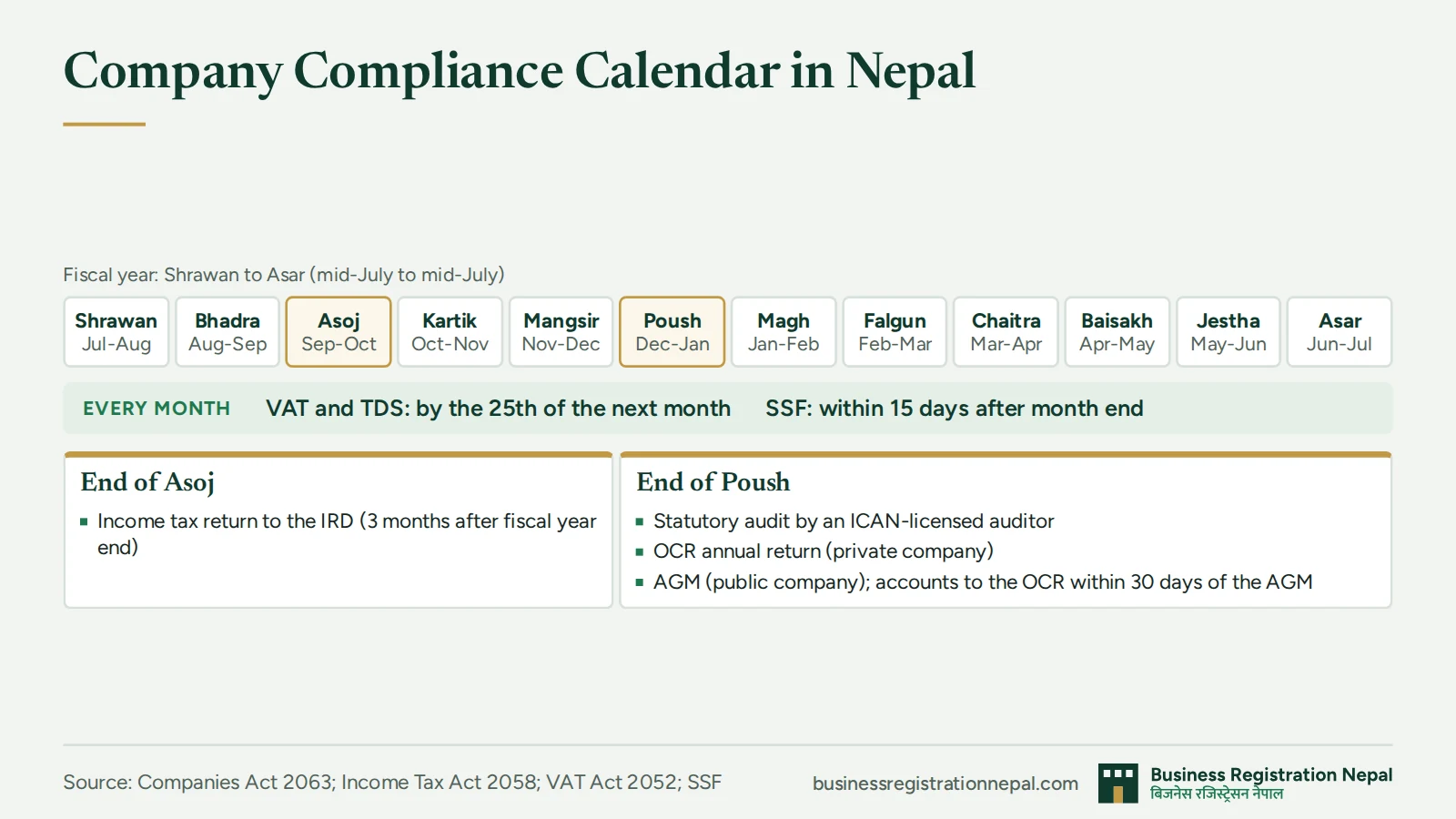
Nepal's fiscal year runs from Shrawan to Asar, so the fiscal year end in Nepal falls in mid-July each year. The table maps the company annual obligations in Nepal to their deadlines on the Nepali calendar, with approximate Gregorian dates.
| Obligation | Deadline | Nepali calendar date | Authority |
|---|---|---|---|
| Income tax return | Within three months of fiscal year end | End of Asoj; for fiscal year 2082/83, Asoj 31, 2083 (17 October 2026) | IRD |
| Statutory audit | Within six months of fiscal year end | End of Poush; for fiscal year 2082/83, Poush 30, 2083 (14 January 2027) | ICAN-licensed auditor |
| OCR annual return (private company) | Within six months of fiscal year end | End of Poush | OCR |
| AGM (public company) | Within six months of fiscal year end; accounts to the OCR within 30 days of the AGM | End of Poush | OCR |
| VAT return | Monthly, by the 25th | 25th of the following month | IRD |
| TDS return and deposit | Monthly, by the 25th | 25th of the following month | IRD |
| SSF contribution | Monthly | Within 15 days after the month ends | SSF |
| Tax clearance certificate | Where needed, after the tax return | On request | IRD |
The income tax return deadline comes 3 months before the audit and OCR deadlines, so a company prepares its audited accounts early. The Nepal company compliance calendar follows the same fiscal-year dates, from the monthly 25th returns to the six-month OCR filing.
What Are the Penalties for Missing Annual Compliance?
Missed annual compliance brings 4 kinds of penalty: OCR fines by paid-up capital, an income tax late fee with interest, VAT and TDS penalties, and SSF interest. Each authority charges its own penalty for late filing.
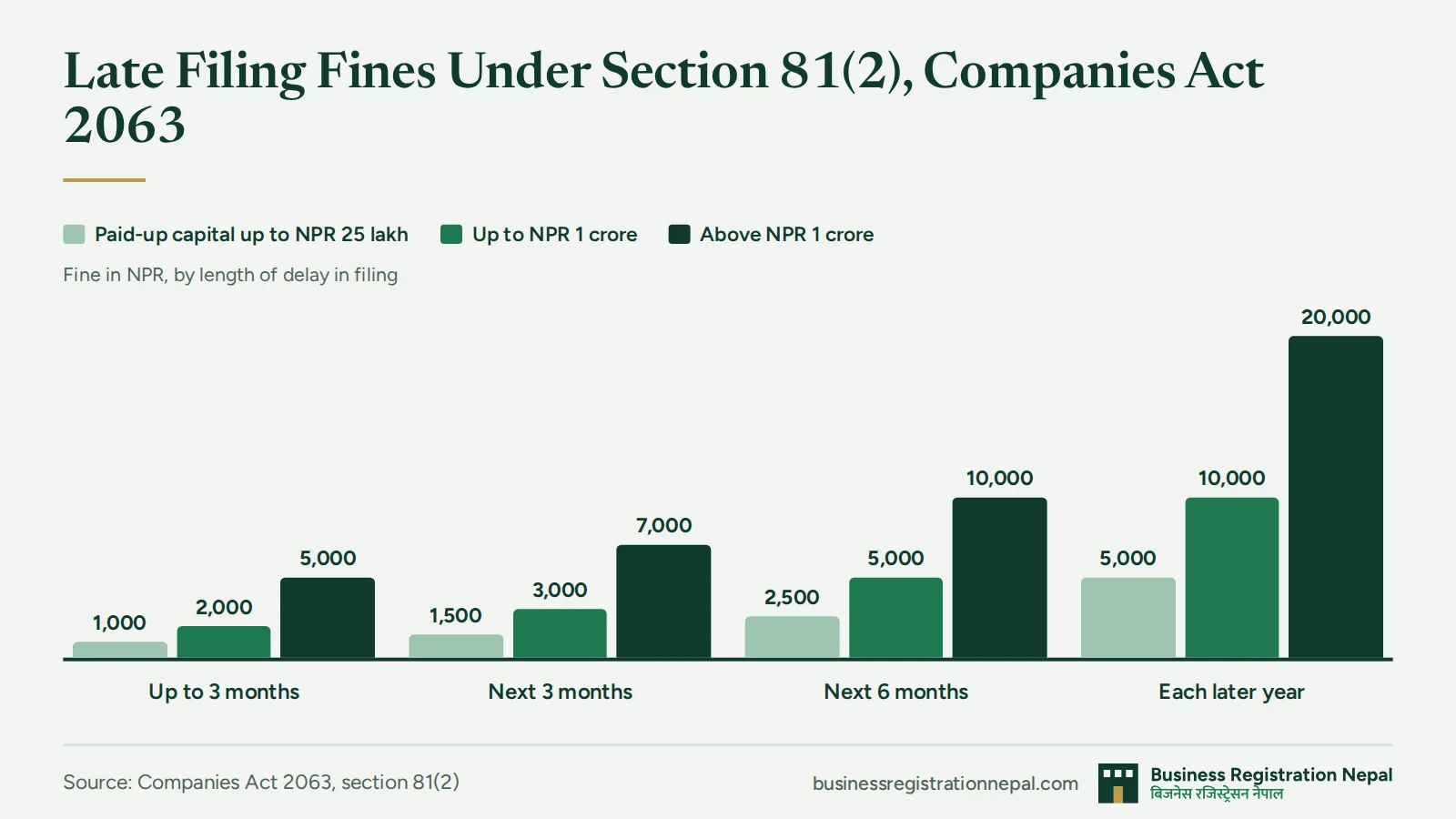
Under the Companies Act 2063, the OCR fines a company that does not submit its required details on time, including a late audited annual return. The table shows the OCR fine by paid-up capital and length of delay, in NPR.
| Paid-up capital | Up to 3 months late | Next 3 months | Next 6 months | Each later year |
|---|---|---|---|---|
| Up to NPR 25 lakh | NPR 1,000 | NPR 1,500 | NPR 2,500 | NPR 5,000 |
| Up to NPR 1 crore | NPR 2,000 | NPR 3,000 | NPR 5,000 | NPR 10,000 |
| Above NPR 1 crore | NPR 5,000 | NPR 7,000 | NPR 10,000 | NPR 20,000 |
A profit-not-distributing company pays the fine of the NPR 1 crore band. A late statutory audit delays the audited statements, so it leads to the same OCR fine.
Under the Income Tax Act 2058, the IRD charges a fee on a late income tax return and interest on tax paid late. Section 117 sets the late-return fee at 0.1% of assessable income or NPR 100 for each month of delay, whichever is higher, and section 119 charges interest of 15% a year on unpaid tax. Late VAT returns carry a fee and late VAT payments carry interest under the VAT Act 2052, and TDS deposited late carries the same 15% yearly interest under the Income Tax Act 2058.
The SSF charges 10% interest on a monthly contribution the employer deposits late. The OCR's yearly fine repeats for each year a mandatory filing stays missing.
What Are the Common Annual Compliance Mistakes to Avoid?
Companies make 4 common annual compliance mistakes: breaking the audit-before-tax-return order, filing late with the OCR, missing monthly VAT, TDS or SSF payments, and leaving accounts unreconciled. Each mistake starts a fine, a fee or interest.
The 4 mistakes stop a company from complying with the yearly cycle on time:
- Breaking the audit-before-tax-return order: the income tax return falls due within three months of fiscal year end and rests on the audited accounts. A company that leaves the audit to the six-month limit files its tax return late.
- Filing late with the OCR: a private company's audited statements reach the OCR within six months of fiscal year end. A delay starts the OCR fine at NPR 1,000 or more, by paid-up capital.
- Missing monthly VAT, TDS or SSF payments: these returns and deposits fall due every month, VAT and TDS by the 25th. One missed month carries its own penalty and interest.
- Leaving accounts unreconciled: the ledgers, bank statements and monthly VAT and TDS returns agree before the auditor starts. A mismatch delays the audit and every filing that follows it.
A private company that appoints its auditor early, and sends the auditor's name to the OCR within 15 days, keeps the audit ahead of the tax deadline. The directors of a public company prepare the annual financial statements at least 30 days before the AGM, which sets their audit timetable. A company that reconciles its books every month reaches the year-end audit with its records already matched.
Frequently Asked Questions
What is the difference between the annual return to OCR and the tax return to IRD?
The annual return to the OCR updates the company's corporate records at the registrar, and the tax return to the IRD reports its income and tax. They are separate obligations with separate deadlines: six months for a private company's OCR filing and three months for the tax return.
Does a dormant or non-operating company still file annual compliance?
Yes, a dormant or non-operating company still files its annual return with the OCR and a nil income tax return with the IRD, backed by audited accounts. Skipping either filing starts the OCR fine or the IRD late fee, even in a year with no business.
Do small or private companies have lighter filing requirements?
No, the core annual filing requirements in Nepal, the audit, tax return and OCR annual return, apply to small and private companies as well. The difference lies in the AGM: a private company follows its articles of association, and a public company holds its AGM within six months on 21 days' notice.
Does a company with zero income still need an audit?
Yes, a company with zero income still has its accounts audited before it files its tax return and OCR annual return, because the audit duty does not depend on turnover. A zero-income company follows the same statutory audit rules as any company, and audit explained covers statutory, internal and tax audits.
Are foreign branches and liaison offices subject to annual compliance?
Yes, a foreign company's branch or liaison office in Nepal files annual returns and accounts for its Nepal presence. A branch files its income tax return under the Income Tax Act 2058 within three months of the fiscal year end and its audited Nepal accounts with the OCR within six months. A liaison office files auditor-certified statements of its spending and the tax it deducted. A foreign company that opens an office in Nepal registers it through branch office registration, and its annual filings start from that registration.
Which filings go to the registrar versus the tax office?
Company-record filings go to the registrar, the OCR, and income tax, VAT and TDS filings go to the tax office, the IRD. The OCR receives the audited financial statements, the AGM details and the Adyawadik update, and the IRD receives the yearly tax return and the monthly returns. Both offices count their deadlines from the fiscal year end Nepal sets in mid-July, and a compliance calendar keeps both on track.