

A foreign company that wants to trade in Nepal without a new company opens a branch office: an extension of the parent with no separate legal personality, registered with the Office of the Company Registrar (OCR) under Companies Act 2063 Section 154 after competent authority approval. Each foreign company branch office in Nepal carries on the parent's business within its approved scope. Business Registration Nepal handles this filing inside our FDI & foreign company registration service and company registration in Nepal work, covering activities, process, documents, cost and tax.
What Is a Branch Office in Nepal?
A branch office in Nepal is part of the foreign parent, not a new Nepali company. It has no separate legal personality, so the parent company, or head office, stays liable for every contract and debt the branch signs here.
That sets a branch of foreign company apart from two other routes. A subsidiary is a distinct Nepali company with its own liability, and a liaison office cannot earn income at all.
Who Can Register a Branch Office in Nepal?
A foreign company that wants to carry on business or transactions in Nepal can register a branch office once the concerned government authority grants approval. The parent must exist as a registered company in its home country, with audited statements and a board able to authorize the branch.
Which authority approves depends on the sector the branch will operate in, so we confirm the regulator before any filing. The approval usually comes from the ministry, department or regulator that governs the activity, or from the government body whose project or contract the branch will carry out. That check decides how fast a foreign parent can establish its presence in Nepal.
Which Law and Authority Govern Branch Office Registration?
Branch office registration is governed by the Companies Act 2063 (Companies Act 2006), and the Office of the Company Registrar is the registering authority. Under Section 154, a foreign company must register with the OCR before it does business in Nepal, and Section 154(2) requires competent authority approval before that registration.
Whether Department of Industry (DOI) or Nepal Rastra Bank (NRB) clearance applies as a second layer depends on the sector and on how the branch brings in and sends out funds. Section 154, Companies Act 2063, then keeps the branch answerable to the OCR for its annual filings.
What Activities Can a Branch Office Do in Nepal?
A branch office in Nepal may conduct income-generating activities similar to its parent's business, within the scope the competent authority approved and lawful in Nepal. Our team checks the proposed scope against the permitted activities before the application goes in.
Two limits apply. Nothing on the DOI/NRB negative list is open to a branch, and a branch may lease premises but generally cannot own immovable property in Nepal. A foreign investor that needs land holds it through a Nepal-registered company set up under the foreign investment process.
What Is the Branch Office Registration Process?
The branch office registration process in Nepal runs in 5 steps. Anyone asking how to register a branch office in Nepal should know it starts with approval, not with the OCR:
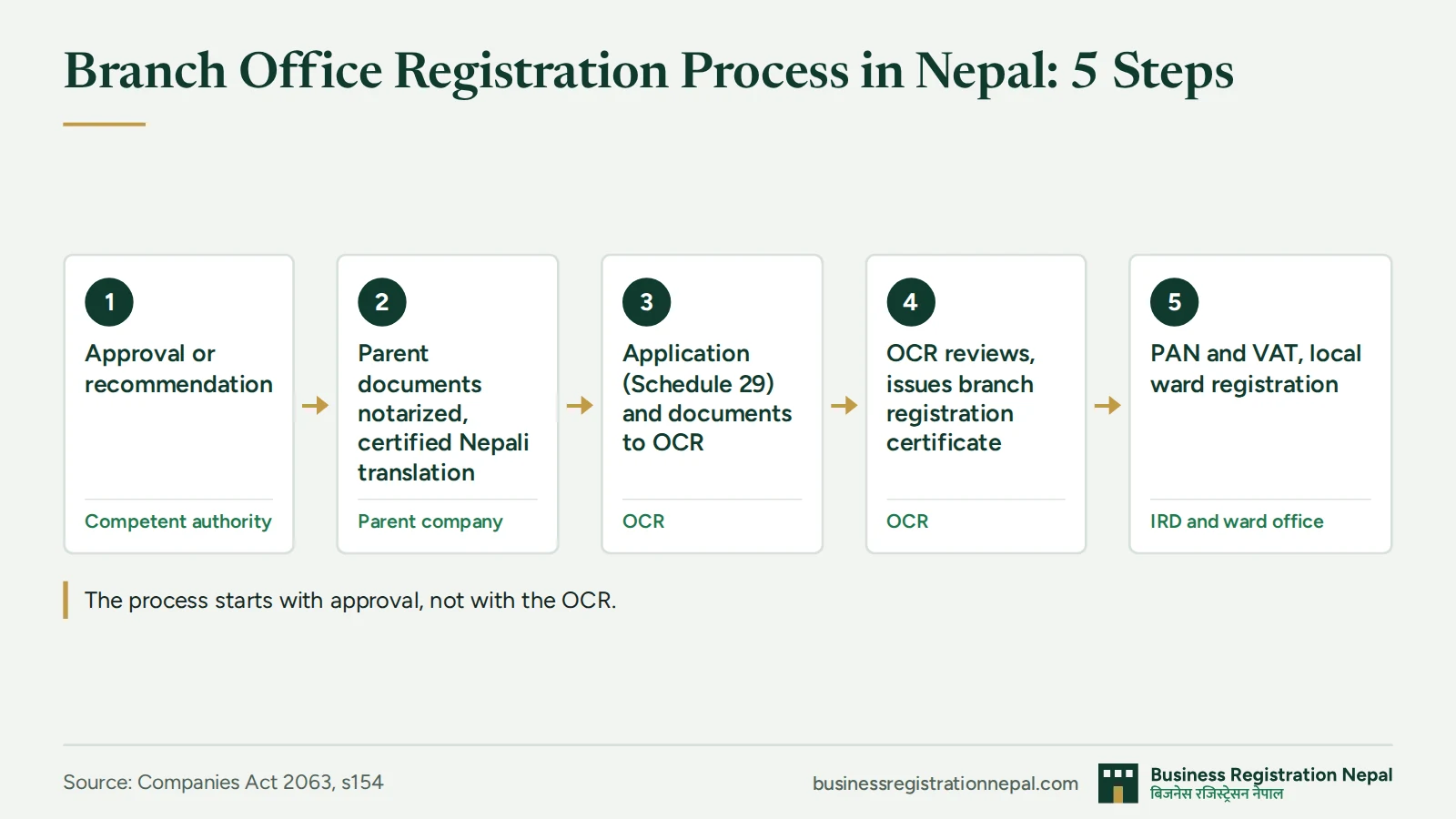
- Obtain approval / recommendation from the concerned competent authority
- Prepare the parent-company documents, notarized with certified Nepali translation
- Submit the application (Schedule 29) and documents to OCR
- OCR reviews the file and issues the branch registration certificate
- Register for PAN and VAT at the IRD and complete local ward registration
We prepare and submit each step through the authorized representative the parent appoints. The last step runs through our PAN registration and VAT registration services.
What Documents Are Required for Branch Office Registration?
Branch office Nepal documents come mostly from the parent company, and each foreign document needs a notarized Nepali translation. The OCR file holds 9 items:
0 of 9 ready
The authorized representative, or local representative, answers to the OCR for the branch. We review every paper against the current OCR checklist before filing.
Is There a Minimum Capital Requirement for a Branch Office?
No, there is generally no minimum capital requirement for a branch office under the Companies Act. A branch uses the parent's capital, so the no minimum capital position follows from its lack of a separate legal personality.
A sector regulator may still set its own capital condition, and a subsidiary faces the FDI minimum instead. We confirm the figure for your sector during the approval step.
How Much Does Branch Office Registration Cost in Nepal?
Branch office Nepal cost has two parts: the OCR government fee and the professional service fee. The OCR charges its government fee on a scale tied to the capital or investment the branch declares, starting at NPR 15,000 for an investment up to NPR 1 crore and set at NPR 100,000 where no investment amount is stated.
| Cost item | How it is set | Amount |
|---|---|---|
| OCR government fee | Scale based on declared capital or investment | NPR 15,000 up to NPR 1 crore; NPR 40,000 for NPR 1 to 10 crore; NPR 70,000 for NPR 10 to 20 crore; NPR 100,000 for NPR 20 to 30 crore, rising in higher bands; NPR 100,000 where no amount is stated |
| Notarization and translation | Per document, in the parent's country and in Nepal | Set by each notary and translator |
| Professional service fee | Scope of the filing and approval route | Quoted in a free consultation |
We quote our own fee in a free consultation once we know the sector and approval route.
How Long Does Branch Office Registration Take?
Branch office registration takes about 2 to 3 weeks on the shortest published estimate and 30 to 45 days on the longest. The OCR is required to register a complete application, or give its reasons, within 30 days. The competent authority approval comes before that and adds its own wait, which depends on the sector.
We shorten the part we control with complete, notarized documents at filing and prompt replies to OCR queries.
How Is a Branch Office Taxed in Nepal?
A branch office is taxed under the Income Tax Act 2058 on the income it earns in Nepal, and it must register for PAN and VAT with the IRD. A branch is taxed at the standard corporate rate of 25%, or 30% in sectors such as banking and telecommunications, and profit it repatriates to the parent is treated as a dividend and taxed at 5%.
Each year the branch must maintain books, file its tax return and file annual financial statements with the OCR within six months of the fiscal-year end. Those statements need an audit, which our statutory audit in Nepal team handles so the branch can comply on time.
What Is the Difference Between a Branch Office, Liaison Office and Subsidiary?
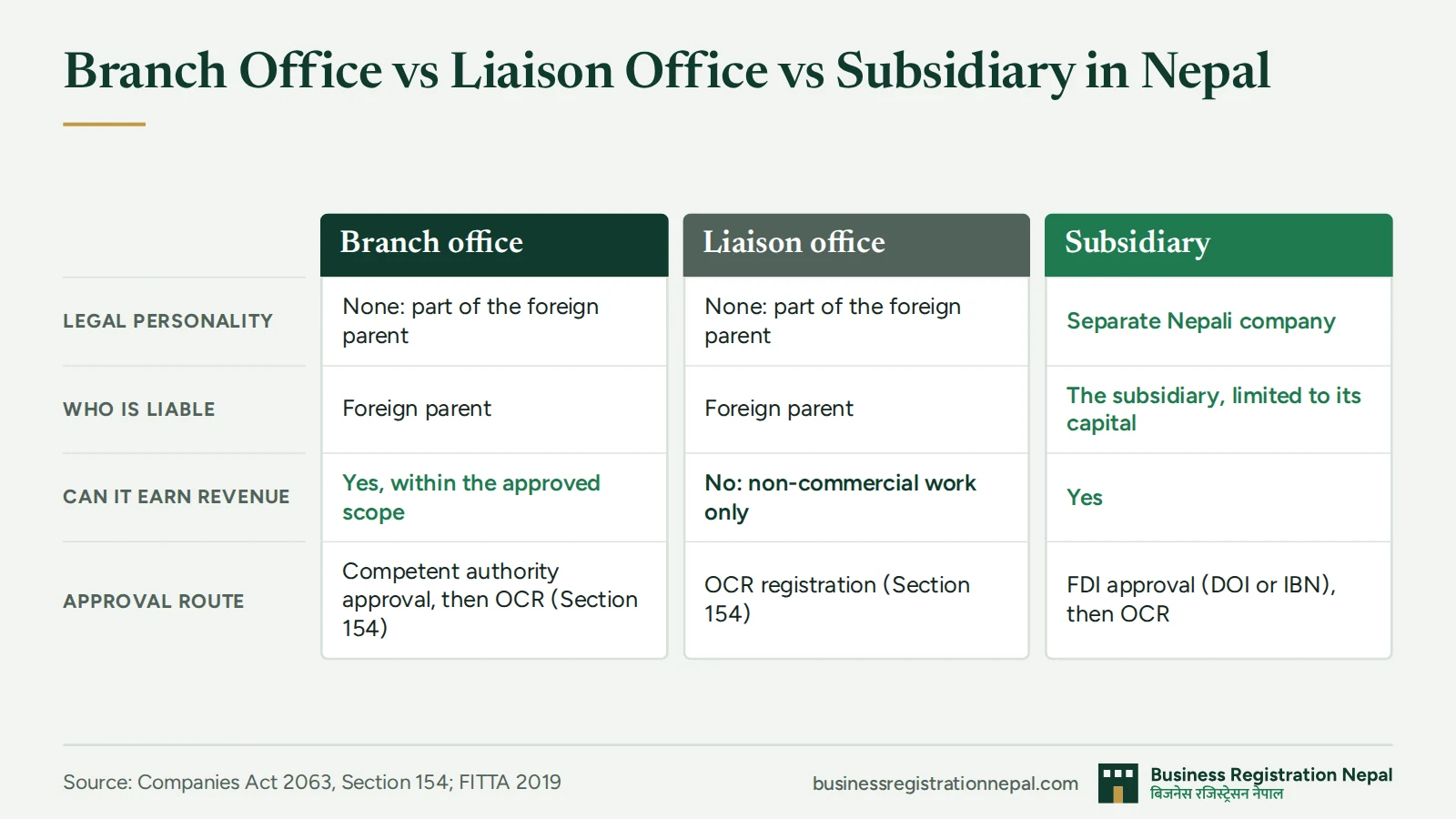
A branch office, a liaison office and a subsidiary differ on 5 points:
| Point | Branch office | Liaison office | Subsidiary |
|---|---|---|---|
| Legal personality | None; part of the foreign parent | None; part of the foreign parent | Separate Nepali company |
| Who is liable | Foreign parent | Foreign parent | The subsidiary, limited to its capital |
| Can it earn revenue | Yes, within the approved scope | No; non-commercial work only | Yes |
| Approval route | Competent authority approval, then OCR under Section 154 | OCR registration under Section 154; government approval usually not required, though the OCR may ask for one in a regulated sector | FDI approval (DOI or IBN), then OCR incorporation |
| Typical use | Carrying on the parent's business in Nepal | Market study and coordination | Long-term investment with local liability |
Branch office vs subsidiary turns on liability, since the branch exposes the parent and the subsidiary ring-fences it. Branch office vs liaison office turns on revenue, since only the branch may earn it. We handle both other routes through representative (liaison) office registration and subsidiary company registration.
Frequently Asked Questions
Can a branch office remit its Nepal profits to the parent company abroad?
Yes, a branch office can remit its Nepal profits to the parent company abroad through the banking channel. The branch pays its taxes before the transfer, and the remittance is recorded with Nepal Rastra Bank through our repatriation of profits service.
Is a branch office treated as a permanent establishment for income tax?
Yes, a branch office is generally taxed in Nepal as a permanent establishment on the income it earns here. A branch is taxed at the standard corporate rate of 25%, or 30% in sectors such as banking and telecommunications, and profit it repatriates to the parent is treated as a dividend and taxed at 5%.
Is the parent company liable for the Nepal branch's obligations?
Yes, the parent company is liable for the Nepal branch's obligations. A branch is not a separate legal entity, so the foreign parent carries responsibility for every contract, tax and debt the branch owes in Nepal.
Can a branch office sponsor work permits and visas for foreign staff?
Yes, a registered branch can support work-permit and visa applications for foreign staff, subject to the labour and immigration process. We confirm the current requirements with the labour and immigration authorities before you apply. The Department of Labour and Occupational Safety issues the work permit under the Labour Act 2074, and the Department of Immigration then issues the non-tourist visa.
Can a branch office later be converted into a subsidiary?
No, a branch office is not usually converted into a subsidiary. A foreign investor who wants a separate Nepali company registers a subsidiary instead, so we plan the structure at set-up.
Must a branch office file audited accounts even with limited activity?
Yes, a branch office must file audited accounts even with limited activity. It files annual returns and audited accounts for its Nepal operations regardless of turnover. The income tax return is due within three months of the fiscal year end, and the audited accounts go to the OCR within six months.