

A foreign investor earning profit from a company registered in Nepal under FDI moves it home through repatriation of profits: the lawful outbound transfer of foreign-investment earnings through the banking system after tax and foreign-exchange clearance. FITTA 2019 Section 20 makes FDI repatriation a statutory right. Business Registration Nepal handles the filings through our FDI & foreign company registration service and company registration in Nepal work, covering eligible funds, tax, process, documents and timing.
What Is Profit Repatriation from Nepal?
An FDI-approved foreign investor or foreign-owned company can repatriate profit from Nepal once its investment is recorded with the Department of Industry (उद्योग विभाग) and Nepal Rastra Bank (नेपाल राष्ट्र बैंक). Profit repatriation moves those earnings to the foreign investors abroad as an outbound transfer through the banking channel.
Repatriation of earnings differs from the exit of capital. Dividends and fees flow out year by year, while the original investment returns only on a share sale, capital reduction or liquidation.
What Can a Foreign Investor Repatriate from Nepal?
A foreign investor can repatriate 5 heads of eligible funds from Nepal:
- Dividends declared from after-tax profits
- Capital gains and sale proceeds from transfer of FDI shares
- Royalties, technical-service, management and franchise fees under approved contracts
- Original capital on exit (buyback, capital reduction, liquidation)
- Principal and interest on NRB-approved foreign loans
Dividend repatriation in Nepal is the recurring flow, since the board must declare a dividend before the company can distribute it, and repatriation of capital in Nepal comes at exit. A technical service fee or loan interest needs the underlying contract or loan approved before any payment leaves.
Which Laws and Authorities Govern Repatriation in Nepal?
Four laws and authorities govern repatriation in Nepal:
- FITTA 2019: Section 20 sets the repatriation right
- Nepal Rastra Bank (NRB): foreign-exchange approval under the Foreign Investment and Foreign Loan Management Bylaw 2078; its fifth amendment (December 2025) lets commercial banks approve dividend and profit remittances directly
- Department of Industry (DOI) or IBN: the repatriation recommendation
- Inland Revenue Department (IRD): tax clearance
These authorities act in sequence, so a gap at one stops the next. The investment must trace back to a recorded approval, the kind our FDI & foreign company registration service obtains at entry so the company can comply later.
What Taxes Apply Before You Repatriate?
Tax is paid and cleared in Nepal before any repatriation, and the IRD issues a tax clearance certificate only after the withholding tax is deposited. Withholding tax on dividends is 5% under the Income Tax Act 2058, and that withholding is final.
Royalties and technical and management fees carry withholding tax of 15% when paid to a non-resident, interest paid abroad carries withholding tax at the rate the Income Tax Act 2058 sets for that payment, and capital gains on share transfers are taxed at rates that depend on whether the shares are listed, the holding period and the seller. A DTAA can lower the applicable rate.
We treat repatriation tax as lawful compliance: we deduct, deposit and document the correct amount. Our tax clearance certificate service closes the IRD step.
What Is the Step-by-Step Repatriation Process?
The repatriation process in Nepal runs in 5 steps, from IRD to DOI to NRB, for anyone asking how to repatriate profit from Nepal:
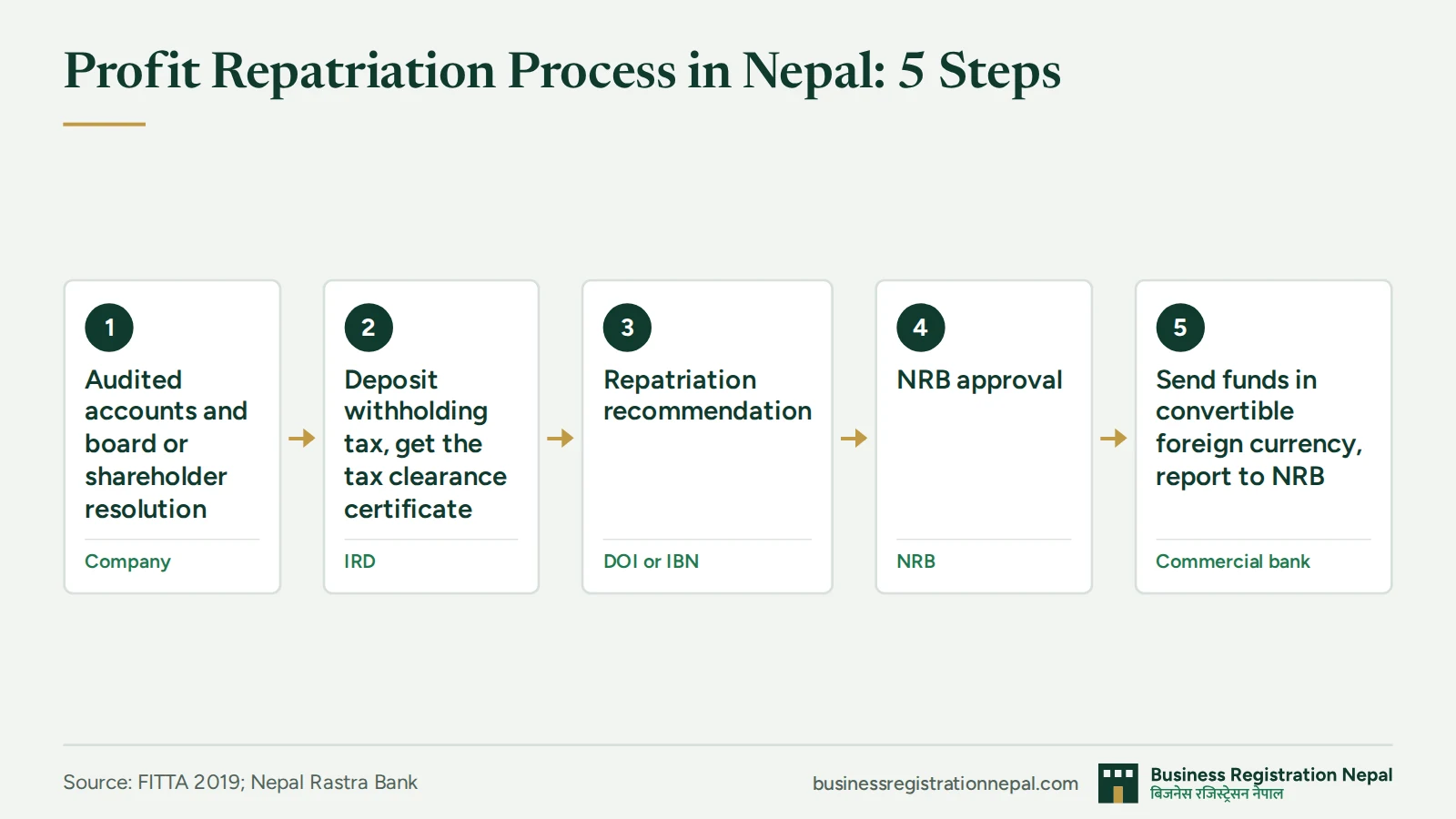
- Prepare audited financial statements and the board/shareholder resolution approving the distribution
- Compute and deposit withholding tax, then obtain the IRD tax-clearance certificate
- Apply to the Department of Industry (or IBN) for the repatriation recommendation
- Obtain NRB approval (or A-class bank approval within delegated limits for routine flows - VERIFY current delegation)
- The commercial bank executes the outbound transfer in convertible foreign currency and reports to NRB
NRB approval for repatriation is the central step, and without NRB approval, repatriation stops at an A-class commercial bank. The audit behind step 1 comes from our statutory audit in Nepal team, and the DOI repatriation recommendation, the Department of Industry recommendation in full, relies on up-to-date annual reports.
What Documents Are Required for Repatriation?
The bank and NRB ask for 10 documents before they execute a transfer:
0 of 10 ready
We verify the set against the checklist of the remitting bank, which applies the NRB bylaw, before we submit it.
How Long Does Repatriation Take in Nepal?
Repatriation takes about 2 to 4 weeks for a clean file, and longer where central NRB approval is needed. Under the fifth amendment to the NRB bylaw, the bank decides a complete application within 15 working days, and a transfer to a country other than the one the investment came from still needs NRB approval. Missing capital records or an open tax query extends that range.
What Are the Common Repatriation Blockers?
Six blockers stop a repatriation request in Nepal:
- Capital not reported to NRB at entry
- Informal or unregistered capital
- Overdue DOI annual reports
- IRD tax disputes
- Missing DTAA residency certificate
- Royalty above the NRB sector cap
We check all six before filing. An investment outside the approved scope, such as one in a negative list sector, has no approval to trace back to.
How Do Double Taxation Avoidance Agreements Reduce Repatriation Tax?
A DTAA lowers withholding tax where the foreign investor is tax-resident in a treaty partner country and holds a tax-residency certificate. Treaty rates differ by country and payment type, so we confirm each rate against the current DTAA text before the transfer.
The resident-country certificate goes to the IRD with the withholding claim. The reduced rate is a legitimate treaty benefit, applied as the treaty states.
Frequently Asked Questions
What is the difference between repatriating dividends, capital and royalties?
Dividends are a profit distribution, capital is the original investment returned on exit, and royalties are fees for technology or brand use. Each follows its own approval and tax path.
Can proceeds from selling shares or from liquidation be repatriated?
Yes, a foreign investor can repatriate proceeds from a share sale or a liquidation of a recorded investment through the banking channel after tax. The company must liquidate under the Companies Act and clear its taxes before the transfer. For a share sale, the transfer is recorded with the OCR and the Department of Industry and the capital gains tax is paid first.
Is fresh approval needed for every remittance?
Yes, each remittance goes through its own tax clearance and NRB or bank approval, while the investment itself is recorded once with the Department of Industry and Nepal Rastra Bank. Since the fifth amendment to the NRB bylaw in December 2025, the commercial bank approves a dividend or profit remittance directly, without a separate NRB approval.
Can foreign loan principal and interest be repatriated?
Yes, a foreign loan approved and recorded with NRB can service principal and interest abroad through the banking channel. We check the NRB loan approval and the approved repayment schedule before the payment leaves.
What can block a repatriation request?
An investment never recorded with the Department of Industry or Nepal Rastra Bank at entry is the common blocker of a repatriation request. Unpaid taxes and missing documents stall a request too.
Which countries has Nepal signed double-taxation treaties with?
Nepal has signed double-taxation treaties with 11 countries: India, Norway, Thailand, Sri Lanka, Austria, Pakistan, China, Mauritius, South Korea, Qatar and Bangladesh. Each treaty can lower withholding tax on outbound payments. Confirm the rate for the investor's country before the transfer.