


A foreign investor entering Nepal with a local partner forms a joint venture: a company the foreign investor and a Nepali partner own together, sharing ownership, profit, risk and management under Nepali law. It is established as FDI in Nepal under FITTA 2019 and the Companies Act 2063. Business Registration Nepal handles this through our FDI & foreign company registration service and company registration in Nepal work, covering the agreement, approval process, ownership, sectors and structure choice.
What Is a Joint Venture Company in Nepal?
A joint venture company, Nepal-registered and jointly owned, is a share company in which a foreign investor and a Nepali partner hold equity together. Each foreign joint venture in Nepal pairs the foreign party's capital with the local partner's presence in the market.
In some regulated sectors a JV is the preferred or required route, because sector caps limit foreign shareholding. Under the Schedule to FITTA 2075, listed consultancy services, for example, allow foreign ownership up to 51%, so a Nepali partner holds the rest. We check the sector before the partners negotiate terms.
What Is the Difference Between an Equity and a Contractual Joint Venture?
Partners forming a JV in Nepal choose between two routes. An equity joint venture is a new share company the partners incorporate, and it is the common registered route in Nepal. A contractual JV is a cooperation governed by contract alone, with no new company and no shared equity.
Nepal's treatment of a contractual JV for tax and registration needs confirming case by case with the IRD and the relevant regulator. We advise the equity route where the foreign investor needs FDI approval and NRB capital recording, since both attach to a registered company.
What Should a Joint Venture Agreement Cover?
A JV agreement in Nepal, signed as a shareholders agreement or JV contract, should cover 5 clauses:
- Ownership and shareholding split (e.g. 51/49, 70/30, 50/50)
- Capital contribution and profit sharing
- Management and board control
- Dispute resolution (Nepali courts or arbitration)
- Transfer, pre-emption and exit provisions
These clauses decide who controls the jointly-owned company and how the exit mechanism works. We draft the joint venture agreement with both partners so it matches the company's articles.
Which Laws and Authorities Govern a Joint Venture?
FITTA 2019 and the Companies Act 2063 govern a joint venture in Nepal as foreign direct investment. The Department of Industry (DOI) grants Department of Industry approval for foreign investment up to NPR 6 billion, and Investment Board Nepal (IBN) approves larger projects, with hydropower above 200 MW going to IBN under the Public-Private Partnership and Investment Act 2075. Since February 2026, investment in 102 listed sectors can use the automatic route with no upper limit.
Nepal Rastra Bank (NRB) records the capital and approves later repatriation. The Office of the Company Registrar (OCR) handles incorporation, and the IRD registers the company for tax so it can operate and comply from its opening month.
What Is the Step-by-Step Joint Venture Formation Process?
The FDI process in Nepal for a JV runs in 5 steps, from agreement to capital recording:
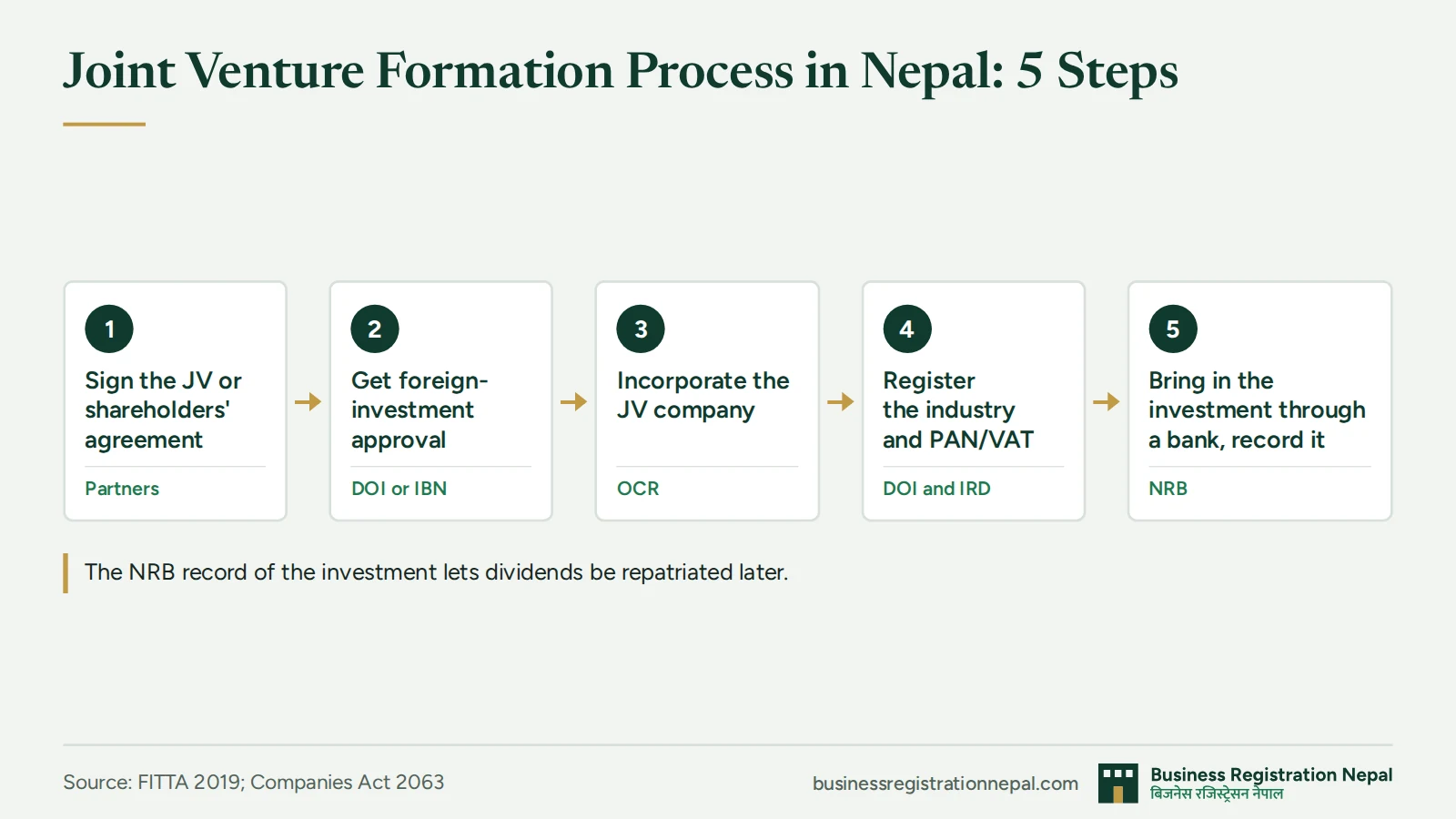
- Sign the joint venture / shareholders' agreement between partners
- Obtain foreign-investment approval from DOI (or IBN)
- Incorporate the JV company at OCR
- Register the industry at DOI and complete tax (PAN/VAT) registration
- Inject the investment through the banking channel and record it with NRB
Incorporation follows the same OCR route as how to register a company in Nepal, with the foreign investment approval attached. The capital injection in the last step lets NRB record the investment so dividends can later be repatriated.
What Is the Minimum Investment and Ownership Structure for a JV?
The minimum foreign investment for a JV is NPR 20 million, and listed information technology and digital industries, such as software development, data processing and BPO, are exempt from that minimum. The ownership structure Nepal law permits for a non-resident investor depends on the sector:
- Common splits: 51/49, 70/30, 50/50
- Sector ownership caps (VERIFY): telecommunications, banking/financial, insurance, consultancy
We structure the split before the DOI application, since the approval records each partner's shareholding.
Which Sectors Suit a Joint Venture in Nepal?
A joint venture suits 6 sectors in Nepal, where a local partner or shared capital is common or mandatory:
- Hydropower and energy
- Banking and financial services
- Manufacturing
- Tourism and hospitality
- Infrastructure projects
- Information technology
Sector-specific rules apply in each, so we check the negative list and the permissible foreign share before the partners sign. Banking, for one, needs NRB licensing as well as FDI approval, under the Bank and Financial Institution Act 2073.
What Documents Are Required for a Joint Venture?
The JV file needs documents from both partners, and every foreign paper must be notarized. The DOI and OCR ask for 5 items:
0 of 5 ready
We review the full set against the current DOI and OCR checklist before filing.
How Long Does Joint Venture Registration Take?
Joint venture registration takes about 1 to 2 months on the shortest published estimate and 3 to 5 months on the longest, for the full FDI and incorporation path. The automatic route for listed sectors shortens the approval step. Investment size and sector decide where a file lands in that range.
We shorten the part we control with a complete file and prompt replies to DOI, OCR and NRB queries.
What Is the Difference Between a Joint Venture and a Wholly-Owned Subsidiary?
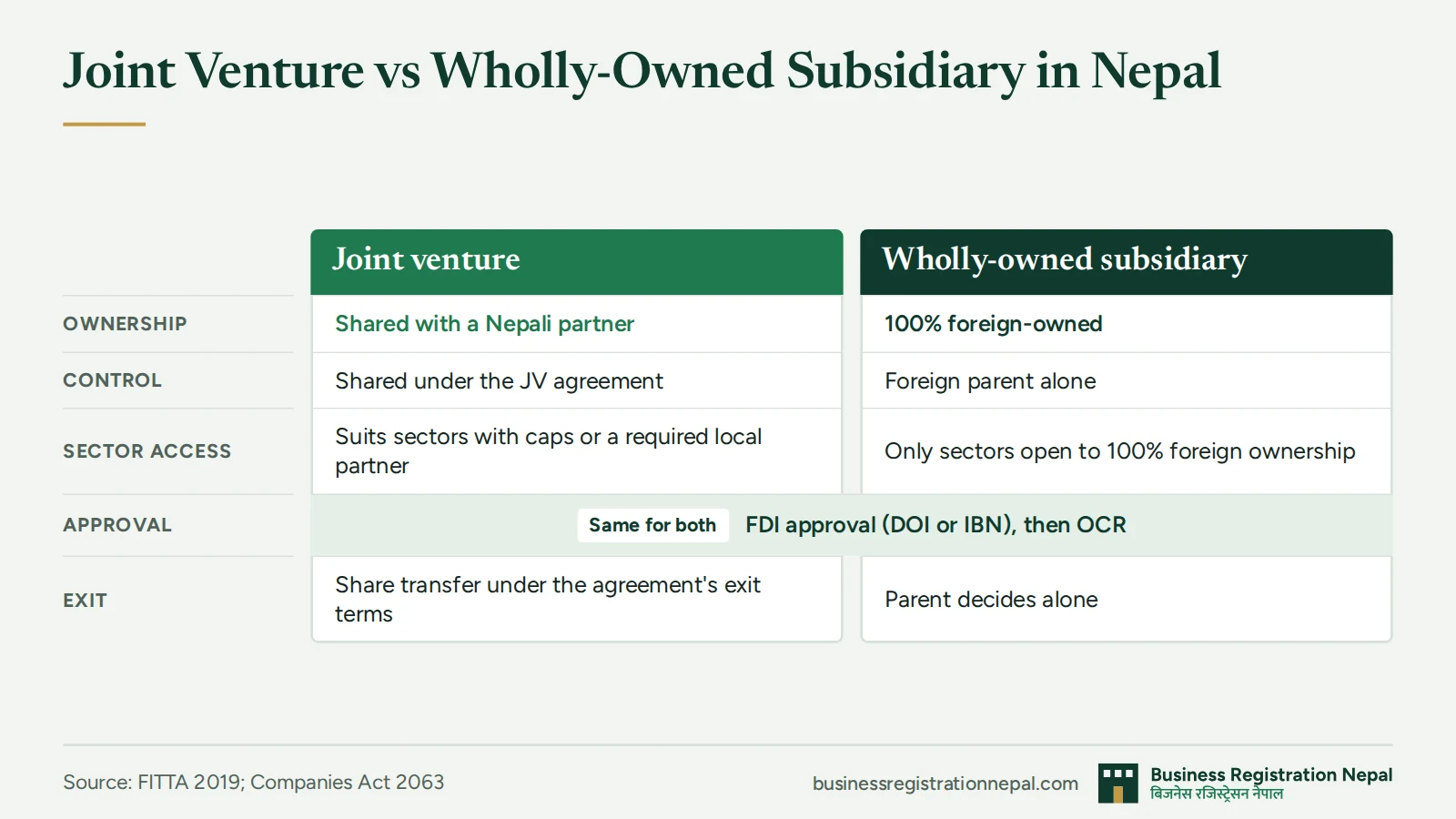
A joint venture and a wholly-owned subsidiary differ on 5 points:
| Point | Joint venture | Wholly-owned subsidiary |
|---|---|---|
| Ownership | Shared with a Nepali partner | 100% foreign-owned |
| Control | Shared under the JV agreement | Foreign parent alone |
| Sector access | Suits sectors with caps or a required local partner | Only sectors open to 100% foreign ownership |
| Approval | FDI approval (DOI or IBN), then OCR | FDI approval (DOI or IBN), then OCR |
| Exit | Share transfer under the agreement's exit terms | Parent decides alone |
Joint venture vs subsidiary in Nepal comes down to control against access: the subsidiary keeps full control, and the JV opens capped sectors. We handle the wholly-owned route through subsidiary company registration.
Frequently Asked Questions
Can a foreign partner hold a majority stake in a Nepali joint venture?
Yes, a foreign partner can hold a majority stake in most sectors, since foreign ownership up to 100% is allowed outside the negative list. Some sectors cap foreign shareholding, so we check the sector before we structure the JV: listed consultancy services, for example, allow up to 51% foreign ownership.
Does a joint venture go through an automatic route or need approval?
Yes, a joint venture needs approval in most cases: the Department of Industry approves foreign investment up to NPR 6 billion and the Investment Board above that. The automatic route covers 102 listed sectors, and a February 2026 notice removed its NPR 500 million upper limit.
Can the foreign partner's dividends and capital be repatriated?
Yes, a recorded foreign investment can repatriate dividends and, on exit, capital through the banking channel after tax. NRB approves each transfer, which our repatriation of profits service handles, under FITTA 2075.
How are disputes between joint-venture partners resolved?
Disputes between joint-venture partners are resolved by the mechanism the JV agreement sets in advance, commonly arbitration, with the seat and governing law stated. We draft that clause with both named, so neither partner contests the forum later.
Can the foreign partner exit by selling shares to another foreigner?
Yes, a foreign partner can exit by selling shares to another foreigner. The transfer needs the relevant investment approval and NRB recording, following the share transfer process in Nepal under FITTA 2075.
How does a double-taxation treaty affect the foreign partner's dividends?
A double-taxation treaty reduces the withholding tax on the foreign partner's dividends where Nepal has a treaty with the partner's country. Eligibility and the rate need confirming for each treaty before the dividend is paid. Without a treaty, Nepal withholds 5% tax on dividends under Section 88 of the Income Tax Act 2058.