

The capital increase process in Nepal runs in 5 steps under the Companies Act 2063, Section 56:
- Step 1: Pass a board resolution proposing the increase.
- Step 2: Pass a special resolution at the general meeting.
- Step 3: Amend the capital clause of the MOA/AOA.
- Step 4: Deposit the increased capital and obtain the bank statement.
- Step 5: File with the Office of the Company Registrar (OCR) and pay the incremental fee.
The difference between authorized and paid-up capital is ceiling against money. Authorized capital caps shares in the memorandum of association (MOA), and paid-up capital is what shareholders deposit.
A company raises capital to fund expansion, meet sector minimums or issue new and bonus shares. The OCR file carries 7 documents, led by the meeting minutes and the amended MOA clause.
The OCR fee is the fee on the new authorized capital less the fee already paid. The capital increase takes up to 30 days to file after the resolution, and the OCR records it within 7 days. Each capital increment updates the record created at company registration in Nepal.
What Is the Difference Between Authorized and Paid-Up Capital?
Authorized capital is the share ceiling in the memorandum of association (MOA), and paid-up capital is the money shareholders have subscribed and deposited for issued shares. The MOA records both figures.
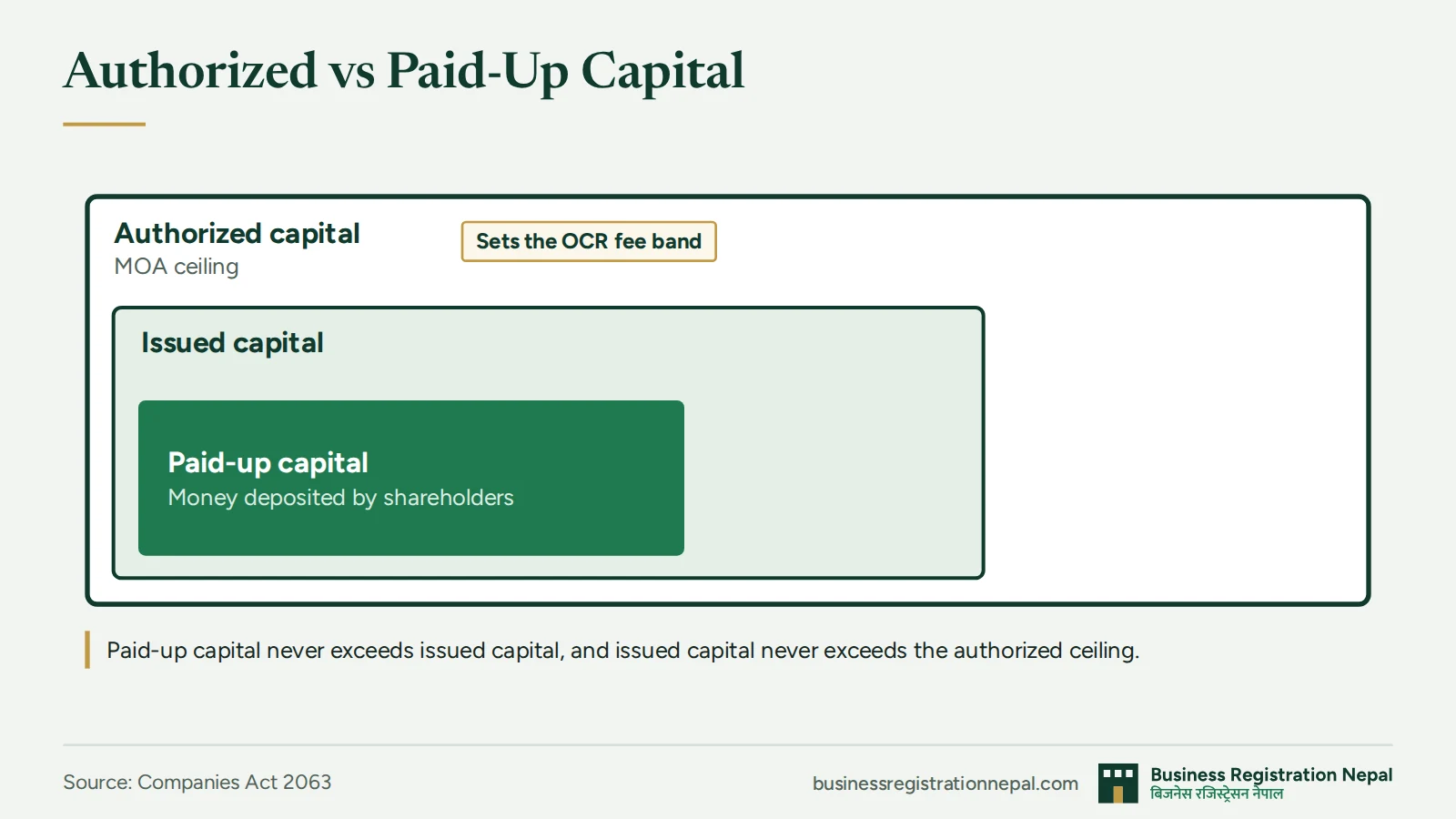
Authorized capital, or registered capital, fixes the company's OCR registration fee band. Paid-up capital (subscribed capital) never exceeds the issued capital, and issued capital never exceeds the authorized ceiling.
Authorized capital vs paid-up capital differs on 5 attributes, as the table shows.
| Attribute | Authorized capital | Paid-up capital |
|---|---|---|
| Meaning | Maximum share capital the MOA lets the company issue | Amount shareholders have paid for issued shares |
| Resolution to raise it | Special resolution of the general meeting | Ordinary resolution to issue shares within the authorized limit, then payment |
| OCR registration fee | Charged on the rise in capital | No fee difference within the authorized limit |
| Legal minimum | NPR 1 lakh at company registration | NPR 1 crore for a public company |
| Evidence | MOA capital clause | Share allotment and the share register |
A company raises authorized capital when a new issue would pass the ceiling, and raises paid-up capital when shareholders pay for shares below it.
Why Do Companies Increase Capital?
A company increases capital for 5 reasons: expansion, sector minimum-capital rules, fresh equity, new or bonus share issues, and stronger creditworthiness. Each reason starts a company capital increase in Nepal under the same Companies Act 2063 rules.
The 5 reasons behind a capital increment are these:
- Expansion: new projects, branches or equipment need funds beyond the existing paid-up capital.
- Sector minimum capital: a public company holds at least NPR 1 crore of paid-up capital, and each foreign investor brings at least NPR 20 million. Regulated sectors set their own floor, such as Nepal Rastra Bank for banks and financial institutions and the Nepal Insurance Authority for insurers.
- Equity raising: new investors buy shares, adding capital without a loan. In a public company, existing shareholders take right shares in proportion to their holding.
- Bonus or new share issues: a new issue above the ceiling needs a higher authorized capital, and bonus shares turn profits into paid-up capital.
- Creditworthiness: a larger paid-up capital shows banks and suppliers more equity behind the company.
Every reason ends in the same record at the Office of the Company Registrar (OCR), the Company Registrar that keeps each company's capital figures.
What Is the Capital Increase Process in Nepal?
5 steps make up the capital increase process in Nepal, from a board resolution to the OCR filing and fee. Section 56 of the Companies Act 2063 lets a company alter share capital by special resolution, subject to its articles of association (AOA).
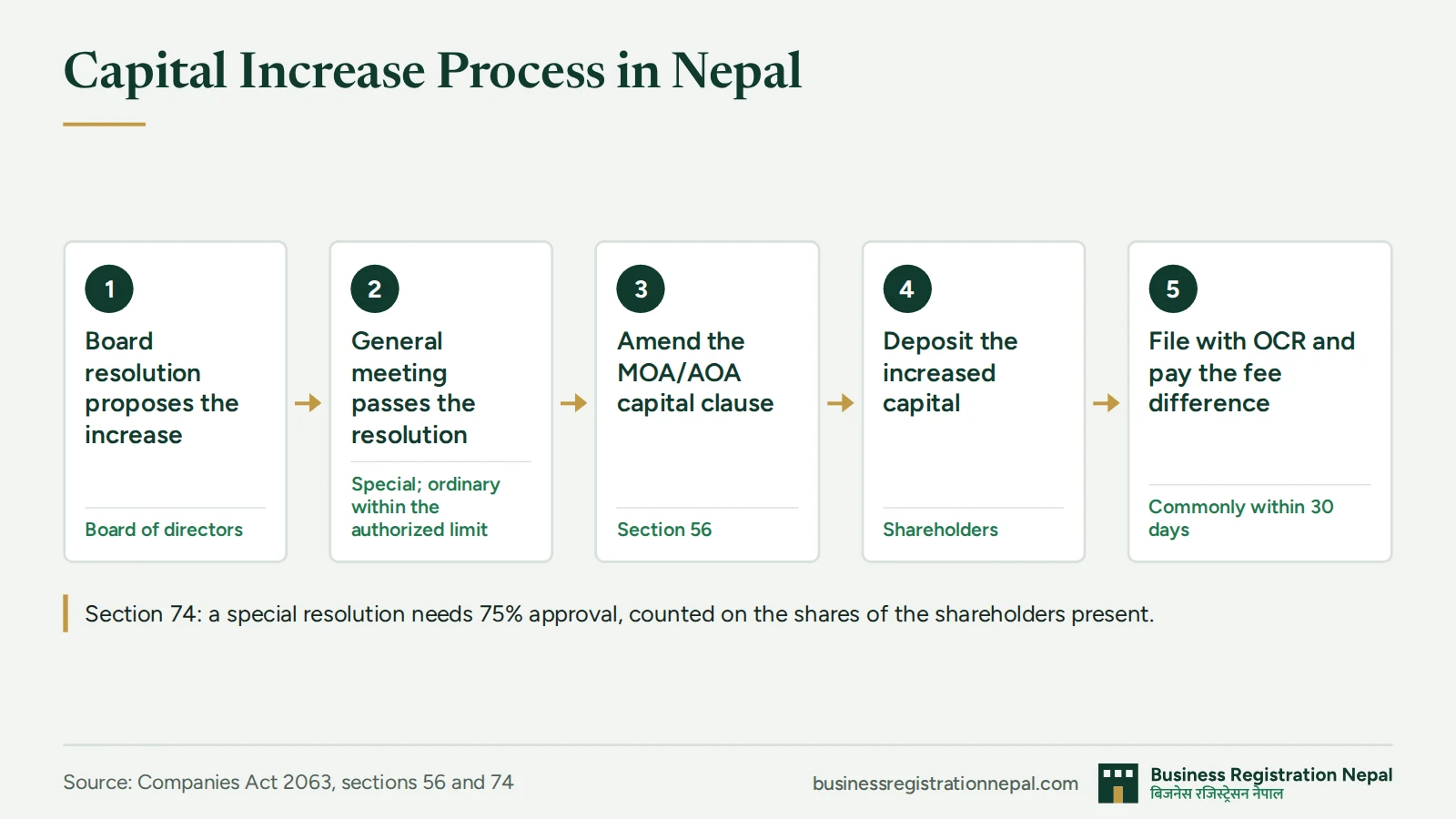
To increase authorized capital in Nepal, a company follows these 5 steps in order:
- Step 1: Pass a board resolution proposing the increase. The board of directors fixes the new amount and calls the general meeting to decide it.
- Step 2: Pass a special resolution at the general meeting (ordinary resolution if issuing within the authorized limit). Under Section 74, a special resolution needs 75% approval, counted on the shares of the shareholders present.
- Step 3: Amend the capital clause of the MOA/AOA. Section 56 deems the MOA and AOA amended to the extent of the new capital. The capital clause change follows the MOA amendment process, with its special resolution and 30-day OCR notice.
- Step 4: Deposit the increased capital and obtain the bank statement. Shareholders pay for the new shares into the company's bank account, and the bank statement for that deposit goes into the OCR file.
- Step 5: File with OCR (commonly within 30 days) and pay the incremental fee. The company submits the resolution, the amended clause and the fee on the added authorized capital.
The OCR record of the new capital closes the capital increase process. Nepal's Company Registrar then applies the amended MOA to every later share issue.
What Documents Are Required to Increase Capital?
A share capital increase in Nepal requires 7 documents, led by the application letter, the general-meeting minutes and the amended MOA or AOA clause. The company submits them to the OCR with the registration fee.
The OCR lists most of these papers under its Companies Act section 56 heading on share capital alteration. The 7 documents are:
0 of 7 ready
OCR staff verify each document against the resolution before recording the change. A foreign-employment company adds a letter from the Department of Labour and Employment Promotion, and a security-guard company adds one from its regional administration office.
What Is the OCR Fee to Increase Capital?
The OCR capital increase fee is the registration fee on the new authorized capital, less the fee already paid on the old capital. The Office of the Company Registrar charges this incremental fee only when authorized capital rises.
The table shows the incremental fee for 4 sample increases on the OCR fee scales, in NPR.
| Capital increase | Fee at old capital | Fee at new capital | Incremental fee |
|---|---|---|---|
| Private company, NPR 20 lakh to NPR 1 crore | 9,500 | 16,000 | 6,500 |
| Private company, NPR 1 crore to NPR 5 crore | 16,000 | 28,000 | 12,000 |
| Private company, NPR 5 crore to NPR 10 crore | 28,000 | 43,000 | 15,000 |
| Public company, NPR 1 crore to NPR 10 crore | 15,000 | 40,000 | 25,000 |
A paid-up capital increase within the authorized limit carries no additional registration fee. The capital increase fee in Nepal follows the same scales that company registration cost and fees lists band by band.
How Long Does the Capital Increase Take?
A capital increase takes up to 30 days to file after the resolution, and the OCR records it within 7 days of a complete submission. Both limits come from the Companies Act 2063, and OCR staff verify the file before the record.
The 30-day limit runs from the amendment of the MOA or AOA, and the OCR informs the company of the record within 7 days. Meeting notice adds time before the resolution. A public company gives 21 days' notice for an annual general meeting and 15 days for an extraordinary general meeting.
3 events lengthen the timeline: a DOI or NRB approval, an OCR request for corrections, and a late share payment.
Frequently Asked Questions
Is there a minimum or maximum authorized capital for a private company?
Yes, a minimum applies: the OCR registers a private company with at least NPR 1 lakh of authorized capital. No fixed maximum applies to an ordinary private company, so founders choose the amount at registration and raise it later. Regulated sectors set their own minimum capital, such as Nepal Rastra Bank for banks and financial institutions and the Nepal Insurance Authority for insurers.
Can capital be decreased later, and how?
Yes, a company reduces share capital by special resolution of the general meeting and court approval, under Section 57 of the Companies Act 2063. The OCR then records the reduction from the application, the amendment details and a certified copy of the court-approved decision. An insolvent company cannot reduce its capital this way.
Can I increase authorized capital without issuing new shares?
Yes, a company raises its authorized capital as a ceiling and allots the new shares afterwards. Paid-up capital changes only when the company issues shares and shareholders pay for them. To increase paid-up capital in Nepal later, the general meeting passes an ordinary resolution for shares within the authorized limit.
Can capital be increased through bonus shares instead of fresh cash?
Yes, a company issues bonus shares from its profits or from funds created out of profits, which raises paid-up capital without new cash. Section 56 of the Companies Act 2063 bars any capital increase or bonus issue made by revaluing assets. The Income Tax Act 2058 treats bonus shares as a distribution of profit, like a cash dividend, so the company withholds 5% tax on the bonus issue.
Does increasing capital in a foreign-owned company need extra approval?
Yes, a foreign-invested company adds a DOI approval or recommendation letter to its OCR capital increase file. The DOI approves foreign investment up to NPR 6 billion, and Investment Board Nepal (IBN) approves larger amounts. The company or investor then applies to NRB to record the added investment within six months of the remittance.
Is stamp duty payable on a capital increase?
Stamp duty depends on the documents involved, so the company confirms whether any stamp charge applies before filing, alongside the incremental OCR registration fee.