


A shareholder in Nepal is added or removed in 4 steps under the Companies Act 2063:
- Step 1: Decide the change and pass the board or general-meeting decision.
- Step 2: Execute the transfer or allotment and update the share register.
- Step 3: Update the shareholder list.
- Step 4: File the change with the Office of the Company Registrar (OCR) on CAMIS, its online portal.
The shareholder change process in Nepal adds a member through a new share allotment or a share transfer. It removes one through a transfer, a buyback or the forfeiture of shares with unpaid calls.
The OCR file carries 7 documents, led by the sale deed or allotment record and the certified board minutes. A foreign shareholder adds Department of Industry (DOI) or Investment Board Nepal (IBN) approval and Nepal Rastra Bank (NRB) compliance under the Foreign Investment and Technology Transfer Act 2019 (FITTA). The share register opened at company registration in Nepal records every change.
How Are Shareholders Added in Nepal?
To add a shareholder in Nepal, a company uses 2 routes: it issues and allots new shares by board resolution, or an existing shareholder transfers shares to the new member. Both routes end with the new name in the share register.
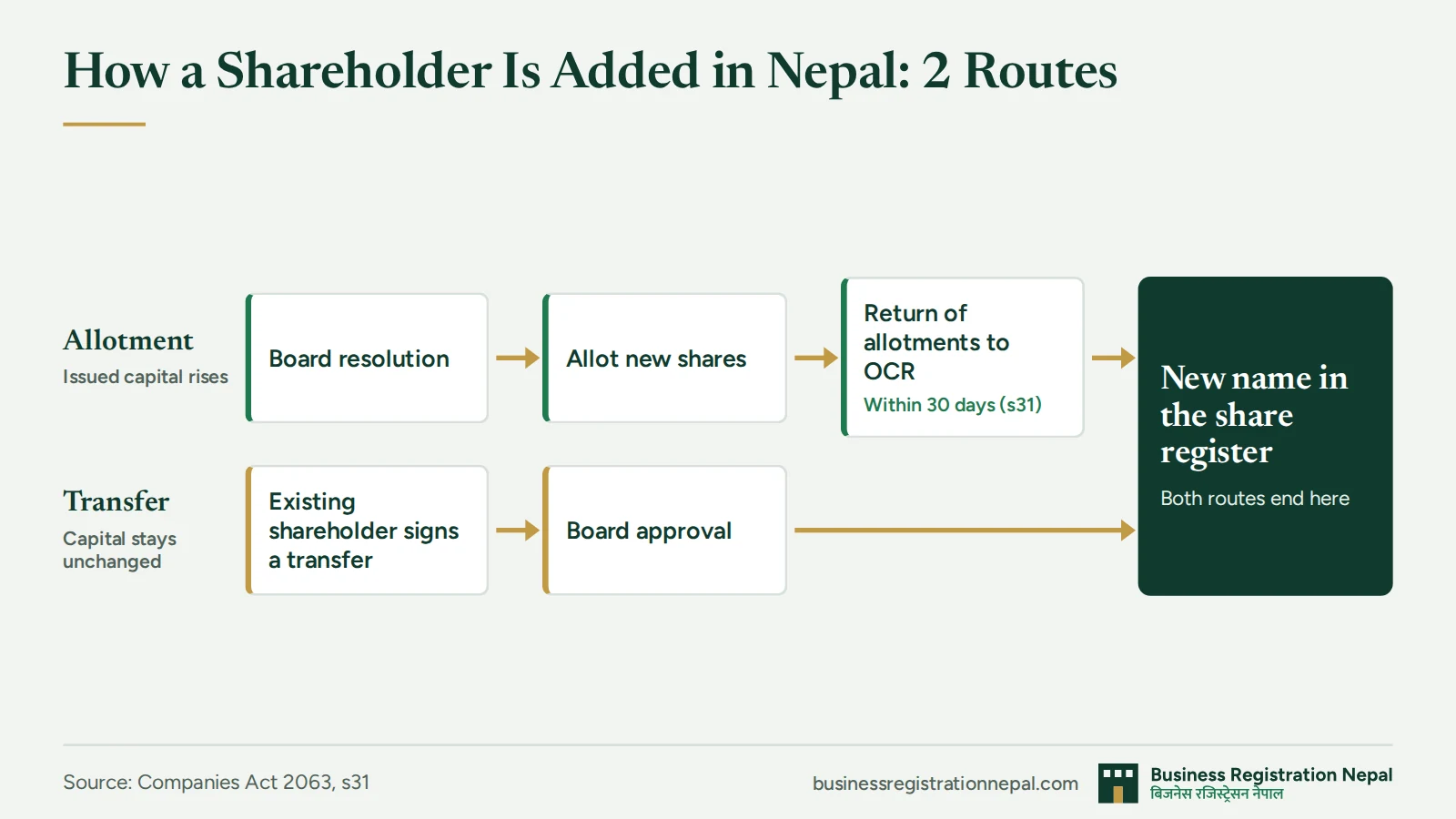
A share allotment, or share issue, gives new shares to the incoming shareholder and raises the company's issued capital. Under section 31 of the Companies Act 2063, the company files a return of allotments within 30 days with the Office of the Company Registrar (OCR). The return names each allottee and states the amount paid or due on each share.
New shares fit inside the authorized capital that the memorandum of association (MOA) sets. A company short of authorized capital follows the capital increase process, where a special resolution of the general meeting amends the MOA before allotment.
A share transfer moves existing shares from a current holder to the new member, so the company's capital stays unchanged.
The sale follows the Act, the MOA and the articles of association (AOA), which set the rules to add or remove shareholder names by transfer. A private company adds members only up to its limit of 101 shareholders. The buyer's application to the registered office starts the share transfer process, which ends with the register entry.
What Is the Shareholder Change Process?
The shareholder change process in Nepal runs in 4 steps: the decision, the transfer or allotment, the revised shareholder list and the OCR filing. A private company makes each member change through the same 4 steps, with its AOA setting any extra approval.
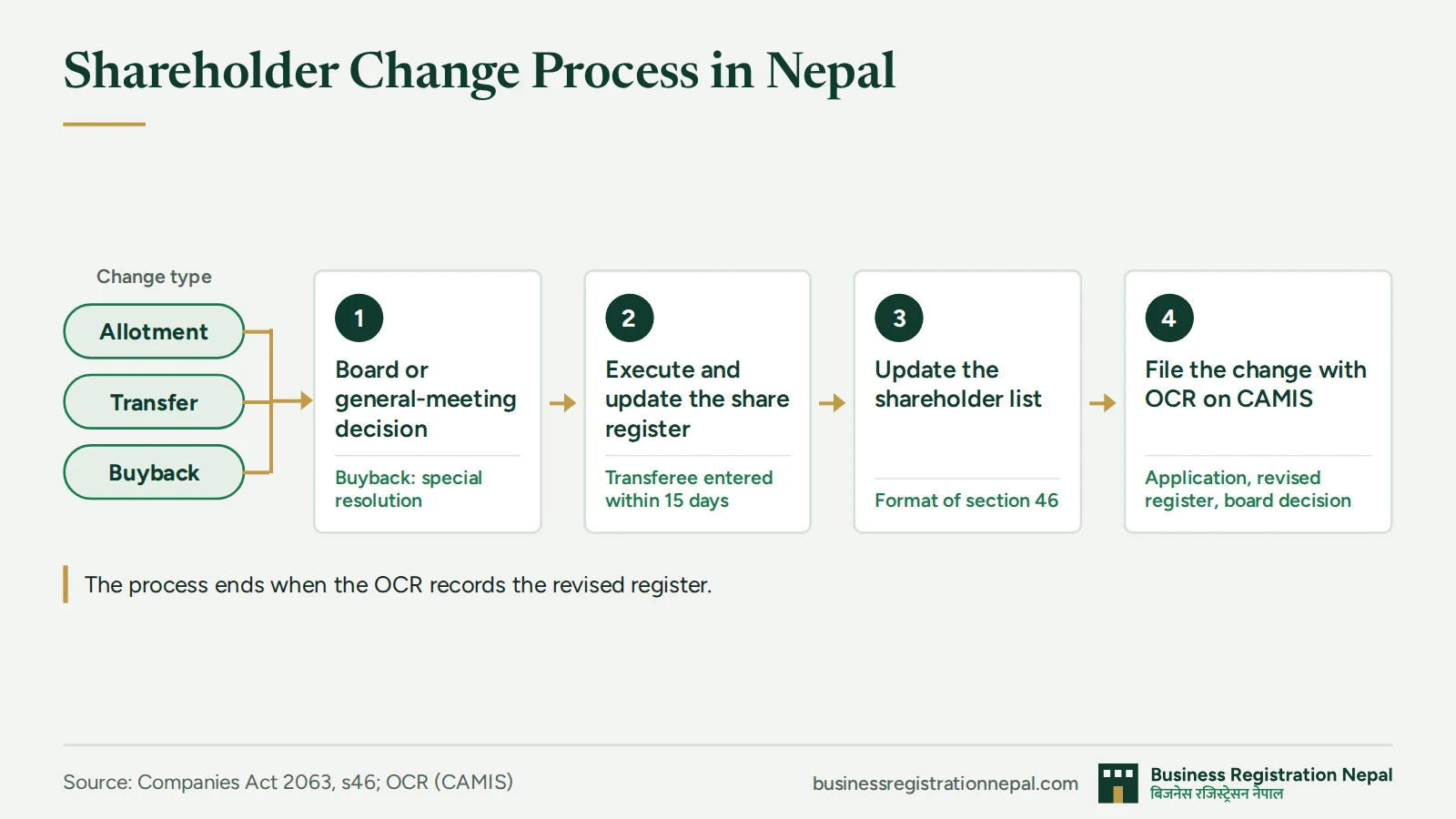
- Step 1: Decide the change (allotment, transfer or buyback) and pass the board/general-meeting decision. The board of directors decides an allotment or approves a transfer. A buyback or a rise in authorized capital needs a special resolution of the general meeting.
- Step 2: Execute the transfer or allotment and update the share register. The seller and buyer sign the share sale deed, or the company issues the allotted shares. The company enters a transferee in its members register within 15 days of the transfer application.
- Step 3: Update the shareholder list. The revised list shows each shareholder's name, address, share numbers and amount paid, in the format section 46 of the Companies Act 2063 prescribes.
- Step 4: File the change with OCR (CAMIS) after the register entry. The OCR takes the application, the revised register and the certified board decision through CAMIS, its online system for company administration.
The shareholder change process Nepal companies follow ends when the OCR records the revised register. The Company Registrar's record then matches the company's own members register.
Frequently Asked Questions
How do I add a new shareholder in Nepal?
A company adds a new shareholder in Nepal by allotting new shares under a board resolution or by recording a transfer of existing shares. The company then updates its share register and files the change with the OCR.
How do I remove a shareholder in Nepal?
A shareholder leaves a Nepali company through a share transfer, a buyback or the forfeiture of shares with unpaid calls. The company then strikes the name from its share register and files the revised list with the OCR.
Do I need to notify OCR of a shareholder change?
Yes, a company in Nepal notifies the OCR by filing the updated shareholder register with the certified board decision on the change. The Companies Act 2063 fixes 15 days for entering a transfer in the company's register and 30 days for a return of allotments.
Can a foreign national become a shareholder in a Nepali company?
Yes, a foreign national becomes a shareholder in a Nepali company through the FDI route, with DOI or IBN approval under FITTA 2019 and NRB compliance. The investment is at least NPR 20 million per foreign investor, and the funds arrive through the banking system.