

Society registration in Nepal is the legal registration of a non-profit membership association (sanstha) at the District Administration Office (DAO), whose Chief District Officer (CDO) is the registering authority. The governing law is the Association Registration Act 2034 (संस्था दर्ता ऐन, २०३४).
The society registration process in Nepal runs in 4 steps:
- Step 1: Decide the structure and draft the constitution.
- Step 2: Hold the founding meeting.
- Step 3: Submit the application and documents to the DAO.
- Step 4: Complete verification and receive the certificate.
At least 7 founding members establish a society and file 7 documents, led by the application, the constitution and a ward recommendation.
Social, cultural, educational and professional societies are the main types, and national-level bodies affiliate with the Social Welfare Council. Renewal at the DAO follows every fiscal year with an audit report. A for-profit business skips the DAO society route and follows company registration in Nepal at the Office of the Company Registrar.
What Is a Society in Nepal?
A society in Nepal is a non-profit, non-governmental membership association that its founders register with the District Administration Office (DAO) for legal recognition. Nepali usage calls it a sanstha, sangh or samaj.
The Association Registration Act 2034 covers associations, institutions, clubs, circles, councils and study centres. Each one serves a social, cultural, educational, religious, literary, scientific, vocational or philanthropic purpose on a not-for-profit basis.
Society registration, Nepal's route to legal status for such a group, turns it into an autonomous body corporate with perpetual succession and its own seal. The registered society holds property and sues in its own name.
Which Law and Authority Govern Society Registration?
Two laws govern society registration in Nepal: the Association Registration Act 2034 for registration at the DAO, and the Social Welfare Act 2049 for affiliation with the Social Welfare Council (SWC). The Chief District Officer (CDO) acts as the registering authority.
The CDO heads the District Administration Office and serves as the local authority under the 2034 Act. Association registration in Nepal therefore happens in the district where the society keeps its office. The society then operates under the constitution that the DAO registers.
The Act leaves the certificate format, validity period and renewal fee to the Association Registration Rules 2034. A national-level body may affiliate with the SWC after DAO registration. Affiliation under the Social Welfare Act 2049 is optional and becomes necessary when the society plans to receive foreign grants or work on SWC-approved projects, and it is renewed every 3 years.
What Is the Society Registration Process?
The society registration process runs in 4 steps, from drafting the constitution to receiving the DAO registration certificate. To register a society in Nepal, the founding members act together at every step, and the DAO checks each of them in person.
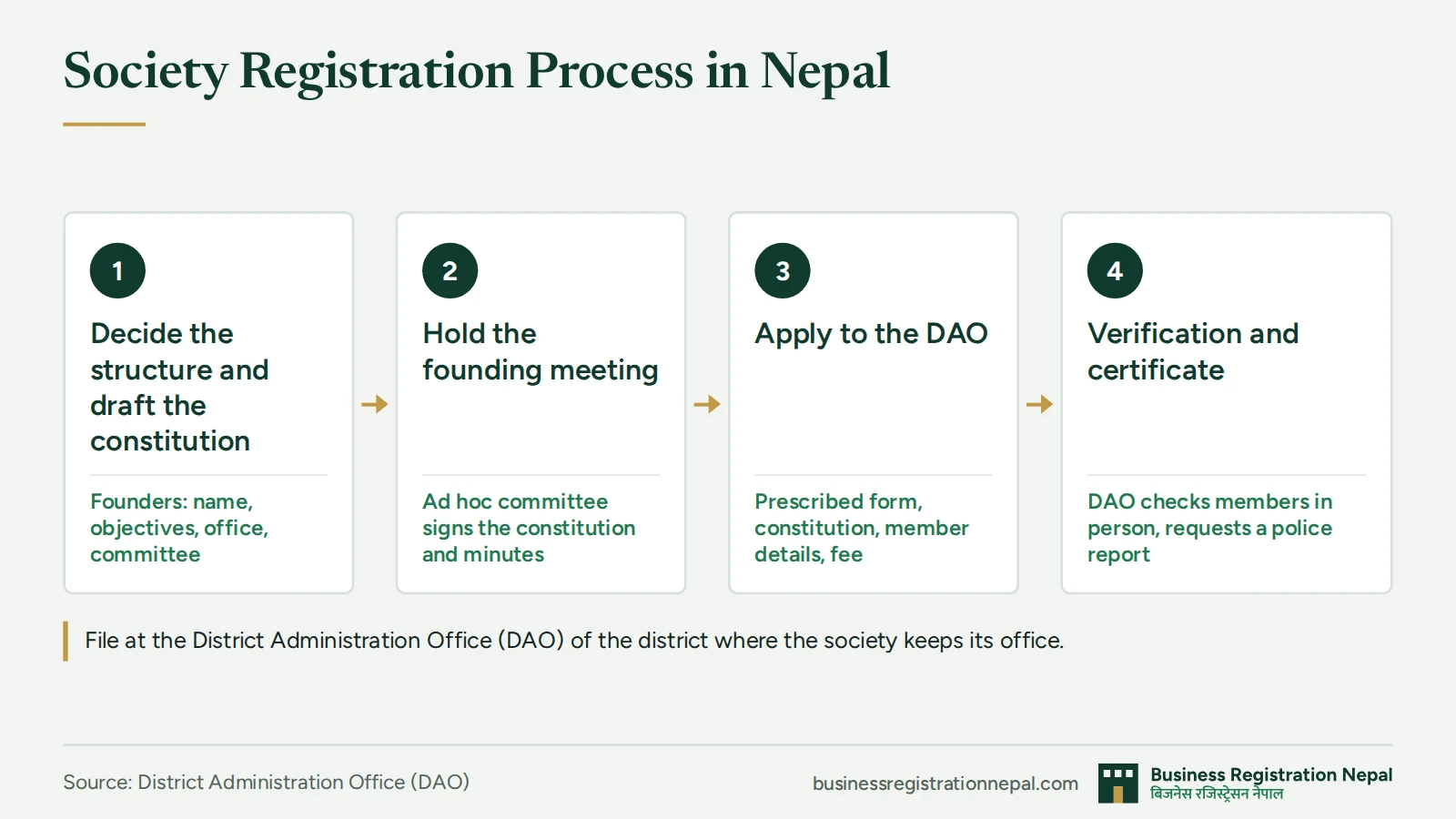
- Step 1: Decide the structure and draft the constitution. The founders fix the society's name, objectives, office address, financial sources and management committee, then write them into the constitution (vidhan), the society's bylaws.
- Step 2: Hold the founding meeting. The founders meet as an ad hoc committee, sign the constitution and record their decision to apply for registration in signed minutes.
- Step 3: Submit the application and documents to the DAO. The application goes on the DAO's prescribed form, with the constitution, the member details and the registration fee.
- Step 4: Complete verification and receive the certificate. DAO staff identify every member in person and request a police report on the office bearers, then register the society and issue its certificate.
The file goes to the DAO of the district where the society keeps its office, since the ward recommendation names that office location. The registration certificate is the society's proof of legal existence from that date.
What Documents Are Required to Register a Society?
The DAO asks for 7 society registration documents: the application, the constitution, citizenship copies, a police report, office papers, the founding-meeting minutes and a ward recommendation. The list follows the DAO Bhaktapur citizen charter for Nepal's society registration service.
0 of 7 ready
Applicants submit photocopies and bring the originals for verification. The DAO Kavrepalanchok charter adds an umbrella-organization recommendation and a recommendation from the relevant agency. Other DAOs list their own additions in each office's citizen charter.
How Many Members Are Required to Register a Society?
At least 7 founding members are required to register a society in Nepal. The Association Registration Act 2034 lets seven or more persons apply, and the DAO application carries the signatures of at least 7 ad hoc committee members.
Each founder gives a citizenship certificate copy and appears at the DAO for identity verification. The same founding members sign every page of the constitution before the file goes in.
What Types of Societies Can Be Registered?
Nepal registers 5 broad types of society: social, cultural, educational, professional and other non-profit societies. The Association Registration Act 2034 extends the list to religious, literary, scientific and philanthropic groups.
The types differ by objective, not by procedure. The DAO registers each type under the same Act and the same application, and each becomes a recognized legal body on registration.
The DAO of the society's district registers all 5 types, and national-level bodies among them affiliate with the Social Welfare Council. The objective written in the constitution decides the type.
What Are the Renewal and Compliance Requirements for a Society?
A society renews its registration at the DAO every fiscal year, with an audit report, a tax clearance certificate and updated committee records. Annual renewal keeps the registration certificate in force.
Under the Association Registration Act 2034, the management committee submits the society's statements of accounts with the auditor's report to the local authority each year. The DAO Bhaktapur citizen charter lists 6 renewal documents.
0 of 6 ready
The DAO Bhaktapur charter sets the renewal fee at NPR 500 plus a NPR 10 stamp, and a late fee applies under the Rules. Societies renew registration annually, because the DAO Kavrepalanchok charter asks for the previous fiscal year's renewal certificate. The DAO also asks for the audit report and general assembly minutes at renewal, and it charges the late fee when the society renews after the deadline.
A licensed auditor prepares the society's yearly audit report, the same professional work that the statutory audit in Nepal covers for companies.
Frequently Asked Questions
How is a society different from an NGO and a company?
A society and an NGO are both associations that the DAO registers under the Association Registration Act 2034, whereas a company registers at the Office of the Company Registrar (OCR). The Companies Act 2063 governs the company, which trades for profit unless it registers as a profit-not-distributing company. Founders weighing a profit-making structure compare the forms in which company type to register.
Can a foreigner or NRN register a society in Nepal?
No, a foreign national does not appear as a founder on the DAO file, because the document list asks for a citizenship certificate copy of each office bearer, and the founders must be Nepali citizens. A Non-Resident Nepali (NRN) meets that rule only while holding a Nepali citizenship certificate. Foreign organizations follow INGO registration with the Social Welfare Council instead.
Is a PAN required for a society?
Yes, a society obtains a Permanent Account Number (PAN) from the Inland Revenue Department (IRD) for its transactions and tax reporting. The IRD registers it on the business PAN form for NGO, charitable and cooperative bodies. A society's PAN is an entity PAN, and PAN in Nepal explained compares it with the personal PAN.
Are societies tax-exempt in Nepal?
Yes, a society qualifies for tax exemption as a non-profit social, religious, educational or benevolent organization of public nature under the Income Tax Act 2058. Section 10 of the Act treats donations and gifts received by such an organization as exempt amounts.
The exemption ends where any person takes a private benefit from the society's property or funds. The status rests on a PAN, IRD approval and yearly filing: the IRD registers the society as a tax-exempt organization under the Income Tax Rules 2059 and issues a certificate, which the society renews each year with its audited accounts, income return and TDS returns.
How much does society registration cost in Nepal?
Society registration costs NPR 1,000 as the DAO registration fee, plus a NPR 10 stamp on the application, in the DAO Bhaktapur citizen charter. The DAO Kavrepalanchok charter lists the same NPR 1,000 fee. Ward recommendation charges and any professional fee add to that total. The ward charge follows the municipality's annual finance act, and other DAOs confirm their fee in their own citizen charter.
How long does society registration take in Nepal?
Registration of a society in Nepal takes about 1 to 2 months from filing to certificate, mostly for member verification and the police report. DAO citizen charters state same-day or next-day action once the file and member verification are complete. The police report on the office bearers comes between member verification and registration.