

INGO registration in Nepal is the affiliation of a foreign non-profit with the Social Welfare Council (SWC, समाज कल्याण परिषद्) in 5 steps:
- Step 1: Partner with a registered local NGO.
- Step 2: Prepare the project proposal and organisational documents.
- Step 3: Apply to the SWC for the General Agreement.
- Step 4: Undergo evaluation and sign the agreement.
- Step 5: Obtain Project Agreements and implement.
The SWC, set up under the Social Welfare Act 2049, regulates every INGO. The General Agreement covers the organization, and a tripartite Project Agreement covers each project. The SWC file holds 8 core documents, led by the authenticated home-country registration.
An INGO renews its General Agreement before expiry and reports progress, finances and annual audits to the SWC. A profit-making foreign venture follows company registration in Nepal at the Office of the Company Registrar (OCR) instead.
What Is an INGO in Nepal?
An INGO in Nepal is an international non-governmental organization: a foreign-based non-profit that delivers development or humanitarian work inside Nepal. The organization stays registered in its home country and operates in Nepal under an agreement, not a local incorporation.
International NGO registration in Nepal therefore means affiliation with the Social Welfare Council (SWC), the national body that approves and supervises social organizations. An INGO signs a General Agreement (GA) to work in the country and a Project Agreement (PA) for each project it funds.
A foreign non-profit brings the funding and programme design, and a local partner NGO implements the activities on the ground. That split between a foreign funder and a Nepali implementer shapes every later step of INGO registration.
Who Regulates INGOs in Nepal?
The Social Welfare Council (SWC) regulates INGOs in Nepal as their primary authority. An INGO does not register directly the way a local NGO does. INGO affiliation with the SWC in Nepal, through signed agreements, replaces that registration.
The Social Welfare Act 2049 established the SWC, and the minister responsible for social welfare chairs it. Under the Act, the Council makes contracts or agreements with local, foreign and international organizations. It supervises, follows up and evaluates their activities.
The SWC Planning and Program division runs INGO appraisal and the agreement process. The same division recommends visa and customs exemption facilities for INGOs. The SWC Monitoring and Evaluation department carries out periodic monitoring and evaluation of NGO and INGO activities.
What Is the Difference Between a General Agreement and a Project Agreement?
A General Agreement is the overarching operating agreement that lets an INGO work in Nepal, while a Project Agreement approves one specific project. An INGO signs the General Agreement before any project, then a separate Project Agreement for each project it funds.
The Department of Immigration names the GA counterparty: its working-visa list asks NGOs and INGOs for their General Agreement with the Social Welfare Council, and the SWC is the body that signs the General Agreement with the INGO.
The table compares the 2 agreements on 5 attributes, using the SWC Project Agreement format for the project side.
| Attribute | General Agreement | Project Agreement |
|---|---|---|
| Purpose | Permission for the INGO to operate in Nepal | Approval of one project, its budget and its districts |
| Parties | The INGO and the SWC | A tripartite agreement signed by the SWC, the partner NGO and the INGO |
| Term | A fixed term of up to 5 years, written in the agreement and renewable | The number of years written in the agreement, ending with the General Agreement |
| Sequence | Signed before any project; the PA file carries a copy of it | Signed for each project after the GA |
| Supporting file | Organizational documents such as home-country registration, the constitution, recent annual and audit reports, and the country representative's passport and bio-data | Project proposal with the logical framework, budget and partner NGO papers |
A Project Agreement depends on a valid General Agreement: the SWC format sets the project expiry to coincide with the GA. A project that runs past an unrenewed GA becomes invalid from the GA expiry date.
What Is the INGO Affiliation Process?
The INGO affiliation process has 5 steps, from choosing a local partner NGO to signing Project Agreements with the SWC. To register an INGO in Nepal, the organization gains approval for itself under the General Agreement and then for each project.
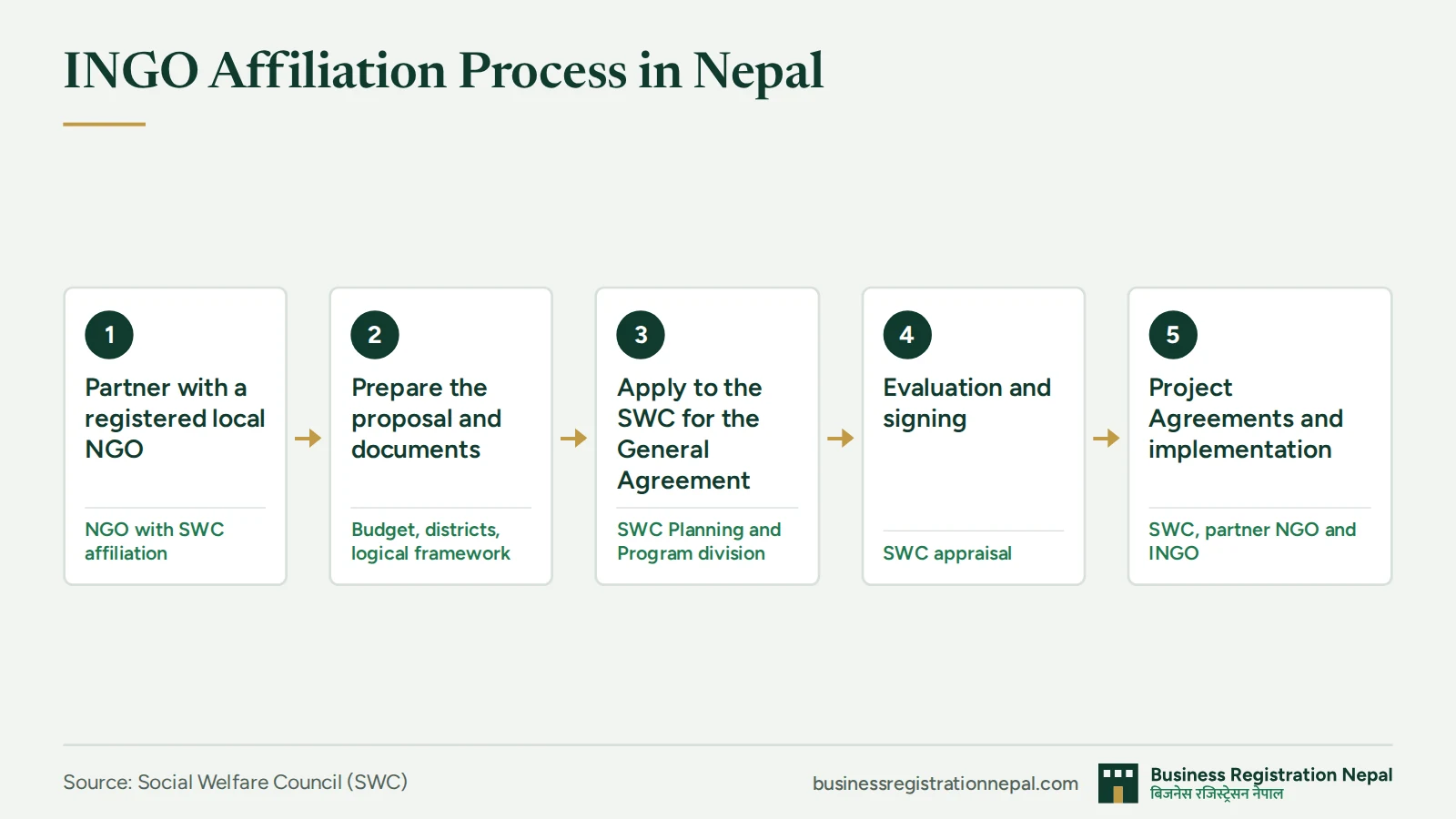
- Step 1: Partner with a registered local NGO. The SWC asks for the partner's registration, affiliation and PAN certificates with its current audit and progress reports. A local partner NGO completes NGO registration and SWC affiliation before it joins an INGO project.
- Step 2: Prepare the project proposal and organisational documents. The proposal sets the budget, the districts and the logical framework of the project. The organisational documents prove the INGO's legal standing in its home country.
- Step 3: Apply to the SWC for the General Agreement. The INGO submits its application and documents to the Council. The SWC Planning and Program division handles INGO appraisal and the agreement process.
- Step 4: Undergo evaluation and sign the agreement. The SWC appraises the organization and its proposal before approval. The General Agreement is signed once the appraisal is complete, and the SWC signs it for the Nepal side.
- Step 5: Obtain Project Agreements and implement. Each project needs a tripartite Project Agreement signed by the SWC, the partner NGO and the INGO. The agreement takes effect on its signing date.
The INGO registration process in Nepal ends with a signed Project Agreement, and the INGO and the partner NGO then implement the project. From that date, both organizations comply with SWC monitoring and reporting until the agreement expires.
What Documents Are Required for INGO Registration?
INGO registration requires 8 core documents, from the home-country registration to the MOU with the local partner. The INGO files them with the SWC for the General Agreement, and each project later adds its own file. The SWC confirms its current checklist when the application goes in.
0 of 8 ready
The embassy authentication proves that the home-country registration is valid, and the audited financial statements show how the foreign non-profit has used its funds.
The SWC Project Agreement checklist adds 8 project-stage documents to that core file.
0 of 8 ready
Construction projects add the approved building map, the land ownership certificate and the land blueprint. Hospital, health clinic and school projects add an approval letter from the concerned authority.
What Are the Renewal and Reporting Requirements for an INGO?
An INGO meets 4 renewal and reporting requirements: GA renewal, a valid Project Agreement per project, periodic reports and an annual audit report. The SWC receives every report and monitors compliance through them.
0 of 4 ready
Each new Project Agreement file asks for the INGO's last audit report and audit clearance certificate, so the reporting record supports the next agreement. Under the Nepal Chartered Accountants Act 2053, audit business needs a Certificate of Practice from the Institute of Chartered Accountants of Nepal (ICAN).
The annual audit report of an INGO therefore comes from an ICAN-certified auditor, the same licence behind every statutory audit in Nepal.
Frequently Asked Questions
Can an INGO register directly without a local NGO partner?
No, an INGO does not register directly in Nepal; it works through an SWC agreement and a registered local partner NGO. The SWC Project Agreement format carries signature blocks for the SWC, the partner NGO and the INGO. The partner's registration, affiliation and PAN certificates form part of every project file.
Can an INGO receive and channel foreign funding in Nepal?
Yes, an INGO receives and channels foreign funding in Nepal under its SWC-approved General Agreement and Project Agreements, with reporting on the funds. The INGO and each partner NGO name a central and a project bank account, and the SWC recommends each account before it opens. The project file records the aid in AIMS at the Ministry of Finance, and quarterly financial reports track the spending.
What visa or work permit applies to INGO staff?
Expatriate INGO staff, including a foreign country representative, hold a non-tourist working visa backed by a work permit from the Department of Labour. The Department of Immigration file adds a line-agency recommendation, the General Agreement with the SWC, a Ministry of Home Affairs work agreement and the organization's tax clearance. The visa runs for the work permit period, at a fee of USD 75 per month.
How long does INGO registration take in Nepal?
The SWC stage of INGO registration in Nepal, from a complete application to the signed General Agreement, has no fixed published timeline; law-firm estimates run from about 2 to 6 months. The time covers SWC appraisal of the organization and its proposal. Each Project Agreement then follows its own appraisal before the project starts, which adds further time.
Are INGOs tax-exempt in Nepal?
No, an INGO is not tax-exempt by default in Nepal; its tax treatment depends on its activity and its agreements. Under its PAN, the INGO still deducts tax at source on salaries and payments and files those returns with the IRD. Under the Income Tax Act 2058, donations and gifts that an organization entitled to exemption receives without consideration are exempt amounts. The SWC recommends VAT, excise duty and customs duty facilities under prevailing law, and each INGO holds a PAN certificate for its project file.
What happens if an INGO's agreement expires?
A Project Agreement that runs past an unrenewed General Agreement becomes invalid from the GA expiry date, so the project loses its SWC approval. The INGO applies for renewal ahead of expiry with its progress and financial reports, so that no project runs without a valid General Agreement. A Project Agreement that reaches its own end date ends SWC approval for that project, and further work needs a new agreement.
How is an INGO different from a local NGO?
A local NGO registers at the District Administration Office under the Association Registration Act 2034, while an INGO affiliates through the SWC with a GA and PAs. The INGO stays registered in its home country as a foreign organization. The local NGO affiliates with the SWC to join INGO projects, because each Project Agreement file asks for its affiliation certificate.