

NGO registration in Nepal is the mandatory registration of a non-profit association at the District Administration Office (DAO), whose Chief District Officer (CDO) is the registering authority. Two laws govern it: the Association Registration Act 2034 for the DAO, and the Social Welfare Act 2049 for Social Welfare Council (SWC) affiliation and approval of foreign assistance.
In NGO registration, Nepal's DAO process runs in 5 steps:
- Step 1: Form the founding team and draft the constitution.
- Step 2: Hold the founding meeting and get the ward recommendation.
- Step 3: Apply to the DAO with documents and verification.
- Step 4: Receive the registration certificate.
- Step 5: Obtain SWC affiliation and PAN where needed.
At least 7 founding members file 7 documents, led by the constitution.
Annual renewal at the DAO requires audited accounts and tax clearance. An affiliated NGO reports to the SWC, which approves any foreign donation.
NGO registration differs from registering a company at the Office of the Company Registrar (OCR). A company not distributing profits, with at least 5 promoters, follows the OCR route within company registration in Nepal.
What Is an NGO in Nepal?
An NGO in Nepal is a non-profit, non-governmental membership association that its members form for social, charitable or developmental work. Nepali law calls it a sanstha, and the District Administration Office (DAO) registers it under the Association Registration Act 2034.
The Association Registration Act 2034 defines an association by its purpose, for example social, religious, literary, cultural, educational or philanthropic work. Clubs, councils and study centres fall within the same definition.
A non-governmental organization writes its objectives in a constitution, known as bylaws or vidhan. DAO Kathmandu accepts only non-political, non-profit social objectives in that document.
Registration turns the association into an autonomous corporate body with perpetual succession and its own seal. The registered NGO holds property, and it sues and is sued in its own name.
Which Laws and Authorities Govern NGO Registration?
Two laws govern NGO registration in Nepal: the Association Registration Act 2034 and the Social Welfare Act 2049. The District Administration Office registers the NGO under the Chief District Officer, and the Social Welfare Council handles affiliation. The Companies Act 2063 governs a separate OCR route.
Under the Association Registration Act 2034, no one establishes an association without registration. The Act names the Chief District Officer (CDO) as the Local Authority that registers it, unless the Government designates another officer in the Nepal Gazette.
The CDO leads the District Administration Office, so the NGO applies at the DAO of the district that holds its office. An applicant refused registration appeals to the designated authority within 35 days of the refusal notice.
The Social Welfare Council (SWC) is the body the Social Welfare Act 2049 sets up to coordinate social organizations. It affiliates NGOs, approves foreign assistance to them and reports each year to the Ministry of Women, Children and Senior Citizens.
The Companies Act 2063 offers the second route. Under Section 166, the Office of the Company Registrar (OCR) incorporates a company not distributing profits for professional, scientific, academic, social, benevolent or public-utility objectives.
Who Registers at the DAO and Who Needs SWC Affiliation?
Every NGO registers at the DAO, because that registration establishes it as a legal body. An NGO that runs foreign-funded or donor-supported programs affiliates with the Social Welfare Council and obtains its approval for that funding.
DAO registration follows the Association Registration Act 2034 and applies to every association, whatever its size or funding source. An NGO funded only by members or Nepali donors faces no Council approval rule for that income, because the rule covers foreign assistance.
Social Welfare Council registration in Nepal follows the Social Welfare Act 2049, which calls it affiliation and leaves it to the organization's choice. The applicant files its constitution, its registration date and office details, and the names, addresses and occupations of committee members.
The Council verifies the application and issues an affiliation certificate on payment of the prescribed fee. Any social organization applies to the Council before it receives foreign assistance. The Council decides within 45 days after consulting the concerned ministry or agency. In practice, the SWC approves foreign-funded projects only for affiliated NGOs, so affiliation comes before the first foreign grant.
What Is the NGO Registration Process?
The NGO registration process in Nepal runs in 5 steps, from drafting the constitution to SWC affiliation and PAN. The founding team works through the ward office and the DAO, and the last step involves the Social Welfare Council and the Inland Revenue Department.
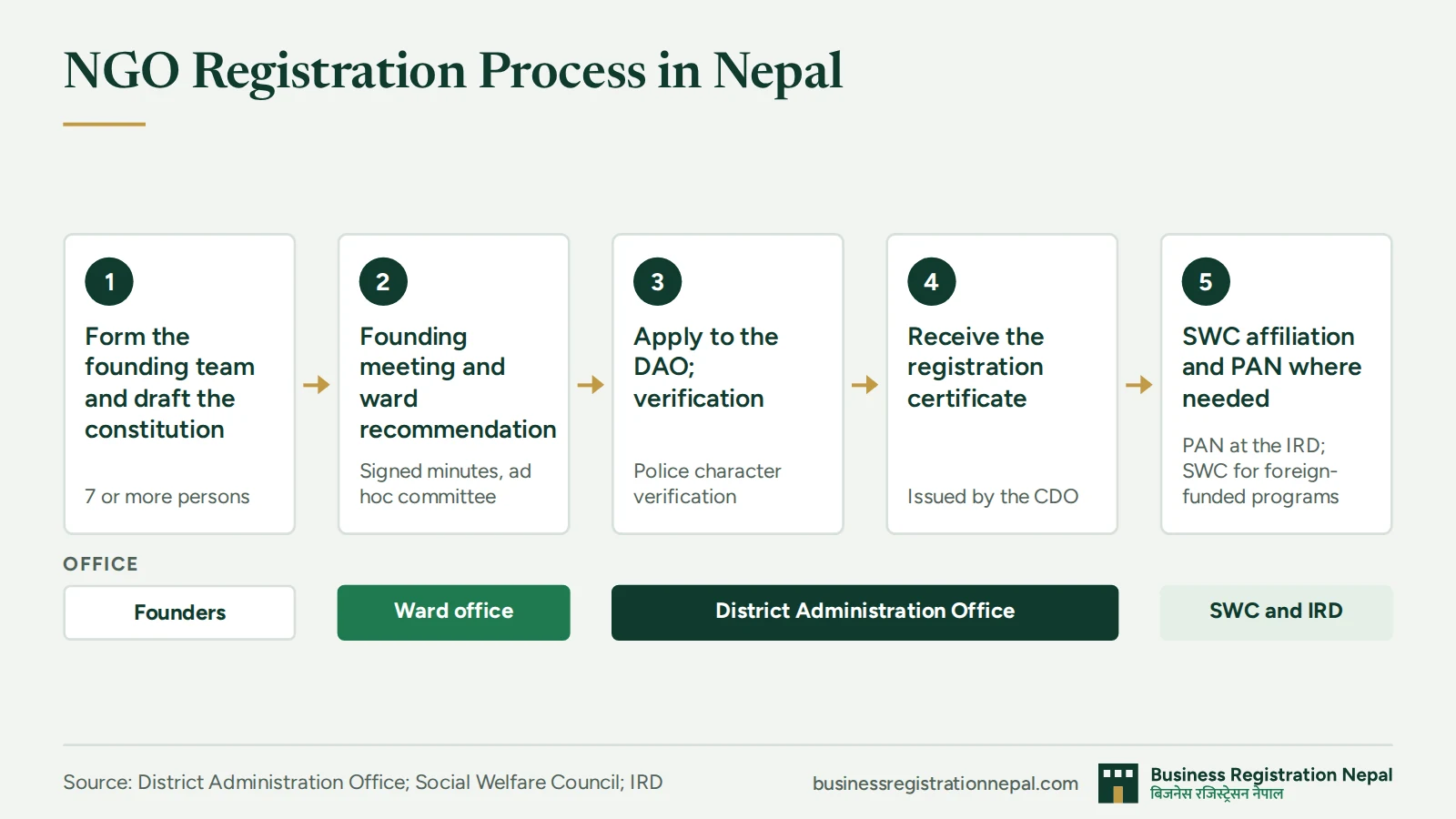
To register an NGO in Nepal, the founders complete these 5 steps in order:
- Step 1: Form the founding team and draft the constitution. Seven or more persons form the team, and the constitution states the NGO's name, objectives, committee and funding sources. DAO Kathmandu publishes a model constitution and accepts names in dictionary Nepali words only.
- Step 2: Hold the founding meeting and get the ward recommendation. The meeting forms an ad hoc committee and records the decision to register in minutes that every participant signs. The ward office of the local government then issues its recommendation letter.
- Step 3: Apply to the DAO with documents and verification. An authorized official submits the application and pays the registration fee. Registration fees are set by the District Administration Office and may change, so the district office confirms the applicable fee at the time of filing. The DAO runs a police character verification, and every ad hoc committee member attends with an original citizenship certificate.
- Step 4: Receive the registration certificate. The CDO issues it after the verification, and the association becomes a corporate body with its own seal. The time for this step depends on the police verification and the DAO's workload.
- Step 5: Obtain SWC affiliation and PAN where needed. The NGO applies for a PAN at the Inland Revenue Department (IRD) on its form for NGO, charitable and cooperative entities. An NGO planning foreign-funded programs applies for Social Welfare Council affiliation.
NGO registration cost in Nepal covers the DAO registration fee, a small stamp fee on the application and any professional fee. The certificate from Step 4 starts the NGO's yearly renewal cycle at the DAO.
What Documents Are Required to Register an NGO?
The DAO asks for 7 documents to register an NGO, from the application and the constitution to the ward recommendation and office proof. The founders present each document in original with a copy, as the DAO Bhaktapur checklist requires.
NGO registration documents in Nepal, as the DAO Kathmandu and DAO Bhaktapur checklists list them, cover 7 items:
0 of 7 ready
An NGO working with women, children or senior citizens adds a recommendation from the women and children office. Members from another district add proof of residence. Each DAO keeps its own checklist, and DAO Kathmandu publishes its checklist on its website.
How Many Members Are Required to Register an NGO?
The minimum required to register an NGO in Nepal is 7 founding members. The Association Registration Act 2034 lets seven or more persons apply for registration. The application to the DAO lists the names, addresses and occupations of the management committee members.
The Act states no citizenship condition for the founding members. The DAO checklists ask for a citizenship certificate from each committee member, and DAO Kathmandu verifies every ad hoc committee member in person, so in practice the founding members are Nepali citizens.
The OCR route counts differently. Under Section 166 of the Companies Act 2063, a company not distributing profits starts with at least 5 promoters. It keeps at least 5 members, and no member transfers that membership.
What Are the Renewal and Compliance Requirements for an NGO?
Renewal and compliance requirements for an NGO in Nepal come to 4 duties: annual renewal, audited accounts, tax clearance records, and a yearly SWC report when affiliated. The DAO receives 3 of them, and the Nepali fiscal year, Shrawan to Asar, sets each cycle.
To comply with both Acts and DAO practice, NGO renewal in Nepal and the related filings follow 4 rules:
0 of 4 ready
Renewal fees are also set by the District Administration Office and may change, and the district office confirms the applicable fee at filing. A renewal filed late in the fiscal year or after it falls overdue costs more than one filed early. The renewal file adds general assembly minutes, the committee list and the local government recommendation to the audit and tax papers.
DAO Panchthar asks for the auditor's licence letter with the audit report, so the NGO completes its statutory audit in Nepal before renewal.
Frequently Asked Questions
Can a foreigner register an NGO in Nepal?
No, the DAO route expects Nepali founders, because each committee member files a citizenship certificate and attends verification in person. A foreign non-profit follows INGO registration, and the Social Welfare Council grants it permission and signs an agreement before work starts.
Can an NGO receive foreign donations in Nepal?
Yes, an NGO in Nepal receives foreign donations after the Social Welfare Council approves that assistance under the Social Welfare Act 2049. The rule covers material, technical, economic and other assistance from foreign countries, international organizations, missions or individuals. The NGO then coordinates with the local agency while it runs the approved project.
Are NGOs tax-exempt in Nepal?
Yes, an NGO qualifies for tax exemption on donations, gifts and related contributions when it holds exempt status under the Income Tax Act 2058. The NGO obtains a PAN and applies to the IRD with its registration certificate, constitution and audited accounts, and the IRD issues a tax exemption certificate that is renewed each year. The Act extends that status to social, religious, educational or benevolent organizations of a public nature with a non-profit motive. The exempt NGO still holds a PAN, and DAO Kathmandu asks for a tax clearance at each renewal. The exempt NGO still files its annual income-tax return with audited accounts within three months of fiscal year end.
What happens if an NGO operates without registration?
An NGO operating without registration breaks the Association Registration Act 2034, and the Local Authority fines each management committee member up to NPR 2,000. The unregistered body has no corporate status, so it holds no property and brings no case in its own name. A bank account and foreign funding follow registration: banks ask for the registration certificate to open an organization's account, and the SWC approves foreign assistance only for a registered, affiliated NGO.
How is an NGO different from a non-profit company?
An NGO is an association that the DAO registers under the Association Registration Act 2034, while a non-profit company is incorporated at the OCR under the Companies Act 2063. Section 166 calls that form a company not distributing profits: it pays no dividend, and its membership is not transferable. The non-profit company is one of the OCR forms that which company type to register compares on liability and compliance.
Can an NGO be registered online in Nepal?
No, NGO registration at the DAO runs in person, and every ad hoc committee member attends the verification with an original citizenship certificate. DAO Kathmandu accepts the file only from an official carrying an authorization letter and identity document. Its website offers the model constitution and the document checklist for download.