


A company in Nepal opens its bank account in 5 steps after registration:
- Step 1: Select the bank and account type.
- Step 2: Prepare the documents and the board resolution.
- Step 3: Submit the application at the branch.
- Step 4: Complete bank verification and KYC/due diligence.
- Step 5: Deposit the minimum balance and activate the account.
The bank account opening process for companies in Nepal starts after incorporation. A company needs the account because, under the Companies Act 2063, it banks its cash and transacts through the bank.
The bank asks for 8 documents, led by the certificate of incorporation and the PAN. Directors authorize the signatories in the board resolution, and each bank sets its own minimum deposit.
An FDI company applies to its bank to hold the incoming capital in a foreign-currency company bank account. Nepal Rastra Bank (NRB) records that capital on the company's application, filed within six months of the inflow. After opening, the company updates its signatory mandate and runs tax and payroll through the account.
The bank account is a core item of what to do after registering a company, after the Certificate of Incorporation. Each step builds on company registration in Nepal at the OCR.
Why Does a Company Need a Bank Account?
A company needs a bank account because it deposits its cash in a bank and transacts through the bank. The same company bank account in Nepal receives the share capital, pays taxes and salaries, and leaves a clear audit trail.
Under the Companies Act 2063, a bank account is mandatory for a company's cash. The company deposits its cash balance in a bank and conducts transactions through the bank. The Office of the Company Registrar (OCR) states one exception, a cash amount that the board of directors fixes.
A company bank account serves 4 purposes for a registered company:
- Capital deposit: shareholders pay their share capital into the account, which gives the paid-up capital a bank record.
- Business transactions: customer receipts and supplier payments pass through the banking channel.
- Payroll and tax: the company pays salaries and remits the tax it withholds from them.
- An audit trail: bank statements let the auditor trace each transaction to the books of account.
The 4 uses make the corporate account the financial record that the OCR, the Inland Revenue Department (IRD) and the auditor rely on.
What Documents Are Required to Open a Company Bank Account?
A bank in Nepal asks a company for 8 corporate account documents, led by the certificate of incorporation, the PAN and the board resolution naming the authorized signatories. The company presents them when it applies to open the account at a branch.
The 8 documents to open a company bank account form one file:
0 of 8 ready
The Asset (Money) Laundering Prevention Act 2064 sets the legal core of this list: a copy of the incorporation document and the details of the directors. The PAN, the Permanent Account Number from the IRD, and the board resolution come from the bank's onboarding rules, and the other items vary by bank. NIC Asia Bank, for example, also asks an existing company for the previous year's audited financials and tax clearance, and for the details of shareholders holding more than 10%.
What Is the Process to Open a Company Bank Account?
The process to open a company bank account in Nepal runs in 5 steps, from selecting the bank to activating the account. Every private or public company follows the same steps, and the board of directors authorizes the account before the application reaches the branch.
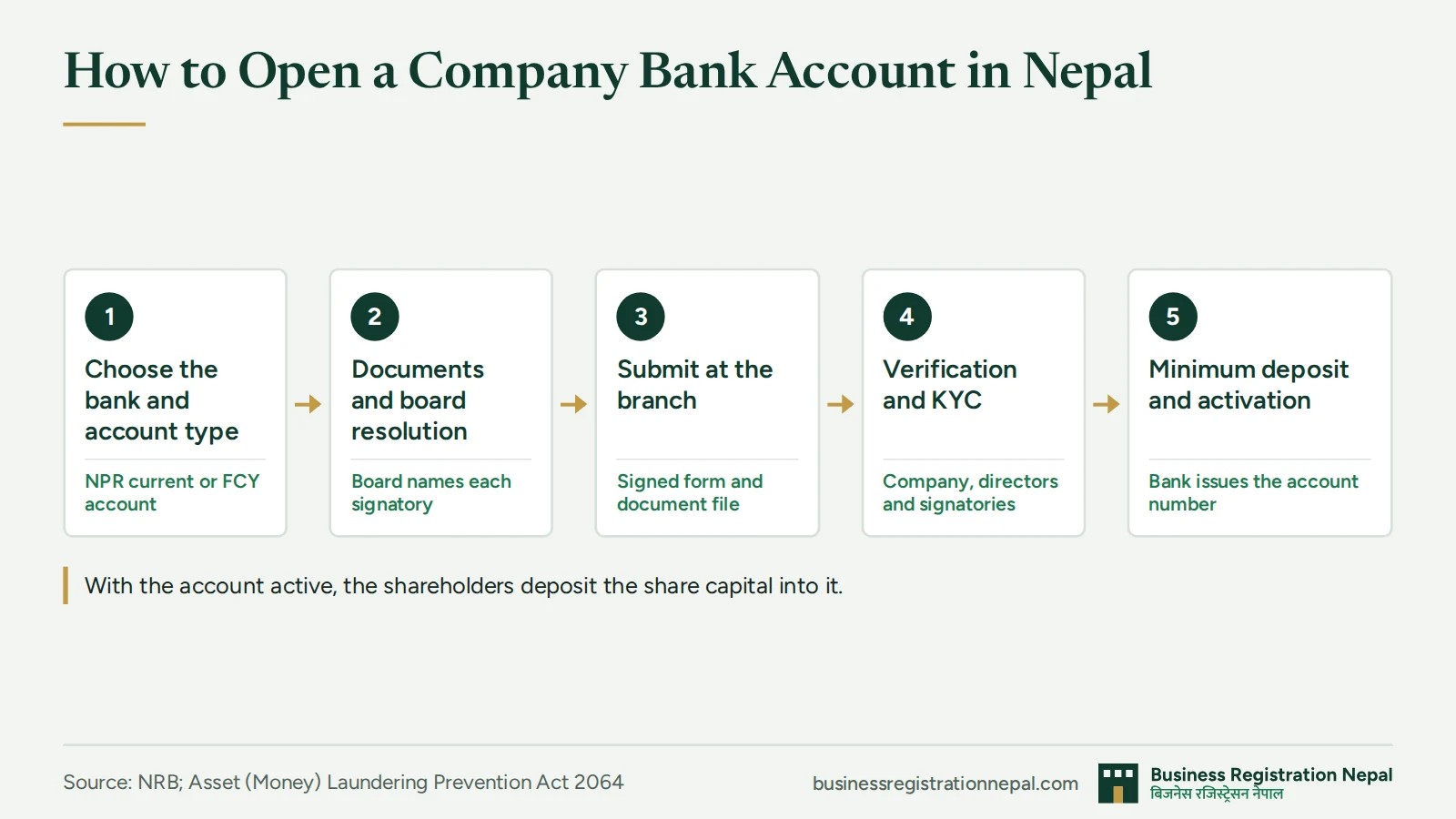
- Step 1: Select the bank and account type. Nepal Rastra Bank (NRB), the central bank of Nepal, licenses the banks and financial institutions that hold company accounts. A company chooses between 2 account types to open: business bank account in Nepali rupees, known as a current account, and a foreign-currency (FCY) account.
- Step 2: Prepare the documents and the board resolution. The board resolution, known as the BOD authorization, approves the account and names each authorized signatory. It joins the 8 corporate account documents in one file.
- Step 3: Submit the application at the branch. An authorized signatory submits the signed account opening form and the document file at a branch of the chosen bank. Bank officials verify the original documents there.
- Step 4: Complete bank verification and KYC/due diligence. KYC, or know your customer, is the bank's check of the company, its directors and its signatories. Under the Asset (Money) Laundering Prevention Act 2064, a bank identifies each customer before it establishes a business relationship.
- Step 5: Deposit the minimum balance and activate the account. The company deposits the bank's minimum initial deposit, and the bank activates the account and issues its account number.
An active account ends the process, and the shareholders then deposit the share capital into it.
What Is the Minimum Deposit and Who Can Be Signatories?
The minimum deposit for a company account in Nepal varies by bank, and the signatories are the persons the board resolution names. The bank sets the deposit, and the board of directors sets the signatories.
Each bank sets the minimum initial deposit for its corporate account types and states it in its account terms. The minimum balance is a bank condition for the account and stays separate from the share capital that shareholders pay under the MOA.
Two items appear in the board resolution: signatories and the signing rule. A signatory, or authorized signatory, is a person the board authorizes to operate the account, and the rule states single or joint signing, within the mandate options the bank offers. Each signatory presents a citizenship certificate or passport for the bank's identity check.
How Do FDI Companies Open a Foreign-Currency Account?
To open a foreign-currency account, an FDI company applies to its bank to hold the incoming investment in the convertible foreign currency instead of Nepali rupees. Nepal Rastra Bank (NRB) rules govern the inflow, the account and the recording of the investment.
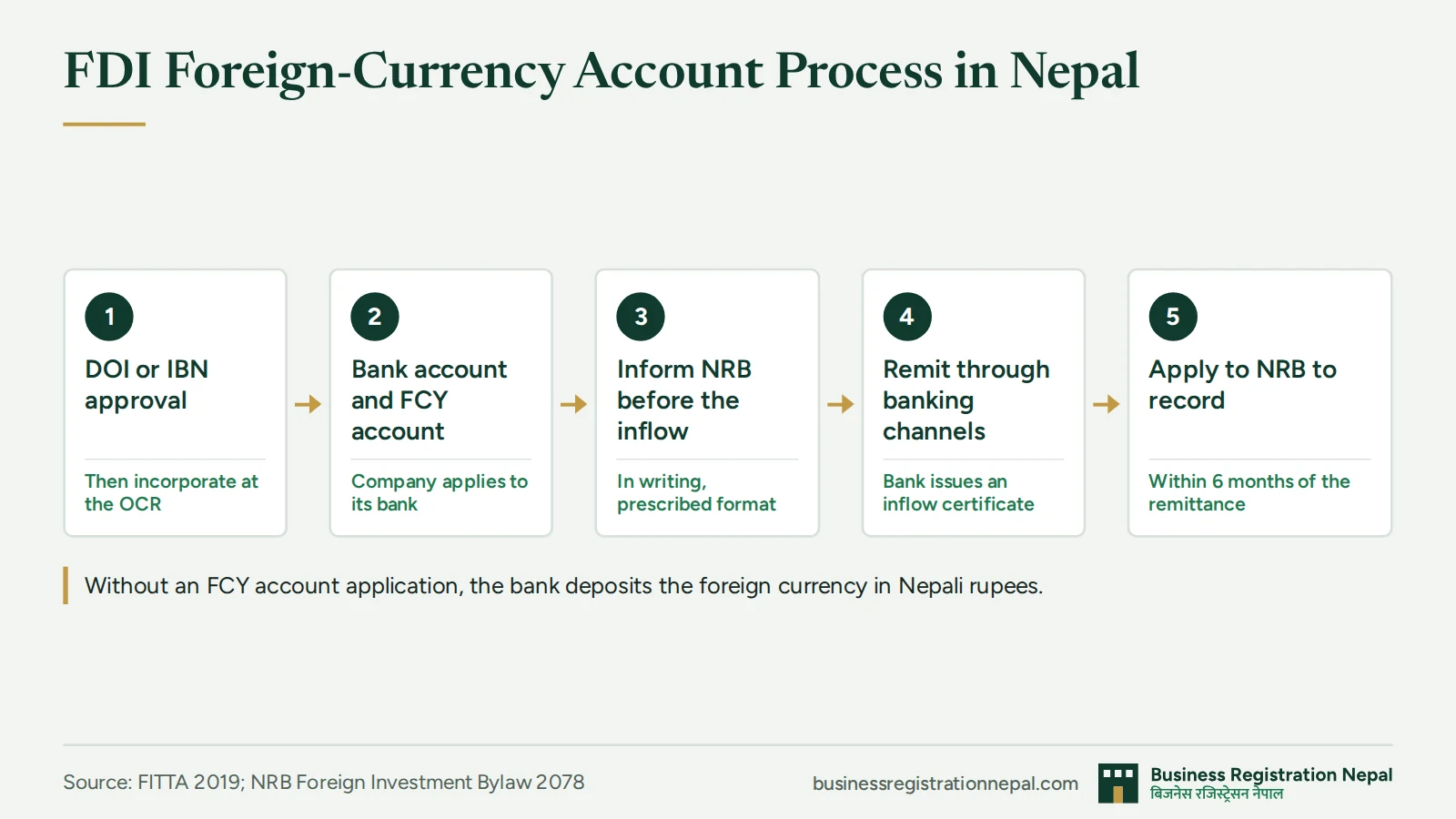
Foreign investment enters Nepal through banking channels and is recorded with NRB. Under the Foreign Investment and Technology Transfer Act 2019 (FITTA) and the NRB Foreign Investment and Foreign Loan Management Bylaw 2078 (2021), an FDI company completes 5 steps:
- Step 1: Obtain foreign investment approval from the Department of Industry (DOI) or Investment Board Nepal (IBN), then incorporate the company at the OCR.
- Step 2: Open the company bank account and apply to the bank for an FCY account. Without that application, the bank deposits the foreign currency in Nepali rupees.
- Step 3: Inform NRB in writing, in the format the bylaw prescribes, before the foreign currency is remitted. A new investment needs no prior NRB approval once the foreign investment approval is issued.
- Step 4: Remit the investment in convertible foreign currency through the banking channel, in the company's name. The bank deposits it into the company account after checking the documents and issues an inflow certificate.
- Step 5: Apply to NRB to record the investment within six months of the remittance. NRB issues a certificate of recording within seven working days of a complete application.
The foreign currency account FDI companies hold keeps the investment in its original currency until the company converts it. A foreign investor bringing at least NPR 20 million follows FDI and foreign company registration, with DOI approval before the bank inflow.
What Are the Post-Opening Compliance Steps?
A company completes 3 post-opening compliance steps: an updated signatory mandate, records kept for the audit, and tax and payroll paid through the account. Each step keeps the corporate account in line with the bank, the IRD and the auditor.
- Step 1: Keep the signatory mandate updated. The board passes a new resolution when a signatory changes, and the company gives the bank that resolution with the new signatory's identity document and specimen signature.
- Step 2: Maintain records for the audit. Under the Companies Act 2063, a company keeps double-entry books of account at its registered office, and bank statements support each entry. Under the Income Tax Act 2058, the company keeps the supporting documents in Nepal for at least 5 years from the end of the income year.
- Step 3: Use the account for tax and payroll. Each resident employer withholds tax from employees' pay under the Income Tax Act 2058, and the account carries both the salaries and the tax deposits.
The 3 steps let the company comply with the statutory audit, the income-tax return and the OCR annual filing from its own bank records.
Frequently Asked Questions
How long does it take to open a company bank account in Nepal?
A company bank account in Nepal opens within about 3 to 7 working days once the bank holds a complete document set. An FDI company's account takes longer where the bank applies enhanced due diligence to its foreign ownership.
How do I choose the right bank for a corporate account?
A company chooses a bank for its corporate bank account in Nepal by comparing 4 factors: branch access, charges, digital banking and foreign-currency support. Foreign-currency support matters to an FDI company that receives investment from abroad. Every bank holding company accounts operates under an NRB licence and NRB's AML/CFT directives.
Should the PAN be arranged before or after registration?
No, the PAN is not arranged before registration: the company obtains it from an Inland Revenue Office of the IRD after incorporation and before the bank account opens. The OCR requires the PAN before the company starts business, and the bank asks for it during onboarding. PAN registration at the IRD issues the company its 9-digit Permanent Account Number.
Can a non-resident Nepali (NRN) or foreigner be a signatory?
Yes, a non-resident Nepali (NRN) or a foreigner serves as a signatory when the board resolution names that person and the bank verifies the passport, subject to the bank's own KYC rules. FDI companies follow NRB rules for the foreign-currency side of the account.
Can a foreign investor open an account before company registration?
No, a foreign investor opens the account after company registration, because the bank deposits the investment into the account of the registered company. The Department of Industry sets the order: foreign investment approval, then incorporation, then the capital inflow through the banking channel. NRB then records the investment on the company's application.
Are there fees for a corporate bank account?
Yes, banks charge account and service fees for a corporate bank account, and the amounts vary by bank and account type. The bank's schedule of charges lists each fee. The company confirms that schedule with its bank before it opens the account.