

Bookkeeping records a business's daily transactions, and accounting turns those records into financial statements and insight. That split is the difference between bookkeeping and accounting, and accountancy is the profession that holds both.
Every company registered in Nepal keeps double-entry books of account and prepares accounts under the Income Tax Act 2058 and NFRS. The process works in 7 steps, on a cash or accrual basis:
- Step 1: Record every transaction from source documents.
- Step 2: Categorise and post entries to the chart of accounts.
- Step 3: Maintain the journals and the general ledger.
- Step 4: Prepare the trial balance.
- Step 5: Reconcile bank and control accounts.
- Step 6: Prepare the financial statements.
- Step 7: Use the accounts for the audit, the income-tax return and management decisions.
A business keeps 7 sets of records for at least 5 years. Clean books matter for tax, audit and funding, and accounting software such as Tally, IMS and Swastik records them.
SMEs, NGOs and FDI companies use accounting and bookkeeping services to keep books current. The books of account begin at incorporation, when company registration in Nepal creates the company.
Written by CA Poshan Babu Basnet, Chartered Accountant (Member, ICAN).
What Is Bookkeeping?
Bookkeeping is the systematic recording, organizing and maintaining of a business's daily financial transactions. It forms the foundation layer of every set of accounts, because each sale, purchase, payment and receipt enters the books on the day it happens.
Bookkeeping carries 2 other names in practice: record-keeping and keeping the books of account. The work produces 3 core outputs. The journal voucher proves each entry, the journal lists entries by date, and the ledger groups them by account.
Under the Companies Act 2063, every company in Nepal keeps its accounts in Nepali or English on the double-entry system. The accounts follow the Nepal Financial Reporting Standards (NFRS). The Accounting Standards Board (ASB) Nepal sets NFRS in line with IFRS, the International Financial Reporting Standards.
What Does a Bookkeeper Do?
A bookkeeper records the daily transactions of a business and keeps its books of account current and accurate. The role covers 6 core responsibilities:
- Record income and expenses from invoices, receipts and vouchers
- Maintain the general ledger, the master record of every account
- Manage accounts payable, the amounts owed to suppliers, and accounts receivable, the amounts customers owe
- Run the bank reconciliation between the cash book and the bank statement
- Process payroll for staff each month
- Keep VAT (value added tax) and TDS (tax deducted at source) records for the Inland Revenue Department (IRD)
The bookkeeper hands the reconciled ledgers to the accountant, who turns them into financial statements.
What Is Accounting?
Accounting is the interpreting, classifying, summarizing and reporting of bookkeeping data as financial statements and decision-useful information. Accounting, known too as financial accounting, starts where bookkeeping ends: with the posted and balanced ledgers.
Bookkeeping forms the recording layer, and accounting forms the analytical layer above it. An accountant classifies ledger balances and adjusts them under NFRS. The resulting reports summarize the year for owners, lenders and the IRD.
The financial statements, called the accounts in everyday use, are the product of that analytical layer. Owners analyze them to judge profit, cash and debt, and the auditor examines them each fiscal year.
What Does an Accountant Do?
An accountant turns the bookkeeper's ledgers into reports and plans through 6 core functions:
- Prepare the financial statements: the income statement, the balance sheet and the cash flow statement
- Calculate the income tax and prepare the income-tax return
- Build a forecast of income, costs and cash for the coming periods
- Set the budget for spending and monitor the variances against it
- Help the business comply with the Companies Act 2063, the Income Tax Act 2058 and the VAT Act 2052
- Prepare the schedules and reconciliations the auditor requests
A tax accountant is the accountant who handles the tax computation and the return. Income tax due for the year but unpaid at the reporting date appears as a provision for tax in the balance sheet. That provision is a liability owed to the IRD.
What Is Accountancy, and Is It the Same as Accounting?
Accountancy is the accounting profession as a whole, covering bookkeeping, accounting, auditing, taxation and advisory work. Accountancy and accounting are not the same: accounting is one function inside that profession, and accountancy is the full discipline.
The common confusion comes from the words themselves, since an accountant practises accountancy by doing accounting. The profession uses 3 common designations: CA (chartered accountant), CPA (certified public accountant, the United States title) and CMA (certified management accountant).
In Nepal, the Institute of Chartered Accountants of Nepal (ICAN) regulates the accountancy profession under the Nepal Chartered Accountants Act 2053. ICAN admits 2 classes of members, chartered accountants and registered auditors, and its chartered accountant members deliver chartered accountant services in Nepal.
What Is the Difference Between Bookkeeping and Accounting?
The difference between bookkeeping and accounting is recording versus interpreting: bookkeeping records daily transactions, and accounting turns those records into financial statements and decisions. Accountancy is the wider profession that holds both.
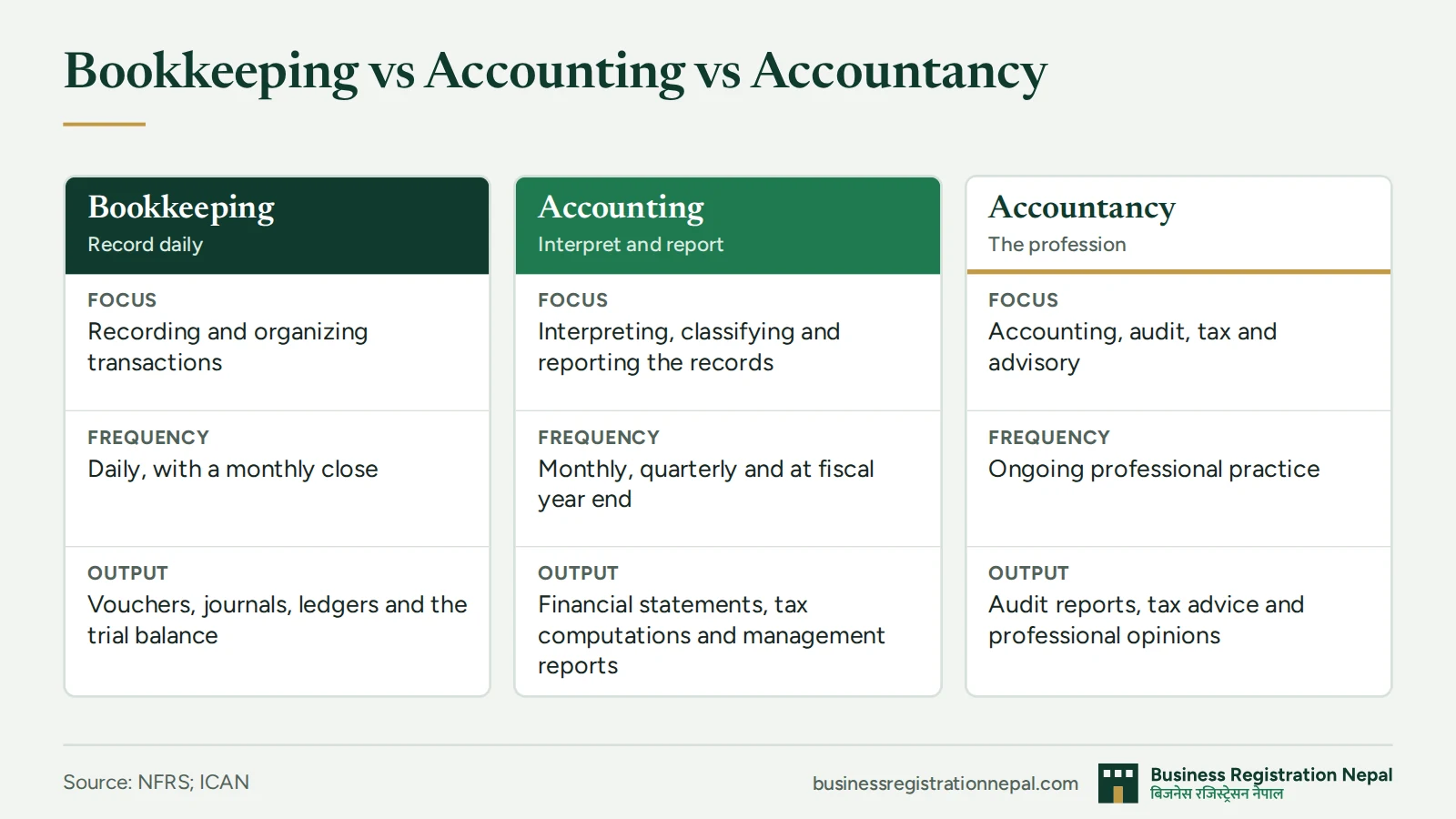
The table compares bookkeeping, accounting and accountancy on 5 attributes: focus, frequency, output, skill level and goal.
| Attribute | Bookkeeping | Accounting | Accountancy |
|---|---|---|---|
| Focus | Recording and organizing transactions | Interpreting, classifying and reporting the records | The whole profession: accounting, audit, tax and advisory |
| Frequency | Daily, with a monthly close | Monthly, quarterly and at fiscal year end | Ongoing professional practice |
| Output | Vouchers, journals, ledgers and the trial balance | Financial statements, tax computations and management reports | Audit reports, tax advice and professional opinions |
| Skill level | Bookkeeping training and accounting software use | An accounting qualification and NFRS knowledge | A professional designation, such as membership of ICAN |
| Goal | Accurate, complete and current records | Decision-useful and compliant financial information | Regulated, independent professional service |
A business with low transaction volume needs a bookkeeper for the daily records and an accountant for the year-end accounts and the tax return. A company that files audited financial statements uses both roles, because the accountant's statements rest on the bookkeeper's ledgers.
Bookkeeping Methods in Nepal
Bookkeeping in Nepal uses 2 recording methods, single-entry and double-entry, and 2 timing bases, cash and accrual. The double-entry method, aligned with NFRS, is the standard for companies, and the accrual basis is the standard timing for company accounts.
Single entry vs double entry decides whether each transaction touches one account or two. The timing basis decides the date a transaction enters the books.
Single-Entry Bookkeeping
Single-entry bookkeeping records each transaction once, as one line in a cash book or an income and expense register. The method is simple and needs no accounting training.
A single-entry record produces no trial balance and no complete balance sheet. That gap limits the record for audit, lending and growth. Single-entry bookkeeping suits only the smallest sole traders.
A company in Nepal does not use the method, because the Companies Act 2063 requires double-entry accounts.
Double-Entry Bookkeeping
Double-entry bookkeeping posts every transaction to 2 accounts, one as a debit and one as a credit of equal value. The debit and credit entries keep the accounting equation in balance: Assets = Liabilities + Equity.
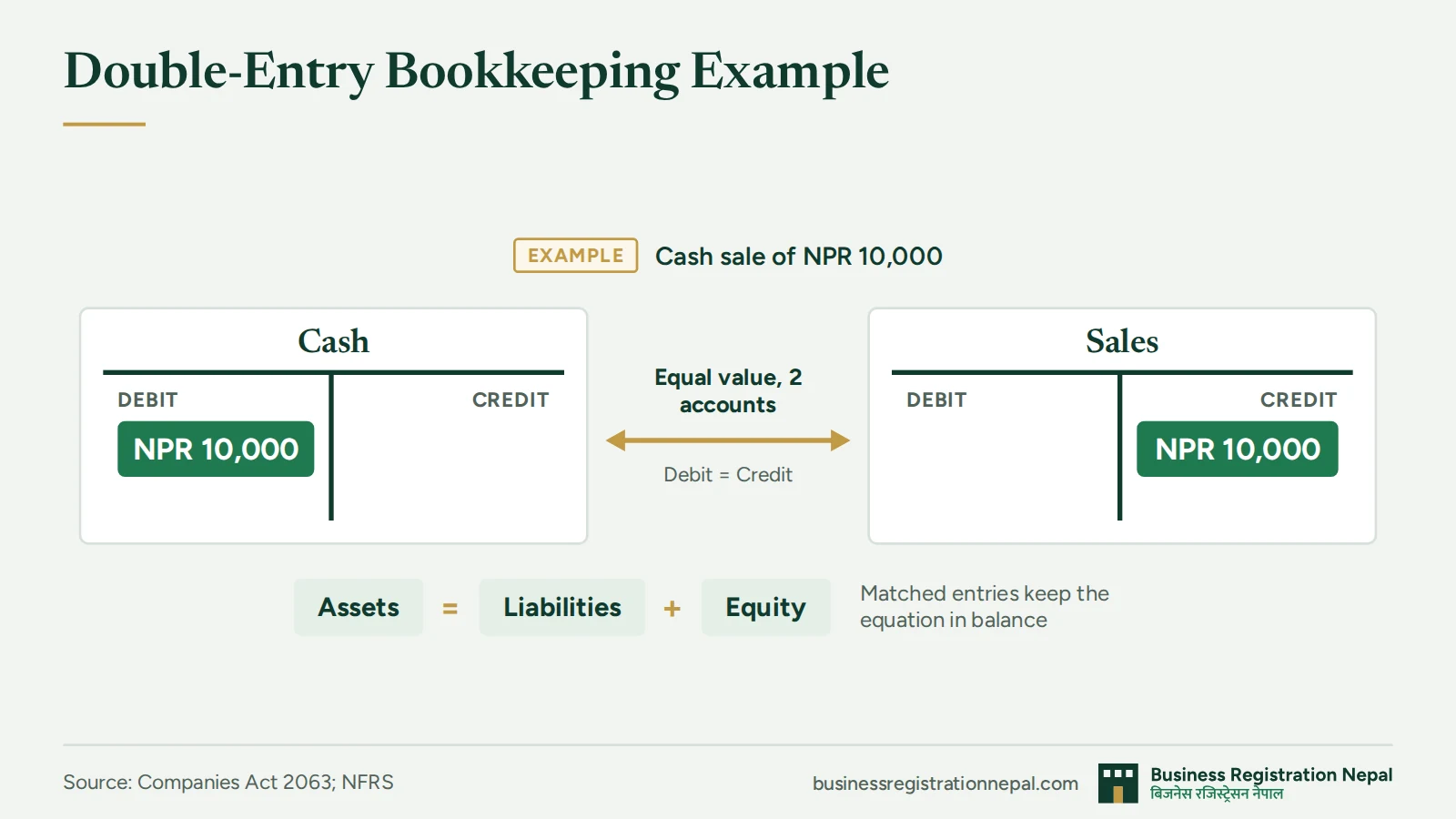
A cash sale of NPR 10,000, for example, debits cash by NPR 10,000 and credits sales by NPR 10,000. Double entry bookkeeping is the standard in Nepal, since the Companies Act 2063 requires it for every company, in line with NFRS.
The matched entries produce a trial balance, full financial statements and an auditable trail from each voucher to the accounts.
Cash Basis vs Accrual Basis Accounting
Cash basis accounting records income and expenses when money moves, and accrual basis accounting records income when earned and expenses when incurred. Cash basis vs accrual basis is therefore a choice of timing, not of recording method.
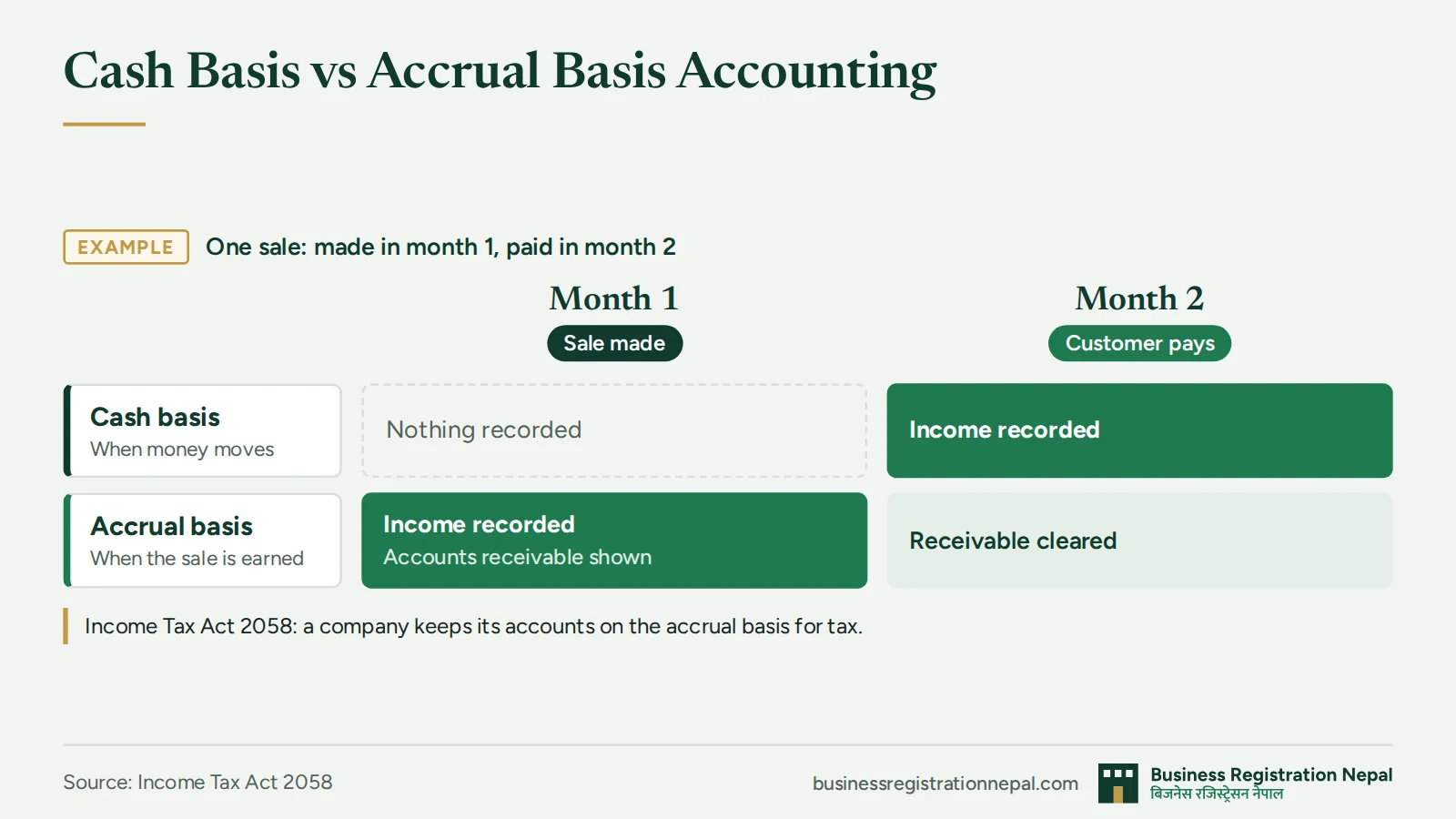
The table compares the cash-basis and accrual-basis methods on 4 attributes.
| Attribute | Cash basis | Accrual basis |
|---|---|---|
| Income recorded | When the customer pays | When the sale is earned |
| Expenses recorded | When the business pays | When the cost is incurred |
| Receivables and payables | Not shown in the books | Shown as accounts receivable and accounts payable |
| Income Tax Act 2058 use | A natural person's employment and investment income | Every company, for tax purposes |
Under the Income Tax Act 2058, a company maintains its accounts on the accrual basis for tax purposes. Audited company statements under NFRS use the accrual basis for every statement except the cash flow statement, under paragraph 27 of NAS 1 Presentation of Financial Statements.
How Does the Bookkeeping and Accounting Process Work?
To work through the bookkeeping and accounting process, a business follows 7 steps, from the source document to the financial statements and their use. Steps 1 to 5 form the bookkeeping process, and steps 6 and 7 form the accounting stage.
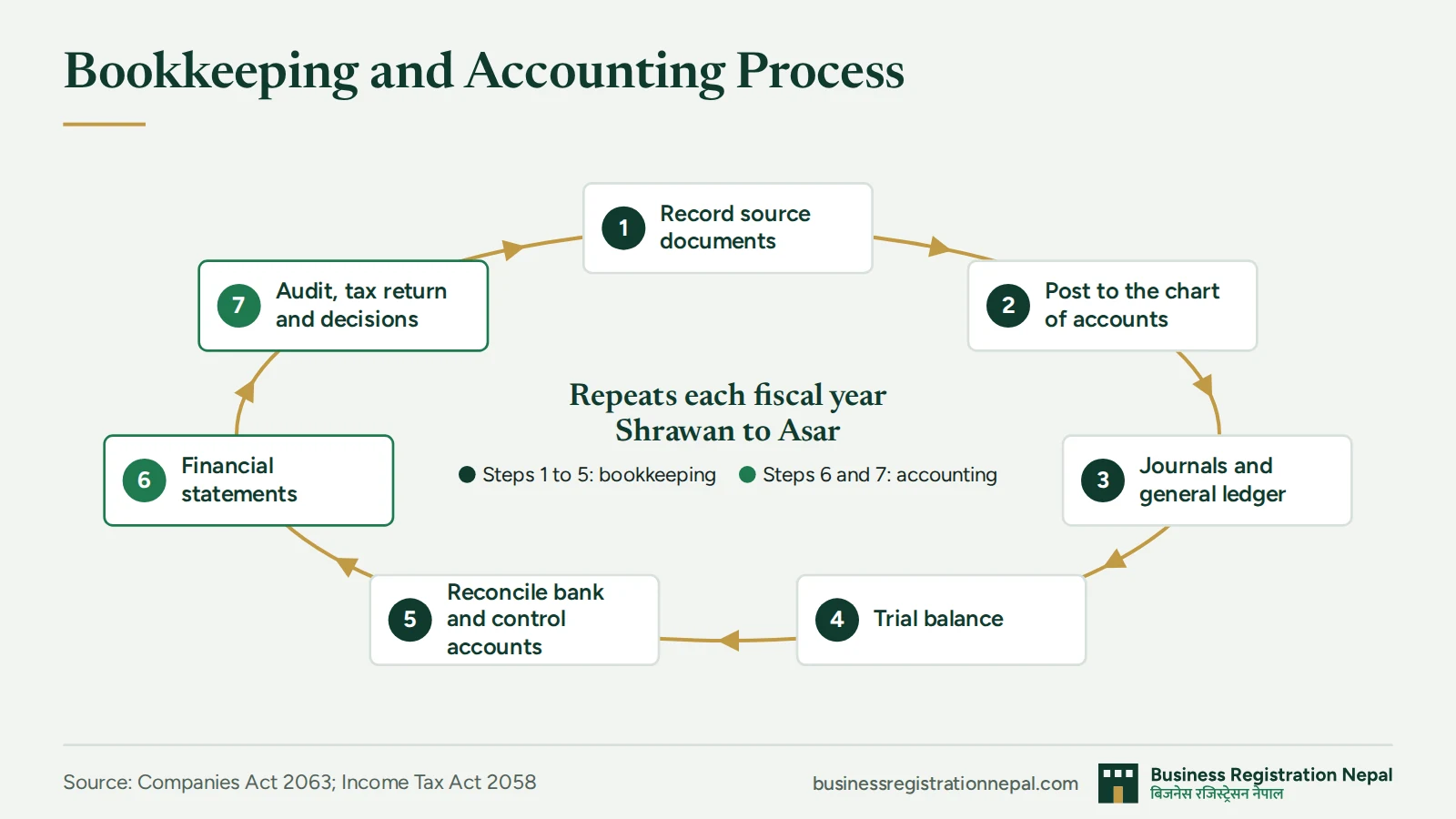
- Step 1: Record every transaction from source documents (invoices, receipts, vouchers). Each entry cites its source document, so every figure traces back to a bill or a receipt.
- Step 2: Categorise and post entries to the chart of accounts. The chart of accounts is the numbered list of ledger accounts, and each entry is categorized to one of them.
- Step 3: Maintain the journals and the general ledger. The journal lists entries by date, and posting moves each entry to its account in the general ledger.
- Step 4: Prepare the trial balance. The trial balance lists every ledger balance, and total debits equal total credits when the posting is correct.
- Step 5: Reconcile bank and control accounts. Bank reconciliation matches the cash book to the bank statement, and each control account is matched to its customer or supplier balances.
- Step 6: Prepare the financial statements (income statement, balance sheet, cash flow). The income statement reports profit or loss, the balance sheet reports assets, liabilities and equity, and the cash flow statement reports cash movements.
- Step 7: Use the accounts for the audit, the income-tax return and management decisions. The auditor verifies the statements, the IRD receives the return, and owners budget and forecast from the same figures.
The general ledger and trial balance close each fiscal year in Nepal, which runs from Shrawan to Asar (mid-July to mid-July). The cycle then restarts with the opening balances of the new year.
What Records and Documents Must a Business Keep in Nepal?
The records a business must keep in Nepal form 7 sets, from sales and purchase invoices to the prior-year audited statements. The Income Tax Act 2058, the VAT Act 2052 and the Companies Act 2063 set the legal duty to keep them.
0 of 7 ready
Books of account under Income Tax Act 2058 rules stay in Nepal for at least 5 years after the income year ends. The IRD sets another period only by written notice. Under the Companies Act 2063, a company keeps its books at its registered office unless the Office of the Company Registrar (OCR) approves another place.
Why Do Bookkeeping and Accounting Matter for a Business?
Bookkeeping and accounting matter for 6 reasons: accurate tax filing, audit readiness, access to loans and funding, better decisions, fraud prevention and legal compliance. Each reason rests on transparent, reliable books.
- Tax accuracy: the income-tax return and the VAT return take their figures from the books.
- Audit readiness: the auditor verifies each balance against the ledgers and vouchers.
- Access to loans and funding: lenders and investors assess a business through its financial statements.
- Decision support: monthly and quarterly reports show profit, cash and costs by activity.
- Fraud prevention: bank reconciliation exposes unrecorded, duplicate or unexplained payments.
- Company law compliance: the Companies Act 2063 makes the directors or officers finally responsible for the books of account.
The same compliant books serve all 6 purposes, so one set of records supports the tax office, the auditor and the owners.
Who Needs Bookkeeping and Accounting Services in Nepal?
5 groups need bookkeeping and accounting services in Nepal: newly registered companies, SMEs, growing companies, NGOs and INGOs, and FDI companies. Every company registered in Nepal must keep books of account from the day of incorporation.
- Startups and new companies: newly registered companies start their books with the share capital deposit and the incorporation costs.
- SMEs: small business accounting services keep the monthly VAT, TDS and payroll records in order.
- Growth-stage companies: rising transaction volume moves the business from a part-time bookkeeper to a full accounting function.
- NGOs and INGOs: non-profit organizations report under NAS for NPOs 2018, the ASB standard for non-profit organizations.
- FDI companies: foreign-invested companies keep the same double-entry books in Nepali or English as any company in Nepal.
Each group chooses between an in-house team and outsourced bookkeeping services, or an accounting bookkeeping service that covers both roles. Accounting services then add the year-end financial statements and the tax return to the monthly books.
What Software Is Used for Accounting in Nepal?
Accounting software in Nepal falls into 2 groups: desktop systems such as Tally, IMS and Swastik, and cloud-based tools such as QuickBooks and Xero. Each group records vouchers, posts ledgers and prepares the trial balance.
The IRD lists the electronic billing software it has certified under the Electronic Billing Procedure 2074. Editions of IMS, Swastik and BUSY and a Tally-based product, TallyCum, appear on that list, and QuickBooks and Xero do not.
Under an IRD decision of 2082/12/27, a taxpayer with annual turnover above NPR 20 crore issues every invoice electronically. Each invoice links to the IRD Central Billing Monitoring System (CBMS) at issue. Banks and financial institutions that do not bill customers directly fall outside the rule.
Online accounting services run on cloud-based software, so the bookkeeper and the owner work on the same live ledgers. The choice of system follows transaction volume, VAT status and the CBMS rule rather than any single product.
How Do Clean Books Support Audit and Tax Compliance in Nepal?
To support audit and tax compliance, clean books produce the 2 documents the law asks for: the audited financial statements and the income-tax return. Both documents draw on the same reconciled ledgers and trial balance.
A private company sends its audited financial statements to the OCR within six months of the fiscal year end. Under the Income Tax Act 2058, the income return reaches the IRD within three months of the end of the income year.
Double-entry bookkeeping gives the statutory audit in Nepal an auditable trail from each voucher to the audited financial statements. Accurate accounting then feeds annual compliance and filings, from the OCR submission of audited accounts to the IRD income return.
Clean books aim at accuracy and lawful tax planning. Every deduction claimed traces to a document the Income Tax Act 2058 requires the business to keep.
Tax and accounting services rely on those records. Accounting records behind a filed return support the application for a tax clearance certificate in Nepal at the IRD.
Frequently Asked Questions
Can I legally do my own bookkeeping instead of hiring someone?
Yes, a business owner can legally keep the books without hiring a bookkeeper, provided the records meet the tax and company law standards. The books still follow the double-entry system and support the audit and the income-tax return. In a company, the directors or officers carry final responsibility for the books of account, whoever keeps them.
Should I outsource bookkeeping or keep it in-house?
No single answer fits every business: transaction volume, in-house skills and cost decide between outsourced and in-house bookkeeping. A small company with low volume outsources the work until the volume justifies a salaried bookkeeper. The legal duty for the books stays with the company either way.
How many years must accounting records be retained in Nepal?
Accounting records in Nepal are retained for at least 5 years after the income year ends, under the Income Tax Act 2058. The IRD sets a different period only by written notice. Company law and VAT rules carry their own retention periods: the VAT Rules 2053 require VAT records to be kept for 6 years.
How often should the books be updated?
The books are updated daily, with a monthly bank reconciliation and close. A VAT-registered business files its VAT return every month, by the 25th of the following month, so its books stay current each month. Regular updates keep filings and reconciliations accurate rather than left to year-end.
What is a chart of accounts and do I need one?
A chart of accounts is the organized list of ledger accounts a business posts to, grouped under assets, liabilities, equity, income and expenses. Every double-entry system needs one, because each entry posts to a named account. The chart underpins consistent reporting from month to month and year to year.
Does a startup with no revenue still need to keep accounts?
Yes, a startup company keeps accounts from incorporation, even before it earns revenue. The Companies Act 2063 duty to maintain accounts applies to every company, and pre-revenue costs, capital and bank balances all enter the books. Startup accounting records support the annual audit and filings, and audit explained covers who is audited and when. The Companies Act 2063 sets no audit exemption by size, so a small company is audited too.
Do small businesses follow a simplified accounting standard?
Yes, smaller entities in Nepal report under 2 simplified standards from ASB Nepal: NFRS for SMEs 2017 and NAS for MEs 2018 for micro entities. NFRS for SMEs applies from FY 2080/81 and NAS for MEs from FY 2081/82, on ICAN's effective-date schedule. A micro entity has, for 2 consecutive years, annual turnover and a balance sheet total of NPR 200 million or less each, and bank or public borrowings and assets held in a fiduciary capacity of NPR 100 million or less each. An entity without public accountability above those limits uses NFRS for SMEs.