

VAT in Nepal is value added tax (मूल्य अभिवृद्धि कर), an indirect consumption tax on taxable supplies under the VAT Act 2052. Registered businesses collect it and remit it to the Inland Revenue Department (IRD). VAT works through input tax credit, so each business pays VAT only on the value it adds.
The standard VAT rate in Nepal is 13%, apart from zero-rated exports and exempt supplies. VAT registration applies above NPR 50 lakh of annual turnover for goods or NPR 30 lakh for services, and to listed sectors whatever their turnover. A VAT bill, or VAT invoice, shows the seller's VAT number and the 13% VAT separately, and a monthly VAT return is due by the 25th.
The VAT number is the business's 9-digit PAN with the VAT flag set. VAT registration at the IRD follows the PAN as one step of company registration in Nepal.
What Is VAT and How Does It Work in Nepal?
Value added tax (VAT) in Nepal is a consumption tax on taxable supplies. Registered businesses collect it from buyers and remit it to the Inland Revenue Department (IRD). VAT works through the input tax credit, which limits each business to tax on the value it adds.
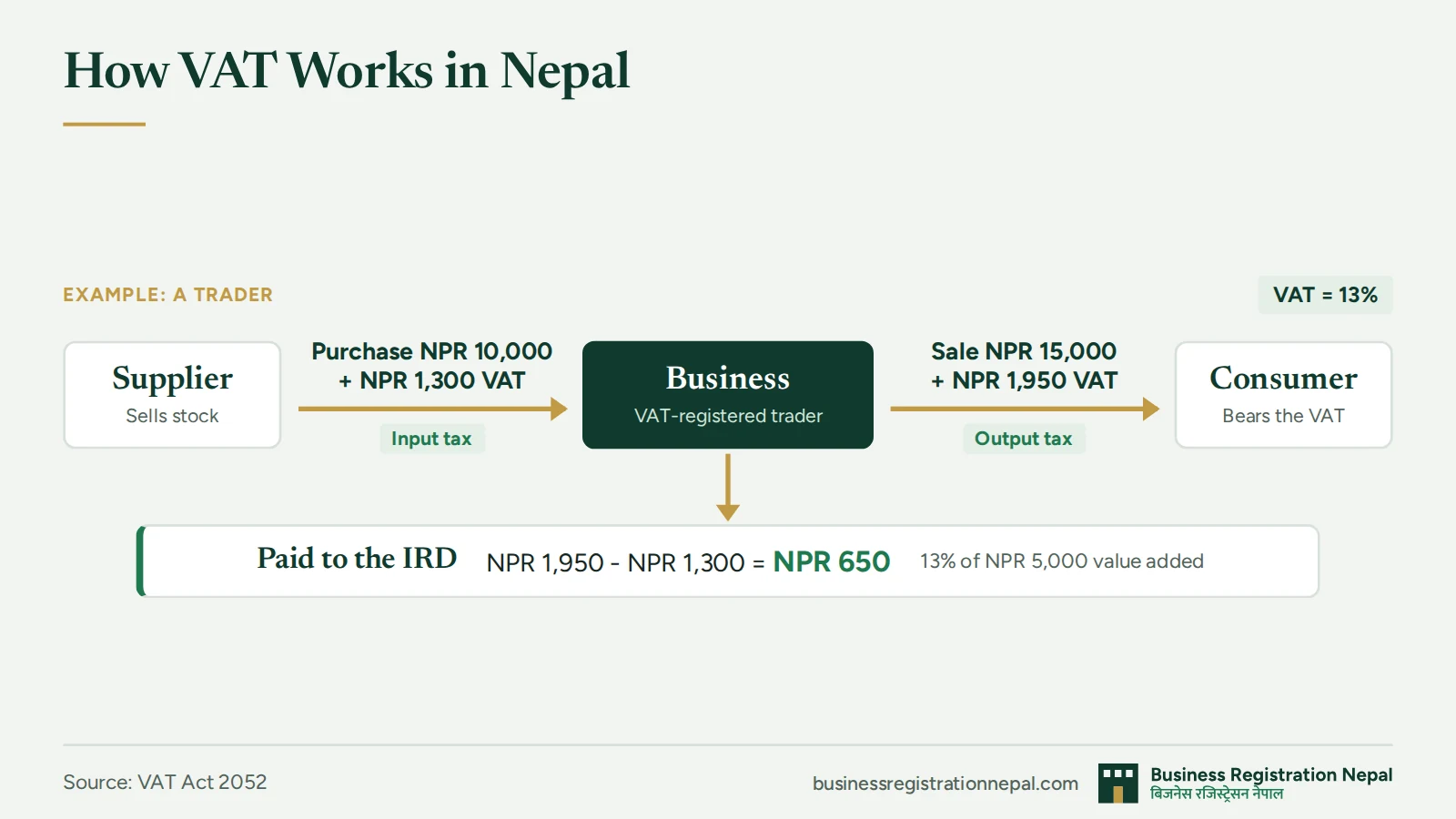
The VAT full form is value added tax, and the VAT Act 2052 governs it. VAT is an indirect tax: the seller collects it inside the price, and the final consumer bears it. Under that Act, VAT applies to goods and services supplied in Nepal, imported into Nepal and exported from Nepal.
A VAT-registered business moves the tax to the IRD in 4 steps:
- Step 1: Charge VAT on each taxable sale and collect it from the buyer as output tax.
- Step 2: Pay VAT on business purchases and imports as input tax.
- Step 3: Deduct the input tax from the output tax. Under the VAT Act 2052, this input tax credit, or purchase VAT offset, covers only purchases for the taxable business. Each claim rests on the prescribed documents, such as a valid VAT invoice.
- Step 4: File the VAT return and pay the difference to the IRD.
For example, a trader buys stock at NPR 10,000 plus NPR 1,300 VAT. The trader sells it at NPR 15,000 plus NPR 1,950 VAT. It remits NPR 650 to the IRD, which is 13% of the NPR 5,000 value added.
What Is the VAT Rate in Nepal?
The VAT rate in Nepal is a single standard rate of 13% on the taxable value of each taxable supply. Under the Value Added Tax Act 2052, the same 13% covers goods and services, with 2 departures: zero-rated supplies at 0% and exempt supplies outside VAT.
To calculate VAT, a business multiplies the taxable value by 13%. A service fee of NPR 100,000 carries NPR 13,000 VAT, so the buyer pays NPR 113,000.
2 groups of supplies depart from the standard VAT rate:
- Zero-rated supplies: goods exported from Nepal and services exported outside Nepal carry VAT at 0% under Schedule 2 of the Act.
- Exempt supplies: Schedule 1 exempts listed goods and services from VAT, for example unprocessed agricultural produce, health services, education, and financial and insurance services.
Every other supply carries the 13% VAT rate, and the VAT invoice shows that tax as a separate amount.
What Is the VAT Registration Threshold in Nepal?
The VAT registration threshold in Nepal is NPR 50 lakh of annual turnover for goods and NPR 30 lakh for services or mixed supplies. A business that exceeds this turnover limit registers for VAT with the IRD, and listed sectors register regardless of turnover.
NPR 50 lakh equals NPR 5 million, and NPR 30 lakh equals NPR 3 million. Under the VAT Act 2052, a small vendor below the threshold needs no VAT registration and files no VAT return. The same Act lets that vendor register on a voluntary basis.
Mandatory registration from the opening sale applies to any sector the IRD designates by notice, whatever its turnover. The IRD changes that list from time to time, so a business checks its sector against the current IRD notice before it starts trading. A business that crosses the VAT threshold completes VAT registration at the Inland Revenue Department before it issues a VAT bill.
What Is a VAT Bill (Invoice) in Nepal?
A VAT bill in Nepal is the tax invoice a VAT-registered business issues for each taxable sale. It shows the VAT number, the itemized value and the 13% VAT as a separate amount. The buyer keeps the VAT bill as proof of the input tax it paid.
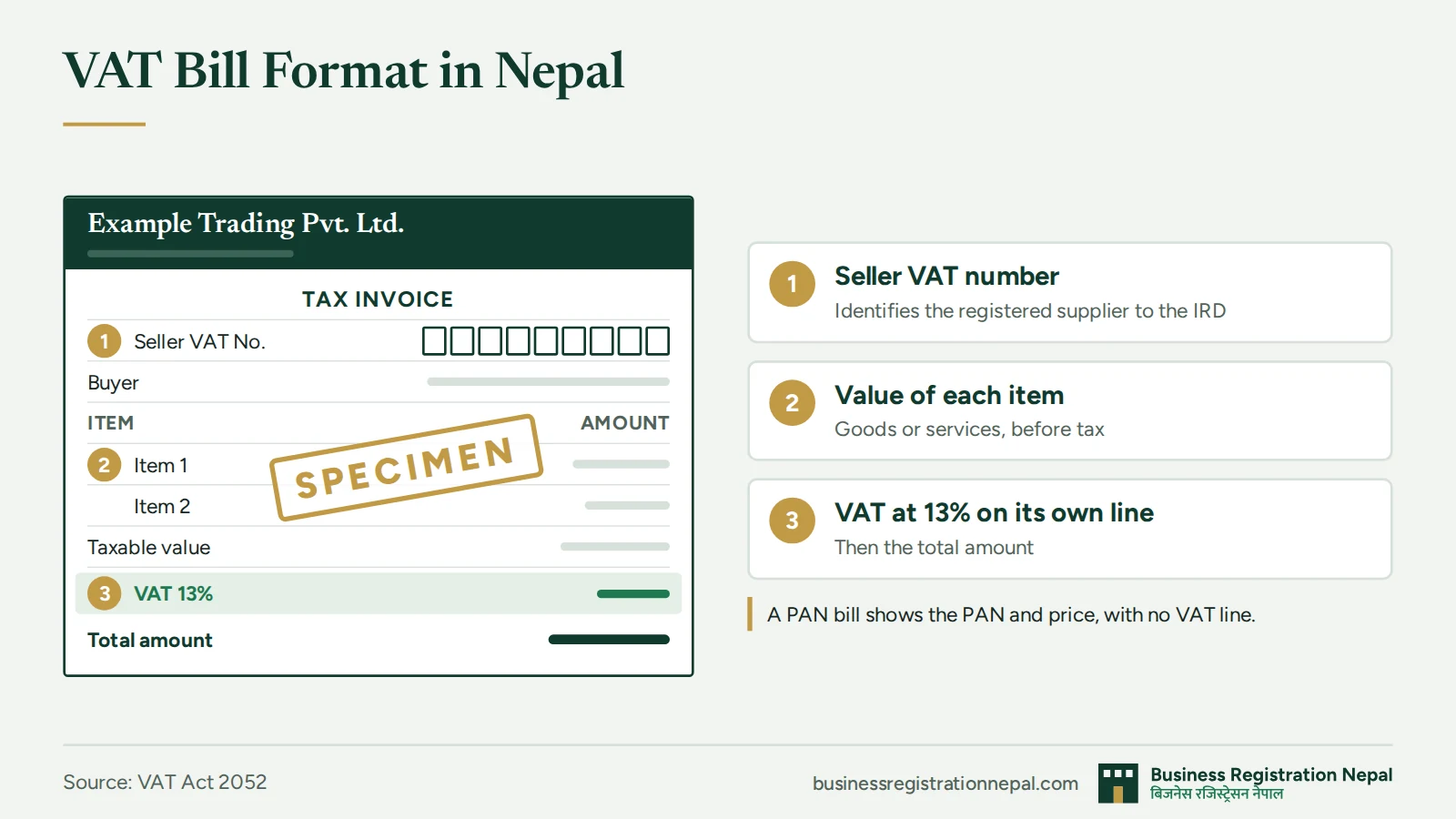
Under the VAT Act 2052, every registered person issues an invoice for each supply of goods or services. The buyer has a duty to take it. The prescribed rules set the VAT bill format, and an unregistered person issues no invoice that shows tax.
The VAT bill format in Nepal separates 3 parts that a plain sales bill merges:
- VAT number of the seller, which identifies the registered supplier to the IRD
- Value of each item of goods or services before tax
- VAT at 13% on its own line, then the total amount
A PAN bill differs from a VAT invoice: a business registered only for PAN shows its PAN and the price, with no VAT line. Taxpayers with annual turnover above NPR 20 crore issue each VAT bill electronically, linked to the IRD Central Billing Monitoring System (CBMS).
How and When Do You File a VAT Return?
To file a VAT return, a VAT-registered business in Nepal submits a monthly return to the IRD by the 25th of the following Nepali month. The net VAT is paid by the same date. The return is due even for a month with no taxable sales.
Under the VAT Act 2052, the taxpayer assesses its own tax for each month and submits the return within 25 days of the month's end. Payment of the tax follows the same 25-day limit. Nepali months follow the Bikram Sambat calendar, so the Shrawan return falls due by 25 Bhadra.
VAT return filing reports 3 figures: the output tax on sales, the input tax on purchases, and the net VAT due to the IRD. The VAT Act 2052 lets prescribed taxpayers file for a period shorter or longer than a month. Print and electronic media publishers are among the taxpayers the IRD allows to file every four months.
The annual compliance checklist of a Nepali company lists the monthly VAT return beside the income-tax return and the annual company filing.
Who Must Register for VAT in Nepal?
4 groups must register for VAT in Nepal: businesses above the turnover threshold, sectors on the mandatory list, importers and exporters, and foreign digital service providers above their threshold. Each group registers with the IRD before it charges VAT.
- Businesses above the threshold: a business whose annual taxable turnover exceeds NPR 50 lakh for goods or NPR 30 lakh for services registers for VAT.
- Sectors on the mandatory list: listed goods and services register from the opening transaction, whatever the turnover, as the current IRD notice designates them.
- Importers and exporters: traders that import or export goods register for VAT where the VAT Act 2052 or an IRD notice requires it for their trade.
- Providers of digital services from outside Nepal: a non-resident provider selling digital services to consumers in Nepal registers online with the Large Taxpayers Office once its annual sales in Nepal cross the threshold the law sets, and charges 13% VAT.
Under the VAT Act 2052, a person in Nepal who buys services from an unregistered supplier outside Nepal assesses and collects the VAT on them. A business outside all 4 groups stays out of VAT or registers on a voluntary basis.
What Is the Difference Between VAT and PAN?
PAN is the 9-digit permanent account number that identifies a taxpayer, and VAT is the tax a registered business charges on its sales. A business holds a PAN before VAT, and its VAT number is the same PAN with the VAT flag set.
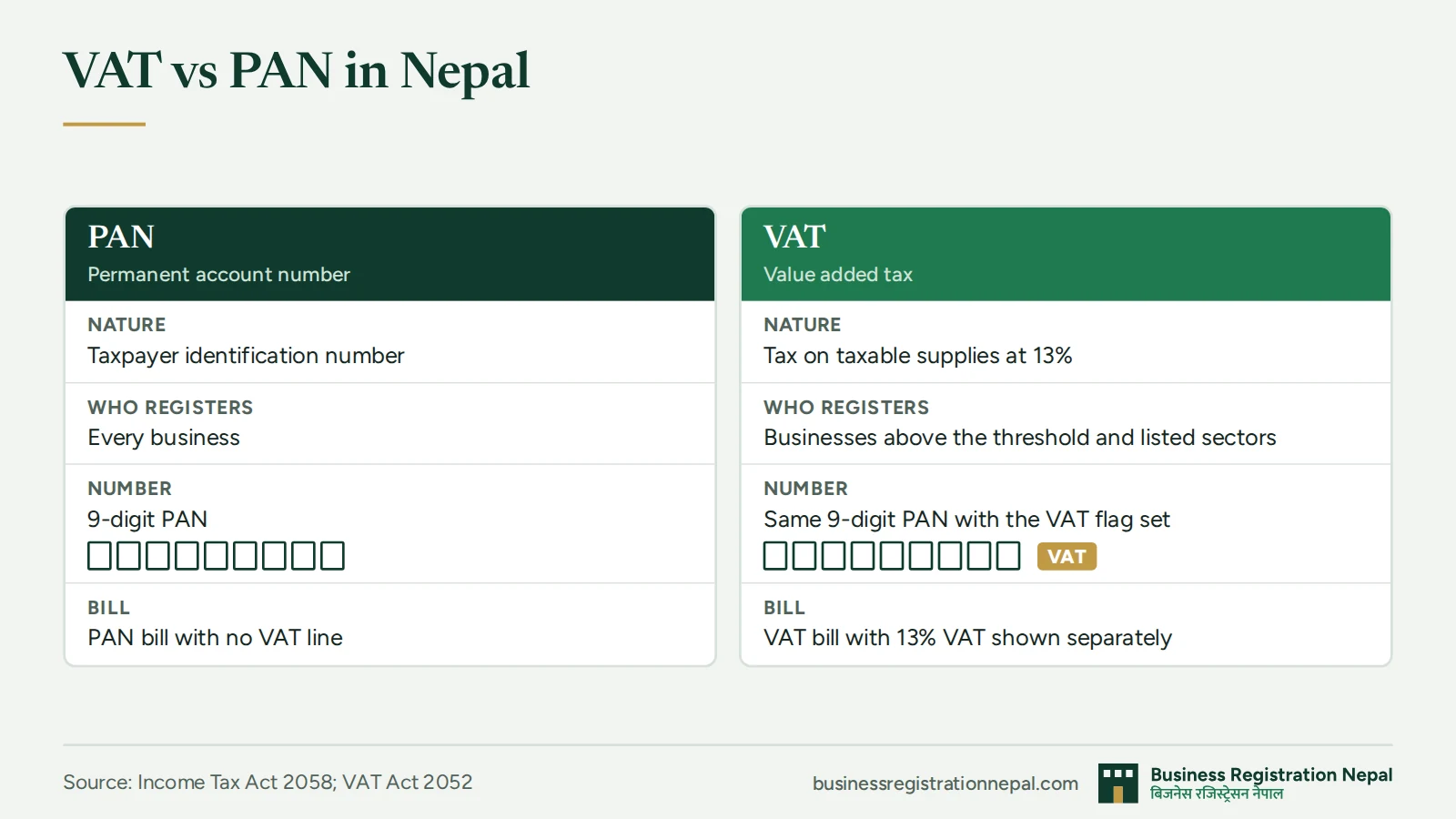
The IRD issues the PAN under the Income Tax Act 2058 and registers VAT under the VAT Act 2052. The table compares VAT vs PAN on 5 attributes.
| Attribute | PAN | VAT |
|---|---|---|
| Nature | Taxpayer identification number | Tax on taxable supplies at 13% |
| Who registers | Every business | Businesses above the threshold and listed sectors |
| Number | 9-digit PAN | Same 9-digit PAN with the VAT flag set |
| Bill | PAN bill with no VAT line | VAT bill with 13% VAT shown separately |
| Return | Annual income-tax return | Monthly VAT return by the 25th |
A trader below the threshold works with PAN alone, and a business above it adds VAT to the same number. The guide PAN in Nepal explained sets out personal and business PAN, the number every VAT registration builds on. The VAT number check confirms whether a supplier's PAN carries the VAT flag before a buyer claims input tax.
Frequently Asked Questions
Which sectors must register for VAT regardless of turnover?
Sectors on the IRD's mandatory VAT registration list register before their opening sale, whatever their annual turnover. The IRD designates those sectors by notice and changes the list from time to time. The NPR 50 lakh goods threshold and the NPR 30 lakh services threshold do not apply to these sectors.
What details must a valid VAT tax invoice show?
A valid VAT tax invoice shows the seller's and buyer's details, the seller's VAT number, the invoice number and date, and the VAT charged separately. Under the VAT Rules 2053, the document carries the heading "tax invoice" and is issued in three copies. The VAT Act 2052 grants input tax credit only against prescribed documents, so an incomplete invoice weakens the buyer's claim.
Can VAT registration be cancelled or deregistered?
Yes, a tax officer cancels VAT registration under the VAT Act 2052 when a business closes, is sold, stops taxable business or was registered by mistake. A business that falls below the threshold applies to its tax office to cancel the registration, and the tax officer decides on the application. VAT falls due on closing stock that earned an input tax credit.
What is the difference between VAT-exempt and zero-rated supplies?
Zero-rated supplies carry VAT at 0% and keep the input tax credit, and exempt supplies carry no VAT and lose the input tax claim on related purchases. Exports of goods and services are zero-rated under Schedule 2 of the VAT Act 2052. Education and health services are exempt under Schedule 1.
Can input VAT on purchases be claimed?
Yes, a VAT-registered business deducts input VAT on purchases for its taxable business from the output VAT it collects. Under the VAT Act 2052, each claim needs the prescribed documents, such as a valid VAT invoice. Purchases for exempt supplies earn no input tax credit.
What is the penalty for issuing a fake VAT bill?
Under the VAT Act 2052, a false VAT bill is an offence punished by a fine, up to 6 months' imprisonment, or both. The fine follows the VAT Act as amended by later Finance Acts. An unregistered person who issues a bill showing VAT pays back the tax it collected. A valid VAT invoice from a registered seller is the only basis for an input tax claim.