

Patent registration in Nepal gives an inventor the exclusive right over a new, useful and lawful invention, registered with the Department of Industry (DoI) under the Patent, Design and Trade-mark Act 2022.
The patent registration process in Nepal runs in 5 steps:
- Step 1: Prepare the specification and drawings of the invention.
- Step 2: File the application at the Department of Industry.
- Step 3: Undergo examination for novelty and patentability.
- Step 4: Publication and processing of the application.
- Step 5: Registration and issue of the patent certificate.
The application carries 4 documents, led by the application form. An invention already registered to another person, or one harmful to public health, morality or the national interest, cannot be patented.
Registration brings the exclusive right to exploit the invention, protection against copying, and the right to transfer or license it. Protection lasts 7 years and renews up to twice for 7 years each.
Foreign applicants apply at the DoI with Paris Convention facilities, and each transfer or licence is recorded through a joint application. A company that holds or licenses a patent is formed through company registration in Nepal.
What Is a Patent?
A patent is a grant of exclusive right over an invention that is new and useful, tested for novelty, inventive step and industrial applicability. In Nepal, the Department of Industry (DoI) grants it under the Patent, Design and Trade-mark Act 2022.
Under the Patent, Design and Trade-mark Act 2022, a patent is a useful invention relating to a new method of process or manufacture. The definition covers a new method of operating or transmitting materials, and an invention built on a new theory or formula.
Novelty means newness: the invention was not previously disclosed, so no prior art describes it. Inventive step marks an advance that is not obvious from that prior art, and industrial applicability means industry makes or uses the invention. The Act's own wording names a new and useful invention, and the DoI's substantive examination also assesses inventive step.
The inventor, or a person who holds title from the inventor, applies for the patent. The registered patent holder, called the patentee, then holds the exclusive right to make, use and license the invention in Nepal.
What Can and Cannot Be Patented in Nepal?
In Nepal, an invention is patented when it is new, useful and lawful. Examples are a new manufacturing process, a new method of operating or transmitting a material, and an invention built on a new theory or formula. The Department of Industry refuses the rest on 4 grounds.
Under the Patent, Design and Trade-mark Act 2022, the Department of Industry does not register a patent in 4 circumstances:
- Registration of the same patent in another person's name
- Absence of title, where the applicant is neither the inventor nor a successor to the inventor's right
- Threat to public health, conduct, morality or the national interest
- Contravention of a law in force in Nepal
The 4 grounds make lawfulness and title part of patentability, next to newness and usefulness. The Act names no category list such as software or business methods, so the DoI decides each application on the 4 grounds and the newness and usefulness tests.
Why Register a Patent?
Inventors register a patent in Nepal for 3 legal benefits: the exclusive right to exploit the invention, protection against copying, and the right to transfer or license it. Each benefit starts on the date of registration and lasts for the term of protection.
Under the Patent, Design and Trade-mark Act 2022, a person who wants rights over a patent registers it in that person's own name. After registration, no one copies, uses or lets others use the patent without a transfer of ownership or the patentee's written permission.
The registered right protects the inventor's market for the product or process, and the Act backs it with fines, confiscation of goods and compensation. A registered patent works as an asset, so the patentee sells it outright or licenses its use to a manufacturer.
What Is the Patent Registration Process?
To register a patent in Nepal, an applicant completes 5 steps at the Department of Industry, from the specification to the patent certificate. The patent registration process in Nepal follows the Patent, Design and Trade-mark Act 2022.
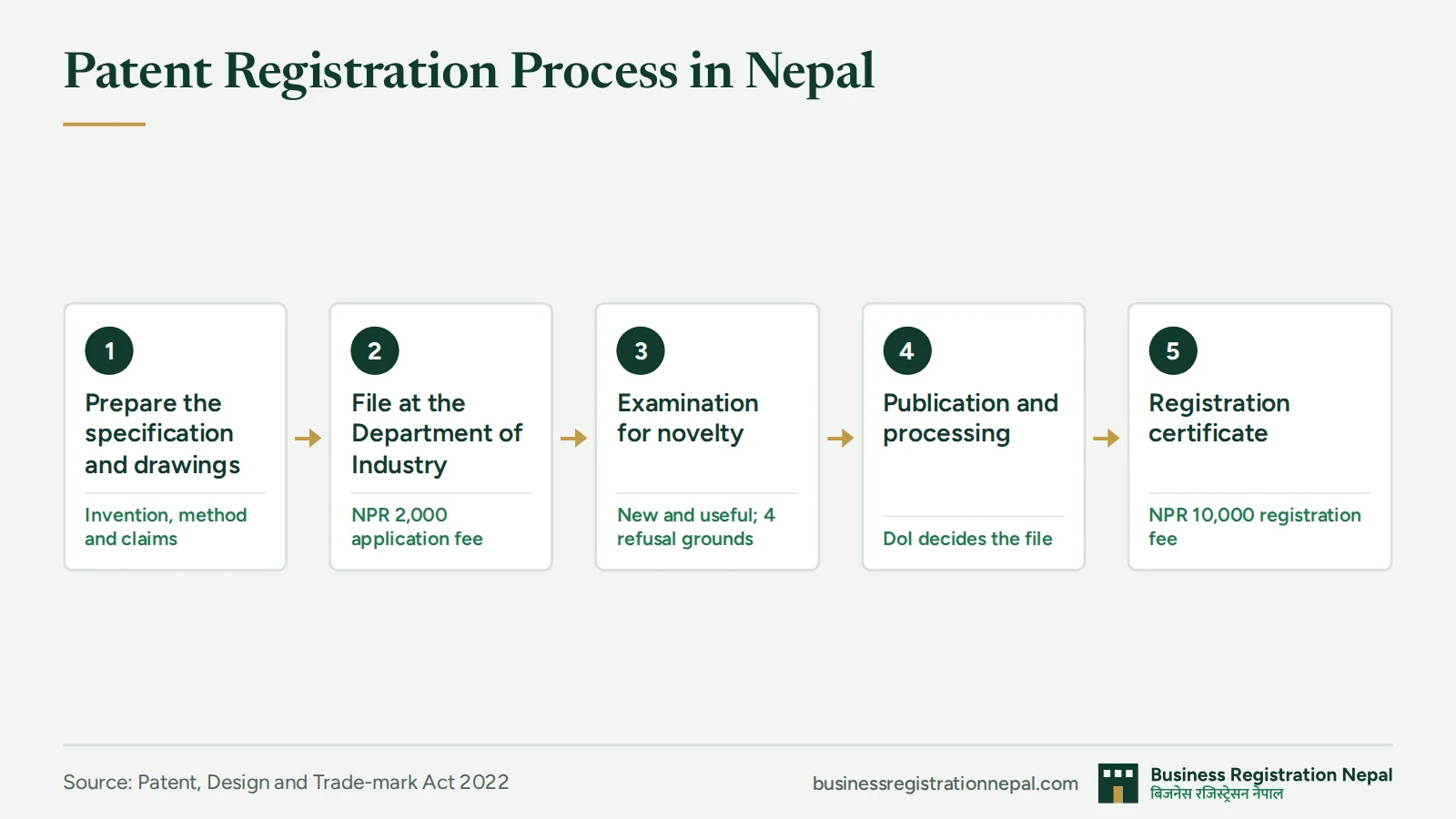
- Step 1: Prepare the specification and drawings of the invention. The specification describes the invention, the method of making, operating or using it, and the claims to protect. The DoI checklist names this complete specification and no provisional filing.
- Step 2: File the application at the Department of Industry. The DoI (Industrial Property Section) receives the formal application, the specification and the receipt for the NPR 2,000 application fee.
- Step 3: Undergo examination for novelty and patentability. The DoI examines whether the invention is new and useful to the general public, consulting technical advisers where needed, and tests the 4 refusal grounds.
- Step 4: Publication and processing of the application. The DoI processes the examined file to a decision, and the Act places publication in the Nepal Gazette after registration. Any person objects to the DoI within 35 days of seeing or copying the published patent.
- Step 5: Registration and issue of the patent certificate. The DoI issues the certificate after the applicant pays the NPR 10,000 registration fee.
The patent certificate closes the process and names the patentee. A patent that the national interest requires to be kept secret stays out of the Nepal Gazette.
What Documents Are Required for Patent Registration?
The Department of Industry requires 4 documents for patent registration in Nepal: the formal application, the patent specification, a power of attorney for any representative, and the application-fee receipt. A foreign patent adds 2 documents.
The DoI checklist for a domestic patent lists 4 documents:
0 of 4 ready
The specification carries the applicant and inventor details: the inventor's name, address and occupation, and the patent owner's name and address. A foreign applicant adds evidence of the original application in another country. A patent registered abroad adds a certified copy of its foreign patent certificate.
What Is the Term of Protection and Renewal?
The term of protection for a patent in Nepal is 7 years from registration, renewable up to twice for 7 years each, or 21 years at most. Patent validity in Nepal depends on each renewal reaching the Department of Industry on time.
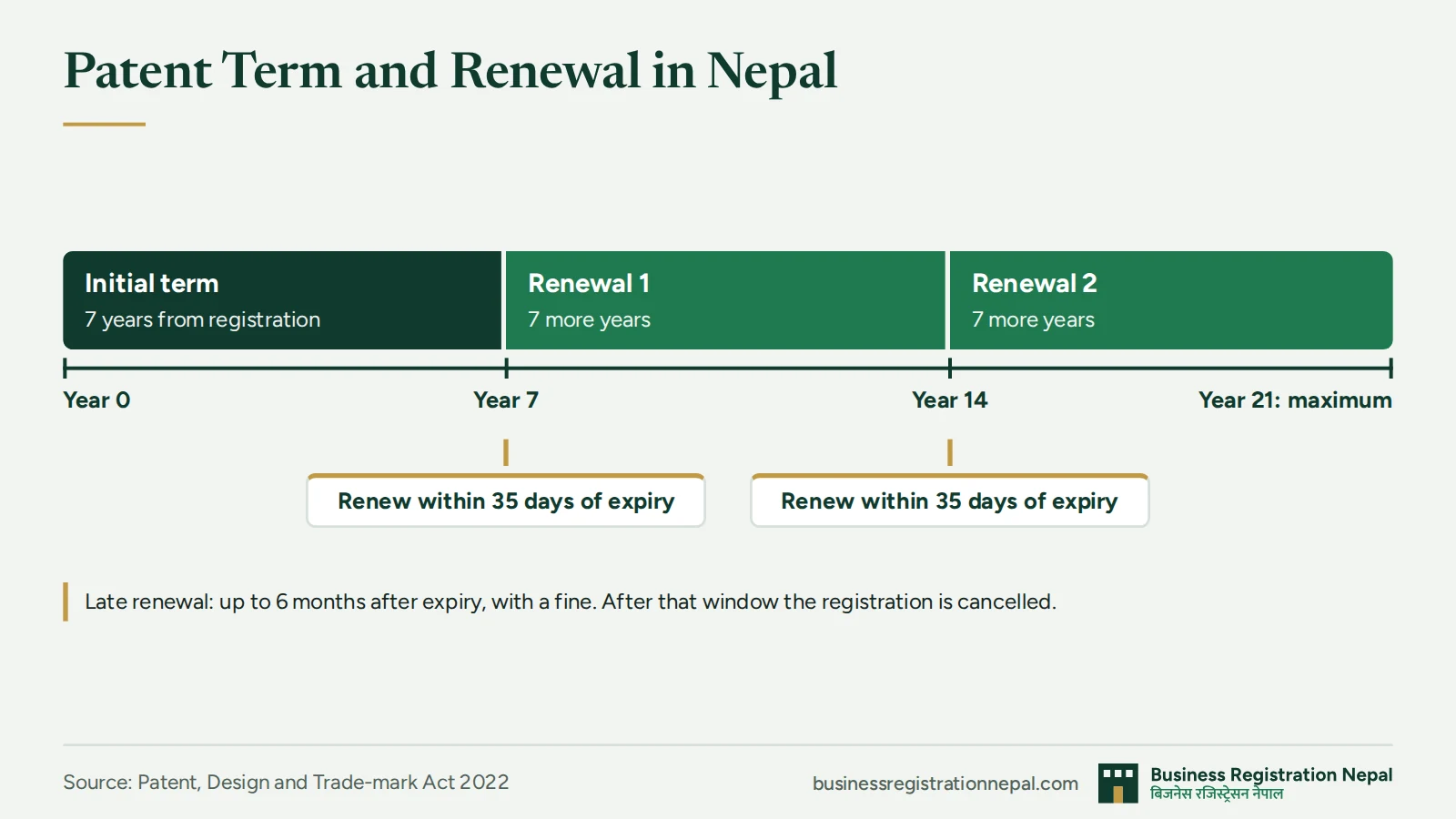
Under the Patent, Design and Trade-mark Act 2022, the patentee renews within 35 days from the expiry of the term. The table sets out the patent term renewal stages, their timing and the fee in Schedule 3 of the Act.
| Stage | Timing | Fee (Schedule 3) |
|---|---|---|
| Initial term | 7 years from registration | NPR 10,000 registration fee |
| Renewal 1 | Within 35 days from expiry; 7 more years | NPR 5,000, once for the 7-year term |
| Renewal 2 | Within 35 days from expiry; 7 more years | NPR 7,500, once for the 7-year term |
| Late renewal | Up to 6 months after expiry | NPR 1,000 fine with the renewal |
| Lapse | After the 6-month window | Registration cancelled automatically |
The Government of Nepal alters Schedule 3 fees by notice in the Nepal Gazette, and the fee schedule in use still lists NPR 5,000 for the first renewal and NPR 7,500 for the second. Patent renewal in Nepal needs an application, the original patent certificate, the renewal-fee receipt and any power of attorney. A foreign patent adds proof that its home registration was renewed.
Can Foreign Applicants Patent in Nepal?
Yes, foreign applicants patent in Nepal by filing at the Department of Industry, and a foreign patent has no force in Nepal until it is registered here. Nepal has been a party to the Paris Convention since 22 June 2001.
Under the Patent, Design and Trade-mark Act 2022, the DoI registers a patent already registered in a foreign country without a fresh enquiry. The application carries the foreign registration certificate. The DoI extends to the holder the facilities of the Paris Convention for the Protection of Industrial Property 1883.
The DoI grants each foreign applicant Paris Convention priority based on the home filing, when the Nepali application follows within 12 months of the earliest priority date. The priority claim carries the home-country filing details and a certified copy of the home application or registration, with an English translation. A foreign applicant usually files through a representative in Nepal appointed under a power of attorney.
A foreign company that exploits its patent through a Nepali subsidiary follows FDI and foreign company registration, with Department of Industry approval before incorporation.
How Are Patent Rights Transferred or Licensed?
Patent rights are transferred or licensed through a written transfer or approval of use and a joint application to the Department of Industry, which records the change. An unrecorded deal leaves the register unchanged.
Under the Patent, Design and Trade-mark Act 2022, a patentee either assigns ownership of a registered patent or approves its use in writing. An assignment moves the whole right to a new patentee, and a licence lets a licensee use the invention while the patentee keeps ownership.
For a patent transfer, licensing or other change of right, both parties file a joint application with the DoI and pay the prescribed fee. Schedule 3 of the Act sets the transfer fee at NPR 5,000, the figure the fee schedule in use still lists for a transfer of ownership.
The DoI then transfers ownership in its register or approves the use. For a licence, the DoI updates the register and the certificate on file and issues a note to the licensee.
Frequently Asked Questions
Is Nepal a member of the Patent Cooperation Treaty (PCT)?
No, Nepal is not a contracting state of the Patent Cooperation Treaty (PCT), so no PCT national-phase route leads into Nepal. An applicant files directly at the Department of Industry. Nepal is a party to the Paris Convention and, as a WTO member, to the TRIPS Agreement.
How many patents are registered in Nepal?
Very few patents are registered in Nepal, and the patent system sees little use. The Department of Industry reports patent registrations with trademarks and designs in its Industrial Statistics, which carry the current cumulative count.
What is the difference between a patent, a design and a trademark?
A patent protects an invention, a design protects the form or appearance of a product, and a trademark protects a brand sign. All 3 fall under the Patent, Design and Trade-mark Act 2022, and the Department of Industry registers each one. Design renewals run 5 years at a time, up to twice, while trademark renewals run 7 years at a time without a cap.
Unlike a patent, a brand name takes the trademark route at the DoI, and a creative work falls under copyright, a separate law.
Is patent protection automatic without registration?
No, patent protection in Nepal is not automatic, because the right arises only on registration at the Department of Industry. An unregistered invention has no patent right in Nepal. A patent granted abroad gains force here only through its own Nepali registration.
What are the remedies for patent infringement?
A registered patentee has 3 remedies under the Act: a fine on the infringer, confiscation of infringing goods and compensation for the loss. Unauthorised copying or use carries a fine of up to NPR 500,000, and an attempt or abetment up to NPR 250,000. The patentee files the complaint at the DoI Law and Decision Implementation Section, which handles industrial property complaints.
Can a granted patent be cancelled or invalidated?
Yes, the Department of Industry cancels a granted patent on a refusal ground, such as prior registration in another person's name or harm to public health. The patentee receives a reasonable opportunity to show cause before cancellation. A person who objects to a published patent complains to the DoI within 35 days, and a DoI order is appealable to the High Court within 35 days, the High Courts having replaced the Appellate Courts named in the Act.
Does registering a patent in Nepal protect it abroad?
No, a patent registered in Nepal protects the invention only inside Nepal, because patent rights are territorial. Protection abroad requires a separate filing in each country where the owner seeks it. The Paris Convention lets that filing claim priority from the Nepali application, when filed within 12 months of the Nepali filing date in a Paris Convention country.