Register Right. Stay Compliant. Business Registration Nepal handles FDI in Nepal for foreign investors, with chartered accountants taking your foreign direct investment in Nepal from approval and company registration to capital recording and profit repatriation.
FDI investment in Nepal is foreign investment approved under FITTA 2019 and then used to incorporate an FDI company in Nepal. Foreign individuals and companies, joint venture partners and NRNs use it, and Business Registration Nepal handles approval, company registration and Nepal Rastra Bank capital recording end to end, then keeps the company compliant through its statutory audit.
What FDI Setup Involves
FDI setup in Nepal involves 6 stages, and we handle each one for you:
Checking your sector against the negative list
FDI approval from the Department of Industry (DOI) or Investment Board Nepal (IBN)
Company registration at the OCR
PAN, VAT and ward registration
Industry registration
Recording the investment at Nepal Rastra Bank (NRB)
Each stage depends on the one before it, so we prepare the documents for the whole chain before any filing starts.
Foreign Investment Structures We Register
Foreign investors enter Nepal through structures that differ in legal status, trading rights and ownership, and the right choice depends on what the business will do here. Of the forms of FDI, greenfield FDI builds a new entity and horizontal FDI repeats the investor's own business in Nepal, and the FDI vs FPI distinction matters too: FDI takes a lasting, controlling stake, while portfolio investment only buys securities.
FDI / Foreign-Owned Company Registration
Investors setting up a standalone Nepali entity establish a foreign-owned company: a Nepali company incorporated with foreign shareholding of up to 100% in most sectors. Foreign company registration in Nepal follows the company registration process in Nepal for foreign investors, with foreign investment approval before incorporation, and gives you a full local legal entity. Our FDI company registration covers every step of company registration for foreigners, building on the base company registration process.
Subsidiary Company Registration
Corporates expanding into Nepal register a subsidiary company: a Nepali company owned by a foreign parent and incorporated under Nepalese law. The subsidiary company registration process in Nepal creates a separate legal entity from the parent, and our subsidiary company registration page sets out the steps.
Branch Office Registration
A branch office is part of a foreign company operating in Nepal, and it suits foreign firms delivering contracts here. The branch office registration process in Nepal keeps the branch inside the parent rather than as a separate entity, as our branch office registration page explains.
Representative / Liaison Office Registration
Firms exploring the Nepal market before they invest open a liaison office: a non-commercial presence for market study and coordination that cannot trade. Representative office registration in Nepal keeps the office within those limits, and our liaison office registration page covers the restricted activities.
Joint Venture Registration
Investors who need a local partner, or whose sector rule requires local shareholding, register a joint venture: a company formed with a local partner. Joint venture registration rests on a JV agreement setting shared ownership and control, and our joint venture registration page explains it.
Who Can Invest & Minimum Investment
Foreign individuals, foreign companies, joint venture partners and NRNs can invest in Nepal, and 100% foreign ownership is allowed in most sectors. The minimum foreign investment (NPR 20M) applies commonly, with IT startups exempt through the automatic approval route, which covers seven sectors up to NPR 500 million.
The current status of FDI in Nepal rests on FITTA 2019 and online filing, and the role of FDI for an eligible investor is simple: capital plus control of a local company, with 100 percent foreign ownership where the sector allows it.
Sectors & the Negative List
FDI is open in most sectors in Nepal, except those on the negative list, which include 8 restricted areas:
Primary agriculture
Poultry and fisheries
Cottage industries
Personal services
Arms
Real-estate trading
Travel agencies
Domestic courier
The negative list is one of the main challenges of FDI in Nepal, so we identify your sector's status before you apply.
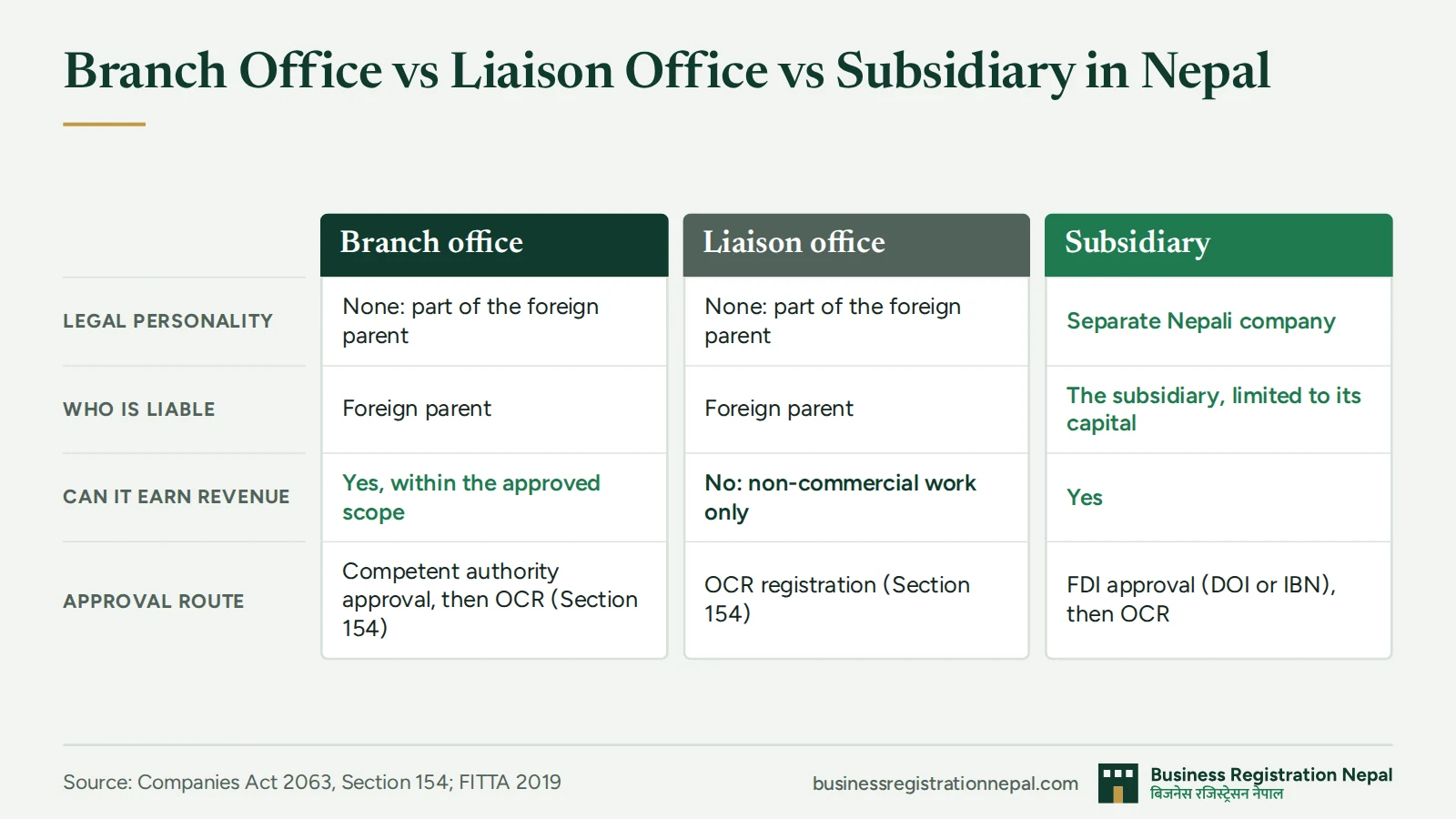
Subsidiary vs Branch vs Liaison Office
A subsidiary, a branch office and a liaison office differ on 4 points:
Attribute
Subsidiary company
Branch office
Liaison office
Legal status
Separate Nepali company
Part of the foreign parent
Part of the foreign parent
Can it trade?
Yes
Yes, for its contracts
No, non-commercial only
Ownership
Foreign parent holds the shareholding
Wholly the parent's
Wholly the parent's
Suits
Corporates expanding into Nepal
Firms delivering contracts in Nepal
Firms exploring the market
A subsidiary is a separate Nepali company; a branch and a liaison office stay part of the foreign parent.
The FDI Approval & Registration Process
The FDI approval process under the foreign direct investment Act in Nepal, FITTA 2019, runs in 6 steps, with the DOI approving investments up to NPR 6 billion and the IBN handling larger ones:
Check the sector against the negative list
Obtain FDI approval (DOI, or IBN above NPR 6bn)
Register the company at the OCR
Complete PAN/VAT and ward registration
Register the industry at DOI
Open a bank account and record the investment at NRB
Filings run through the DOI One-Stop Service Centre, and capital recording at NRB follows as the funds arrive in convertible foreign currency.
Profit Repatriation
Profit repatriation (FITTA s17) lets foreign investors repatriate dividends, share-sale proceeds and loan principal and interest through banking channels, overseen by Nepal Rastra Bank, once tax obligations are met and the company continues to comply with its filings. We prepare the filings and the tax clearance certificate for each transfer, as our repatriation of profits from Nepal page explains.
Cost, Fees & Timeline
The government application fee for FDI approval is NPR 20,000 for investments up to NPR 6 billion and NPR 100,000 above that, plus registration fees and our professional fee, which depends on the investment structure, sector and approvals your project needs. Approval takes about 15 to 30 days up to NPR 6 billion and 30 to 45 days for projects that exceed it, and Business Registration Nepal gives a scoped quote after a free consultation.
Government application feeNPR 20,000FDI approval up to NPR 6 billion; NPR 100,000 above
Our professional feeQuoted for your caseSet by your business size, structure and scope of work
15 to 30 daysApproval for investments up to NPR 6 billion
30 to 45 daysApproval for projects above NPR 6 billion
Documents Required for FDI Approval
FDI approval in Nepal needs 8 document sets, and we prepare and submit each one:
FDI application
Project proposal or business plan
Three years of the investor's audited financials
Passport or foreign company certificate
Bank statement as proof of funds
JV or technology transfer agreement, if applicable
Land or lease documents
Environmental study (EIA or IEE) where required
Areas We Serve for FDI Registration
Business Registration Nepal registers foreign investment projects nationwide from our office in Kapan, Kathmandu, coordinating each filing through the One-Stop Service Centre at the Department of Industry in Kathmandu.
Our chartered accountant brings more than 10 years of industry experience.
End to end.
We carry the project from FDI approval to compliance and profit repatriation.
English-language depth.
Overseas investors get every step explained in English.
Frequently Asked Questions
What is foreign direct investment (FDI) in Nepal?
Foreign direct investment (FDI) in Nepal is foreign investment approved under FITTA 2019 and used to incorporate or invest in a Nepali company; the FDI full form is simply Foreign Direct Investment. That is the foreign direct investment definition and FDI meaning in practice: a lasting, controlling stake rather than a portfolio holding.
The foreign direct investment meaning carries trade-offs. The FDI advantages and disadvantages for an investor come down to full ownership in most sectors and profit repatriation as advantages of FDI, against the minimum capital and approval time as disadvantages of FDI.
What is the minimum FDI amount in Nepal?
The minimum FDI amount in Nepal is NPR 20 million per foreign investor, set in the Government of Nepal's 2022/23 budget. A February 2026 government notice widened the automatic approval route and exempts listed IT industries from the minimum, so we confirm the rule for your sector before you apply.
Can a foreigner own 100% of a company in Nepal?
Yes, a foreigner can own 100% of a company in Nepal in most sectors. Only sectors on the negative list restrict or bar foreign ownership.
What is the FDI approval process?
The FDI process in Nepal runs from a sector check to FDI approval from the DOI or IBN, OCR registration, PAN and VAT, industry registration and NRB capital recording. We manage each FDI approval step so the company can open and hold its bank account on time.
What is the difference between DOI and Investment Board Nepal?
The Department of Industry approves foreign investments up to NPR 6 billion, and Investment Board Nepal handles investments above that. Higher-value projects therefore go through the IBN board.
Which sectors are on the negative list?
The negative list bars FDI from primary agriculture, poultry and fisheries, cottage industries, personal services, arms, real-estate trading, travel agencies and domestic courier. National rules can change the list, so we check your sector at the start.
Subsidiary vs branch vs liaison office - which do I need?
Your structure depends on whether you plan to trade in Nepal: a subsidiary is a separate Nepali entity, a branch is part of the parent and can trade, and a liaison office cannot trade. The choice depends on whether you plan to trade and how much local liability you want to hold.
Can foreign investors repatriate profits?
Yes, foreign investors can repatriate dividends, share-sale proceeds and loan repayments under FITTA section 17 through Nepal Rastra Bank banking channels. Our repatriation of profits page explains the steps.
What is the automatic approval route?
The automatic approval route is fast online approval for seven sectors, energy, agriculture, infrastructure, tourism, IT, services and manufacturing, for investments up to NPR 500 million. It is a core part of the FDI policy in Nepal for smaller projects.
How long does FDI approval take?
FDI approval takes about 15 to 30 days for investments up to NPR 6 billion and 30 to 45 days above that. Complete documents keep it at the short end.
What documents are required for FDI approval?
FDI approval needs the application, a project proposal, the investor's audited financials, a passport or company certificate, proof of funds, and agreements or land documents where they apply. An industrial project may add an environmental study.
Are IT startups exempt from the minimum investment?
Yes, IT startups using the automatic route may be exempt from the NPR 20 million minimum. We confirm eligibility before you apply.
Book a Free FDI Registration Consultation
Your free consultation maps the structure, approval route and timeline for FDI in Nepal. Call +977 9817373909, message us on WhatsApp at +977 9817373909 or book your consultation online.
Business Registration NepalKapan Akasedhara, Suryodaya Colony, Kathmandu, Nepal+977 9817373909businessregistrationnepal.com
Google Business Profile map goes here (share link to confirm). Loads only when tapped, so it never slows the page.