


A liaison office, called a representative office or contact office, is the point of contact that a foreign company registers in Nepal to coordinate for its parent, and it cannot earn income in Nepal.
Liaison office registration in Nepal files with the OCR under Section 154 of the Companies Act 2063, and the OCR registers a complete application within 30 days. Representative office registration in Nepal needs 12 documents, a government fee of NPR 50,000 and no minimum capital.
The office performs 3 permitted tasks, led by liaison with the parent, and it files an annual financial statement and an auditor's certificate with the OCR. A branch office differs from a liaison office because a branch earns income within its approved scope.
A parent that decides to trade or invest follows the FDI & foreign company registration route within company registration in Nepal.
What Is a Liaison (Representative) Office in Nepal?
A foreign company testing the Nepal market uses a liaison office as its point of contact, with no separate legal personality of its own. For contact office registration, Nepal law treats a representative office, a contact office and a liaison office as one entity under three names, each serving as a contact point for the head office.
It is not an investment vehicle. The representative office Nepal's OCR registers exists only to facilitate contact, and it spends money the parent company sends while earning nothing in Nepal.
What Can and Cannot a Liaison Office Do in Nepal?
The prohibition on income-generating activities is the defining rule, and the permitted and prohibited activities fall into 6 items:
- Permitted: maintain liaison and act as the parent's point of contact
- Permitted: help local clients use the parent's products/services without taking remuneration
- Permitted: coordinate with the parent's agent, and do market research
- Prohibited: any income-generating or commercial activity
- Prohibited: signing transaction contracts, and marketing/advertising the parent's products
- Prohibited: issuing shares or debentures in Nepal
A liaison office conducts market research and assists local clients, but it undertakes no sale. Under Section 154(6), the Companies Act 2063 bars every income earning activity, so the written scope of work lists only the permitted items.
Which Law and Authority Govern Liaison Office Registration?
Section 154 of the Companies Act 2063 and the Companies Directives govern liaison office registration in Nepal. The Office of the Company Registrar (OCR) registers the office on an application that carries any permission the law requires.
Under Section 154(3), a foreign company applies to the OCR with the permission, if any, that the law requires. The Act treats a selection by a competent body, or a contract with one, for business in Nepal as that permission. A branch needs competent authority approval before the OCR step, while a liaison office files with the OCR directly.
Because the office is not an investment vehicle, the FDI approval, DOI and NRB steps of an investment do not apply. Sections 155 and 156 of the Companies Act 2063 bind the office to document filing and annual filing with the OCR. The wider foreign company provisions appear in the guide to the Companies Act 2063.
What Is the Liaison Office Registration Process?
The liaison office process in Nepal runs in 4 steps, from the application to the OCR through PAN registration at the tax office, and it carries no investment approval step.
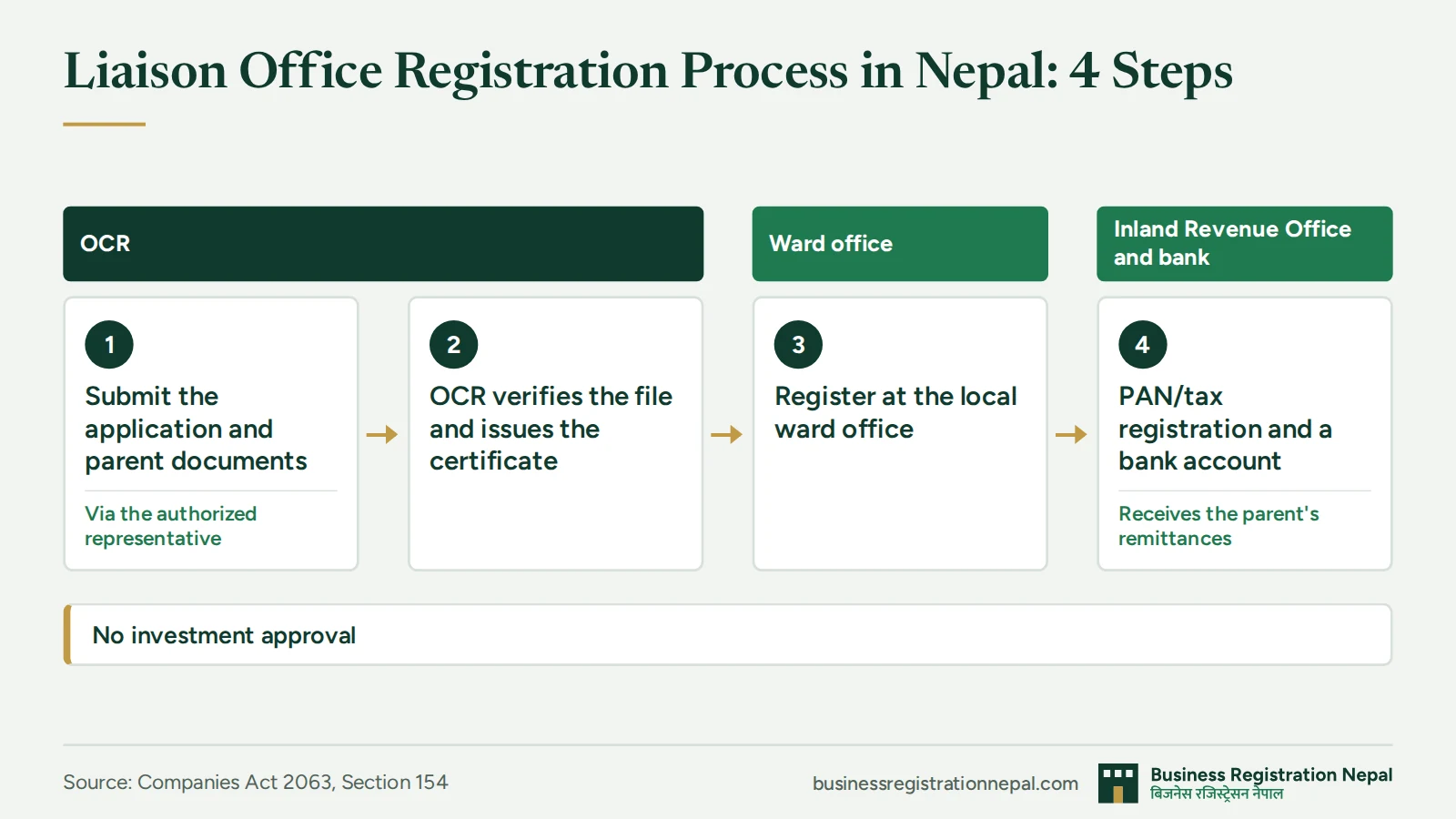
- Step 1: Submit the application and parent-company documents to the OCR, with the director's declaration that the information is true and correct
- Step 2: Receive the registration certificate after the OCR verifies the file
- Step 3: Register at the local ward office
- Step 4: Complete PAN/tax registration at the Inland Revenue Office and open a bank account
The authorized representative whom the parent appoints submits the file. The bank account opened in Step 4 receives the parent's remittances for running costs.
What Documents Are Required for Liaison Office Registration?
The OCR file for liaison office registration in Nepal holds 12 documents, led by the parent's certificate of registration, its MOA and AOA, and the application form.
Section 155(1) of the Companies Act 2063 lists the particulars, and each foreign paper needs a notarized translation into Nepali. The documents fall into 12 items:
0 of 12 ready
Under Section 155(3), the Companies Act 2063 requires every document issued abroad to carry certification under the law of the country where the parent is registered. Check each paper against the current OCR checklist before filing.
Is There a Minimum Capital or Government Fee for a Liaison Office?
No, there is no minimum capital for a liaison office, since it is not an investment vehicle. The OCR government fee for a liaison office in Nepal is NPR 50,000.
The NPR 50,000 fee is the OCR government fee, and translation, notarization and professional fees are paid separately.
How Long Does Liaison Office Registration Take?
Liaison office registration takes about 2 to 3 weeks when the documents are complete. Under Section 154, the OCR registers the company and issues the registration certificate no later than 30 days after the application. The OCR returns an incomplete file, so notarization and translation are checked before filing.
What Are the Post-Registration Compliances for a Liaison Office?
A liaison office in Nepal meets 4 recurring duties under Sections 154 to 156 of the Companies Act 2063: an annual financial statement, an auditor's certificate, change notices and a name board.
Post-registration compliance applies to a liaison office even though it earns no income. The office appoints an auditor, and the table sets out each duty with its deadline and legal basis.
| Duty | Deadline | Legal basis |
|---|---|---|
| Annual financial statement with balance sheet and profit and loss account, filed with the OCR | Within 6 months of the financial year end | Section 156(1) |
| Auditor-certified statements of salary, tax deductions, office rent and operating expenses, filed with the OCR | Within 3 months of the financial year end | Section 156(5) |
| Notice to the OCR of any change in the registered documents | Within 35 days of the change | Section 155(2) |
| Name board and stationery showing the country of incorporation and the registration number | From registration | Section 154(9) |
The annual compliance & filings service keeps the OCR filings on schedule each year.
How Is a Liaison Office Taxed in Nepal?
A liaison office in Nepal registers for a PAN and deducts tax on the salaries and payments it makes, since Section 154(6) bars it from earning income. The office obtains its PAN as set out in how to make a PAN in Nepal.
Section 156(5) requires an auditor to certify the salary, tax deductions, office rent and operating expenses. The office submits that certificate to the OCR within 3 months of the financial year end.
What Is the Difference Between a Liaison Office and a Branch Office?
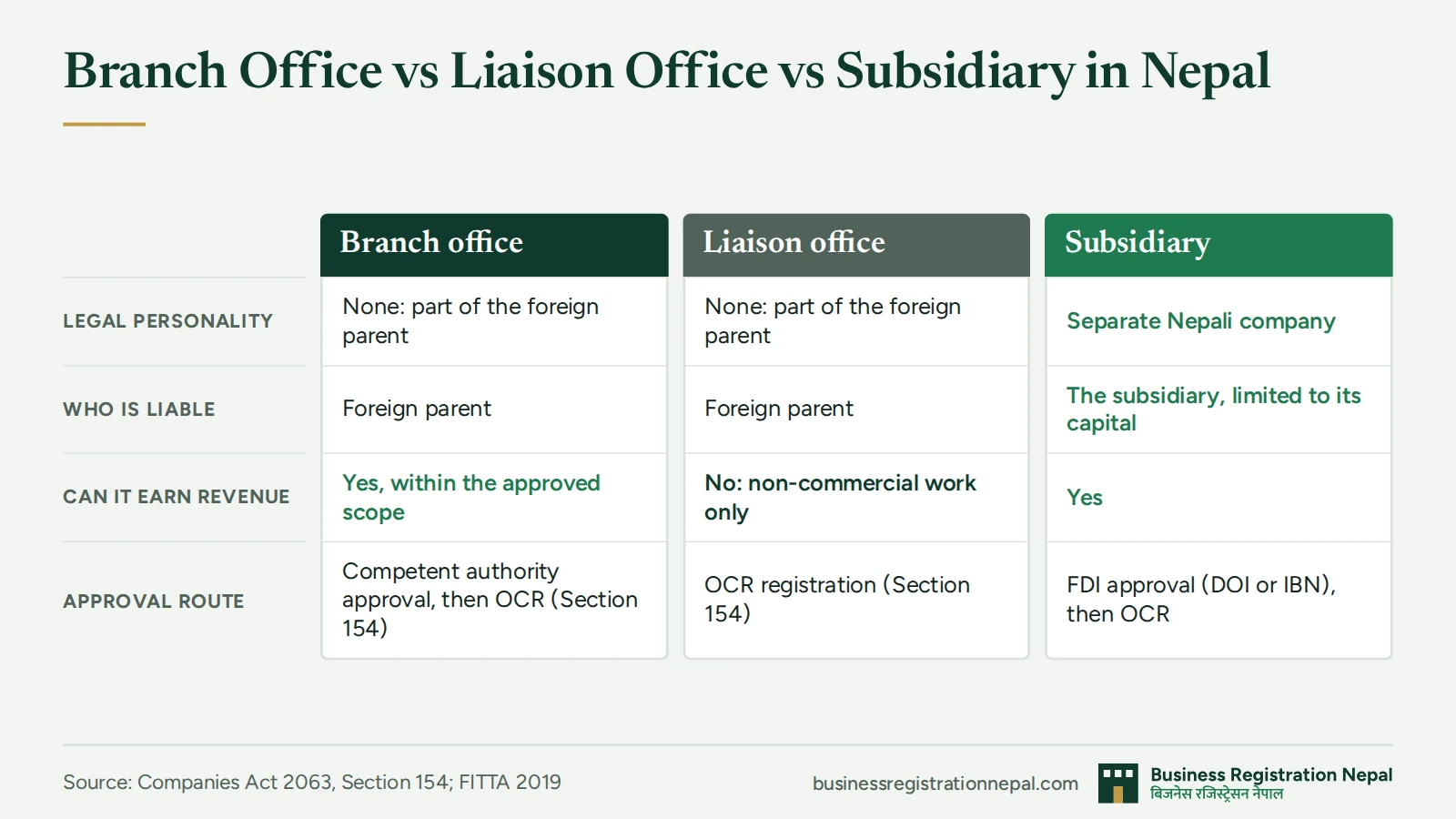
The difference between branch and liaison office covers 5 points:
| Point | Liaison office | Branch office |
|---|---|---|
| Legal personality | None; part of the foreign parent | None; part of the foreign parent |
| Can it earn income | No; point of contact only | Yes, within the approved scope |
| Approval route | OCR registration under Section 154, with any permission the law requires | Competent authority approval, then OCR under Section 154 |
| Minimum capital | None | Generally none |
| Typical use | Market research and coordination | Carrying on the parent's business in Nepal |
Liaison office vs branch office in Nepal comes down to income: a branch earns income within its scope, and a liaison office cannot. A parent ready to trade registers a branch office or a separate company through subsidiary company registration. A foreign company that pairs with a Nepali partner follows joint venture registration.
Frequently Asked Questions
How is a liaison office funded and can it open a bank account?
A liaison office is funded by inward remittance from the parent and runs a Nepali bank account for its costs, set up as in opening a company bank account. It earns no local income, so profit transfer from a trading entity follows repatriation of profits instead.
How is a liaison office registration cancelled in Nepal?
Under Section 158 of the Companies Act 2063, the foreign company applies to the OCR with the prescribed fee and proof that no liability is due and payable. The OCR publishes a notice inviting claims within 21 days and then strikes the name off the foreign company register. A Nepali company closes through company closure and liquidation instead.
Does a liaison office need a physical office in Nepal?
Yes, a liaison office needs a place of business in Nepal, and the application states its principal place under Section 155(1) of the Companies Act 2063. Section 154(9) requires a name board there that shows the company name, the country of incorporation and the registration number. The same details appear on any bill, receipt, invoice or letterhead.
Who can represent a liaison office in Nepal?
A person residing or staying in Nepal represents the liaison office, and the parent authorizes that person to receive summons and notices on its behalf. Section 155(1) of the Companies Act 2063 requires the application to give the name and address of that person. A power of attorney under Section 157 accompanies the application.
What happens to a liaison office if its parent becomes insolvent abroad?
Section 158 of the Companies Act 2063 requires the authorized representative to notify the OCR once insolvency proceedings begin in another country. The representative publishes a notice in Nepali newspapers. The prevailing insolvency law then governs the foreign company's affairs in Nepal.