

A foreign parent that wants its own company in Nepal incorporates a subsidiary: a separate Nepali private limited company it owns, registered as FDI in Nepal under FITTA 2019 and the Companies Act 2063. Each foreign subsidiary in Nepal has its own legal personality and limited liability. Business Registration Nepal handles this through our FDI & foreign company registration service and company registration in Nepal work, covering process, documents, minimum investment, sectors, tax and cost.
What Is a Subsidiary Company in Nepal?
A foreign parent company that wants a Nepali company of its own registers a subsidiary company: a separate legal entity it owns or controls, with liability limited to its share capital. The subsidiary trades, hires and signs contracts in its own name as an independent Nepali company.
That separates it from two other routes. A branch office has no separate legal personality, so the parent stays liable, and a liaison office cannot earn revenue.
What Is the Difference Between a Wholly-Owned Subsidiary and a Joint Venture?
A foreign parent chooses between two ownership routes. A wholly owned subsidiary, Nepal-registered and 100% held by the parent, is a wholly foreign-owned enterprise (WFOE), sometimes called a foreign-owned Pvt Ltd, while a joint venture shares the equity with a local partner.
100% foreign ownership is allowed in most sectors, subject to sector caps, such as 51% in management, accounting, engineering and legal consultancy services and 70% in ride-sharing services. Where a cap or licence rule needs a local shareholder, we handle the shared route through joint venture registration.
Which Laws and Authorities Govern a Foreign Subsidiary?
FITTA 2019 (FITTA 2075) treats the parent's money as foreign direct investment; Nepal's Companies Act 2063 governs the incorporation of the subsidiary. The Department of Industry (DOI) grants Department of Industry approval up to NPR 6 billion, and Investment Board Nepal (IBN) approves larger investments and energy projects above 200 MW.
Nepal Rastra Bank (NRB) records the capital, and each profit repatriation needs Nepal Rastra Bank approval. The Office of the Company Registrar (OCR) handles registration, and the IRD registers the company for PAN and VAT.
What Is the Step-by-Step Process to Register a Subsidiary?
The subsidiary company registration process in Nepal runs in 5 steps, with FDI approval before incorporation. This is the FDI process in Nepal for a new company:
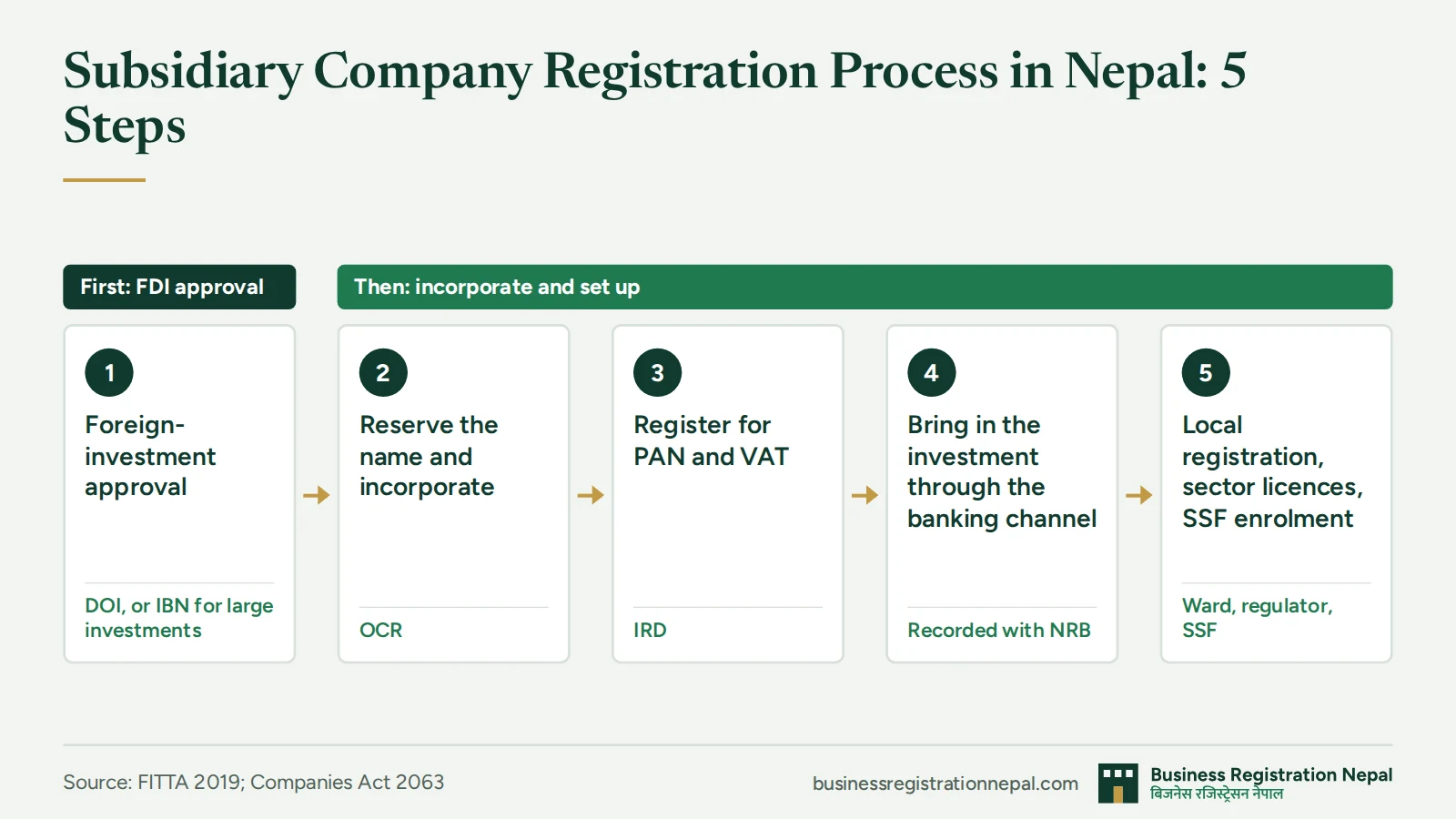
- Obtain foreign-investment approval from DOI (or IBN for large investments)
- Reserve the company name and incorporate the company at OCR
- Register for PAN and VAT at the IRD
- Bring in the investment through the banking channel and record it with NRB
- Complete local registration, sector licences and SSF enrolment
Incorporation follows the same OCR route as how to register a company in Nepal, where we reserve the name, file the MOA and AOA and obtain the certificate of incorporation. The capital injection in step 4 lets NRB record the investment, and step 5 covers ward registration, any sector licence and SSF enrolment in Nepal.
What Documents Are Required to Register a Subsidiary?
Subsidiary documents come from the parent company and the new company, and every foreign-language paper must be translated into Nepali and notarized. The DOI and OCR ask for 10 items:
0 of 10 ready
We prepare the set with you and submit it once it matches the DOI and OCR checklists in force on the filing date.
What Is the Minimum Investment for a Foreign Subsidiary in Nepal?
The minimum investment requirement for a foreign subsidiary is NPR 20 million (about USD 150,000) under FITTA 2019. IT ventures that invest through the automatic route are exempt, and the Government notice of 2082/11/04 (16 February 2026) lists software development, data centres and cloud computing, business and knowledge process outsourcing, digital mapping and IT parks. That FITTA minimum is a foreign investment rule.
It differs from company-law capital. The authorized capital sets the ceiling on shares the company may issue, and the paid-up capital is what shareholders have paid in; we set both in the MOA to match the approved investment.
Which Sectors Allow a Foreign Subsidiary in Nepal?
100% foreign ownership is allowed in every sector outside the negative list, and some sectors carry sector-specific ownership caps under the FITTA annex, such as 51% in consultancy services and 70% in ride-sharing. Two lists decide which sector a foreign subsidiary may enter:
- Negative-list examples: primary agriculture, small/cottage industry, retail (with exceptions), certain media, real-estate trading
- Ownership caps (VERIFY): telecommunications, banking/financial, insurance, consultancy
A restricted sector either stays closed to foreign capital or needs a local shareholder under a joint venture. We check both lists before the DOI application.
How Is a Subsidiary Taxed in Nepal?
A subsidiary pays corporate income tax in Nepal, commonly 25%, with 30% for banks and financial institutions, general insurance, telecom and petroleum companies under the Income Tax Act 2058. It registers for VAT once turnover crosses the threshold, and it must file annual returns after a statutory audit.
Our statutory audit in Nepal team handles the audit so the company can comply on time. After tax, dividends reach the parent through repatriation of profits from Nepal.
How Much Does It Cost and How Long Does It Take?
Subsidiary registration cost has three parts: OCR government fees on a capital-based scale, the DOI application fee and our professional fee. The DOI application fee is NPR 20,000 for investments up to NPR 6 billion and NPR 100,000 above that.
| Cost item | How it is set | Amount |
|---|---|---|
| OCR government fee | Scale based on the company's capital | NPR 1,000 to NPR 43,000 up to NPR 10 crore of authorized capital; NPR 30 per NPR 1 lakh above that |
| DOI application fee | Investment size | NPR 20,000 (up to NPR 6bn) / NPR 100,000 (above) |
| Professional service fee | Scope of the filing and approval route | Quoted in a free consultation |
The full path commonly takes several weeks, and the DOI states 7 days for FDI approval after a complete application. An automatic-route investment is approved online through the DOI system. We quote our own fee once we know the sector and investment size.
What Is the Difference Between a Subsidiary, a Branch and a Liaison Office?
A subsidiary, a branch and a liaison office differ on 5 points:
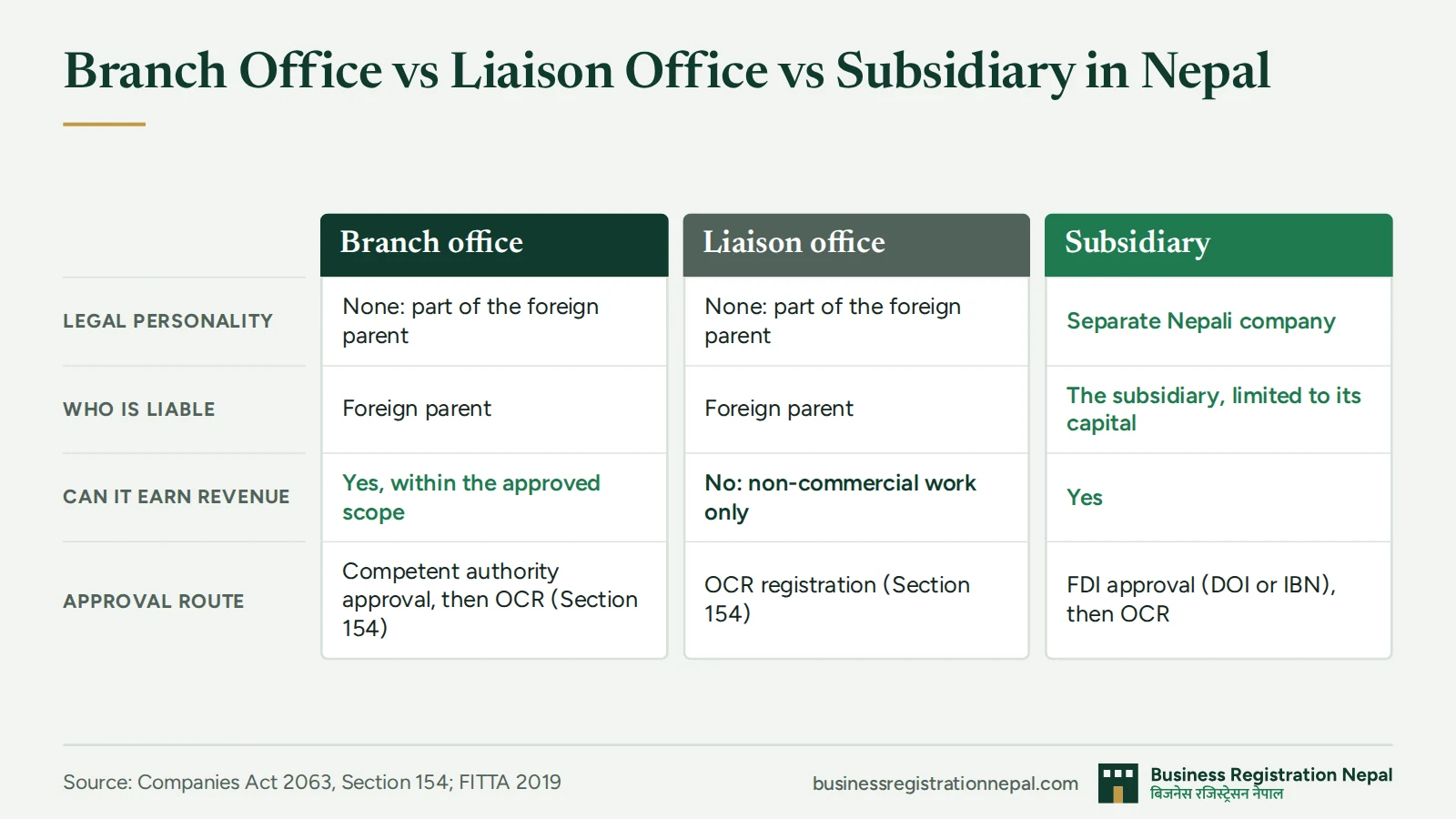
| Point | Subsidiary | Branch office | Liaison office |
|---|---|---|---|
| Legal personality | Separate Nepali company | None; part of the foreign parent | None; part of the foreign parent |
| Liability | Limited to the subsidiary's capital | Foreign parent | Foreign parent |
| Can it earn revenue | Yes | Yes, within the approved scope | No; non-commercial work only |
| Approval route | FDI approval (DOI or IBN), then OCR incorporation | Competent authority approval, then OCR under Section 154 | OCR registration under Section 154, plus any approval the sector's regulator requires |
| Typical use | Long-term investment with limited liability | Carrying on the parent's business in Nepal | Market study and coordination |
Branch office vs subsidiary comes down to liability: the subsidiary ring-fences the parent, and the branch exposes it. We handle the other two routes in Nepal through branch office registration and representative (liaison) office registration.
Frequently Asked Questions
Does a subsidiary's foreign investment use the automatic route or need approval?
Yes, a subsidiary's foreign investment needs approval in most cases: the Department of Industry approves investments up to NPR 6 billion and the Investment Board above that. The automatic route covers listed sectors and sizes only, which the Government notice of 2082/11/04 (16 February 2026) widened to 102 industries with no upper investment limit. Approval on that route is issued online through the DOI system.
Can the subsidiary repatriate dividends and return capital to the parent?
Yes, the subsidiary can repatriate dividends and, on exit, return capital to the parent through the banking channel after tax. The investment must be recorded with NRB, and our repatriation of profits service handles each transfer.
Can the subsidiary sponsor work permits and visas for foreign staff?
Yes, a registered subsidiary can support work-permit and business or investor visa applications for foreign staff, subject to the labour and immigration process. We confirm the current requirements before you apply. The Department of Labour and Occupational Safety issues the work permit, and the Department of Immigration issues the visa, with a DOI recommendation for investors.
Is the foreign parent shielded from the subsidiary's liabilities?
Yes, the foreign parent is generally shielded from the subsidiary's liabilities. A subsidiary is a separate Nepali company with limited liability, so the parent's exposure is limited to its investment.
Can the foreign shareholding later be sold to another foreigner?
Yes, the foreign shareholding can later be sold to another foreigner. The transfer needs prior DOI approval and NRB recording, following the share transfer process in Nepal.
Can the subsidiary use the foreign parent's brand or trade name?
Yes, the subsidiary can use the foreign parent's brand or trade name, and the parent can license the mark to it. A licensed brand is secure only once the mark is protected in Nepal through trademark registration.