

To get a share certificate in Nepal and record it in the share lagat, the shareholder and the company complete 6 steps under the Companies Act 2063:
- Step 1: Deposit the paid-up capital.
- Step 2: Pass a board resolution.
- Step 3: Prepare the certificate.
- Step 4: Sign and seal the certificate.
- Step 5: Deliver the certificate to the shareholder.
- Step 6: Record the holding in the share register.
A share certificate is the company's document certifying a shareholder's ownership of the shares it states, and prima facie evidence of title. The share lagat is the official shareholder register, verified by the OCR, that lists each shareholder's name, details and investment.
Each certificate contains 7 details, from the company name to the seal, and the company issues it within two months after the allotment. Two officers sign a public company's certificate, and the articles name a private company's signer.
A lost or destroyed certificate is replaced by a duplicate for a fee. Each certificate matches the share lagat that starts with company registration in Nepal.
What Does a Share Certificate Contain?
The contents of a share certificate in Nepal are 7 standard details, from the company name and the shareholder's name to the company seal. Each detail ties the certificate to one holding in the company's share register.
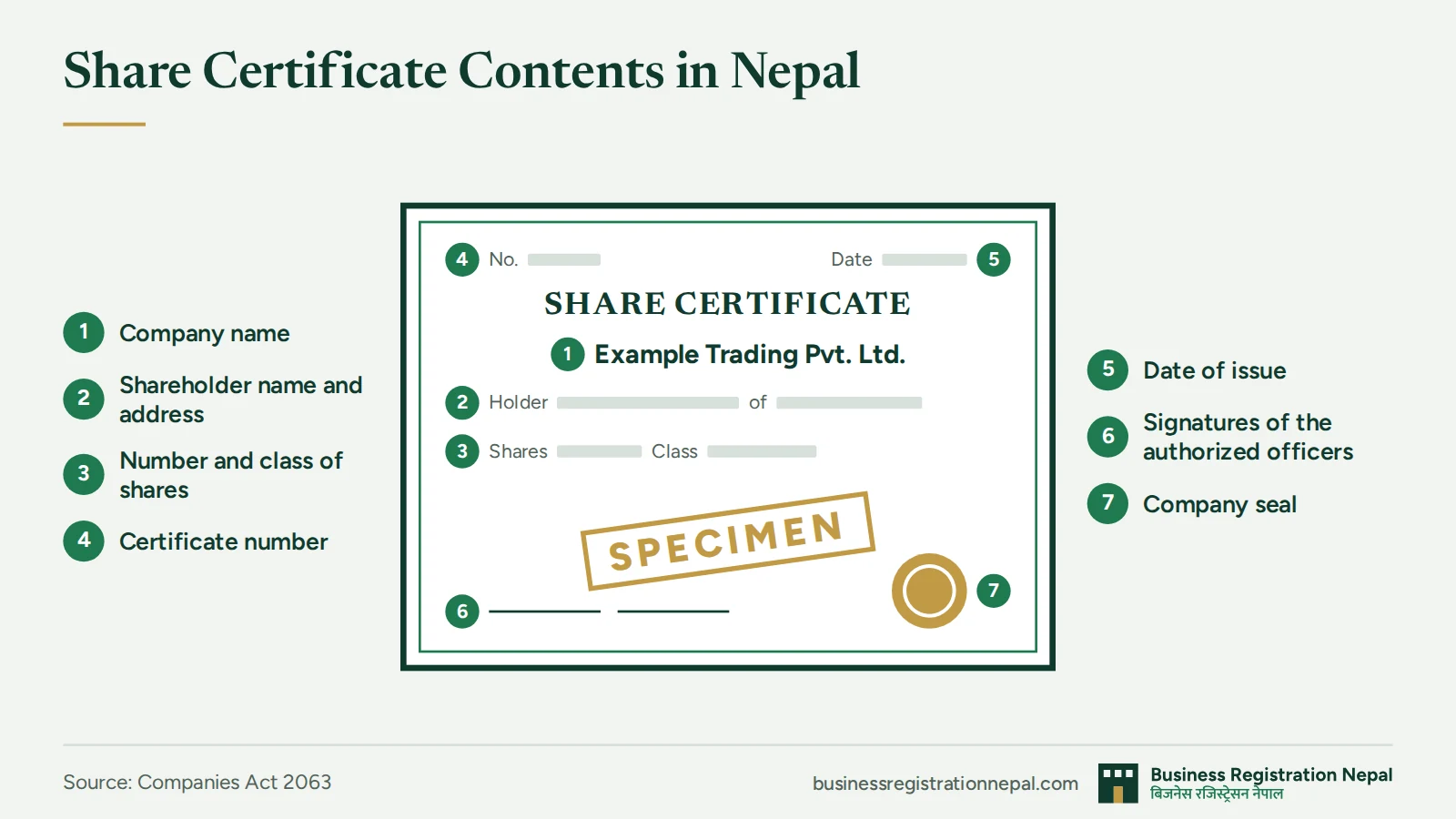
The 7 details on a share certificate are these:
- Company name
- Shareholder name and address
- Number and class of shares
- Certificate number
- Date of issue
- Signatures of the authorized officers
- Company seal
Under the Companies Act 2063, each certificate follows the prescribed format. That prescribed layout sets the share certificate format in Nepal, and the share lagat format records the same details in the company's register. Shares held jointly by 2 or more persons go on one certificate that names every joint holder, and the register lists all of them.
When Must a Company Issue a Share Certificate?
Under Companies Act section 33, a company must issue a share certificate to every shareholder within two months after the allotment of shares. The allotment date starts the count, and the rule binds private and public companies in Nepal alike.
The same allotment starts a filing duty at the Office of the Company Registrar (OCR), the Company Registrar under the Companies Act 2063. Within 30 days of the allotment, the company files a return of allotments with the OCR. The return lists the allotted shares, the allottees' names and addresses and the amount paid or due per share.
The Act sets 2 exceptions to the two-month rule. A listed company whose register an authorized securities registrar keeps issues a securities deposit passbook instead. Shares allotted to a licensed securities dealer fall outside the rule.
How Do You Obtain or Issue a Share Certificate?
To obtain or issue a share certificate, a company completes 6 steps, from the deposit of paid-up capital to the entry in the share register. The shareholder pays for the shares, and the board and the signing officers carry out every other step.
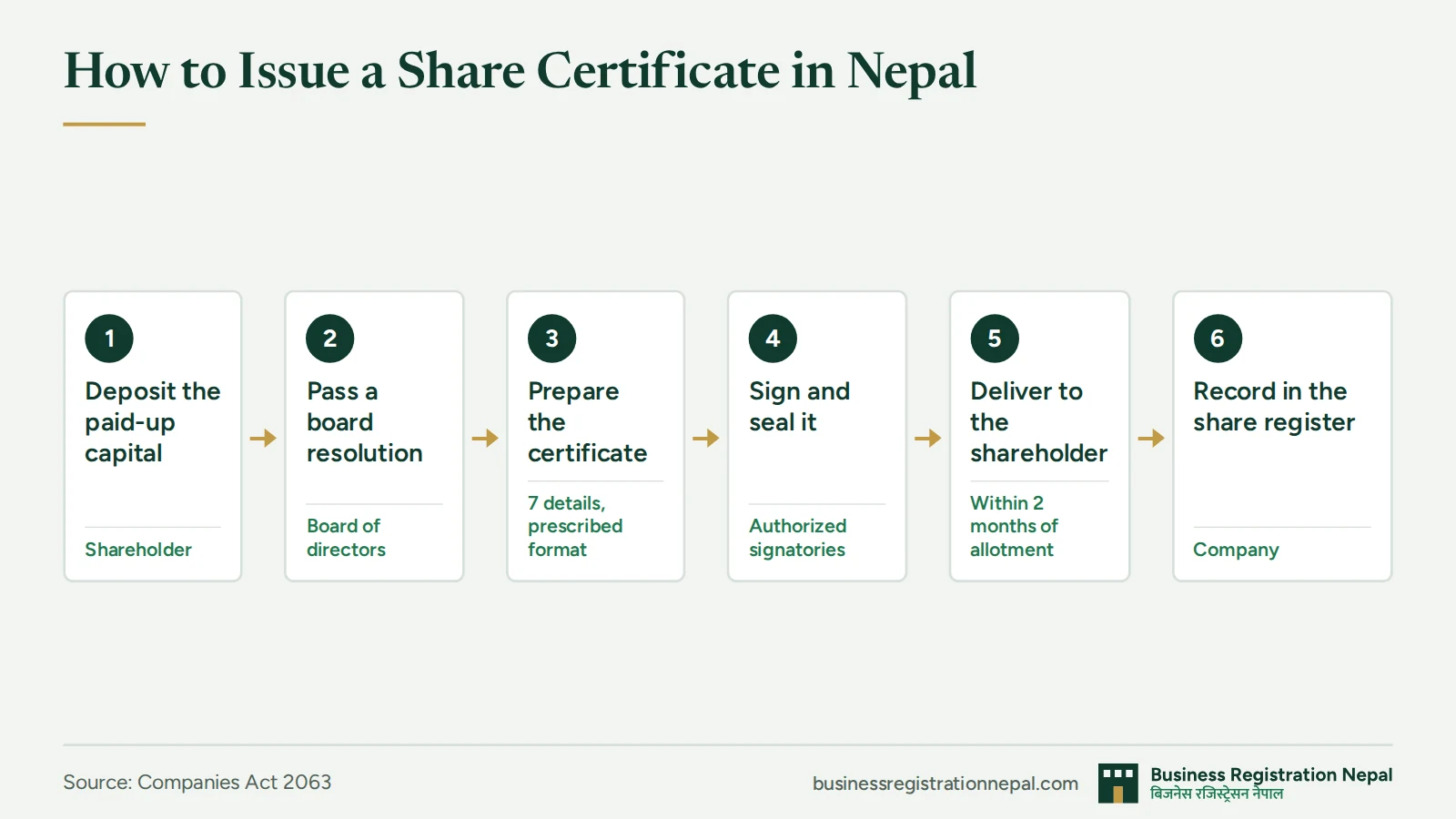
- Step 1: Deposit the paid-up capital. The shareholder deposits the amount due on the allotted shares in the company's bank account.
- Step 2: Pass a board resolution. The board of directors resolves to allot the shares and to issue a certificate to each allottee.
- Step 3: Prepare the certificate. The company fills in the 7 details of the prescribed format, including the certificate number and date of issue. The signing officers verify each detail against the allotment.
- Step 4: Sign and seal the certificate. The authorized signatories sign it, and the company seal goes on it where the company uses one.
- Step 5: Deliver the certificate to the shareholder. The certificate reaches the shareholder within two months after the allotment.
- Step 6: Record the holding in the share register. The shareholder register, known as the members register, records the name, address, shares and amount paid.
For a shareholder, how to get share certificate proof of title involves 2 acts: paying for the shares and collecting the signed certificate. The OCR issues no share certificate, and it receives the return of allotments instead.
On a share transfer, the buyer submits the seller's certificate with the application. The company enters the buyer in the register within 15 days. Each new member, by allotment or transfer, follows the add or remove shareholder process, which ends in the share register.
Frequently Asked Questions
Can shares be held in dematerialised form instead of a paper certificate?
Yes, a listed company whose register an authorized securities registrar keeps issues a securities deposit passbook or another certificate instead of a paper share certificate. Listed shares are held in dematerialised (demat) form with CDS and Clearing Limited through a depository participant, and since January 2016 SEBON allows trading on NEPSE only in demat shares. A private company issues paper share certificates to its shareholders.
What is the share register (lagat khata) and is it mandatory?
Yes, the share register, known as the share lagat (lagat khata), is the company's official record of its shareholders and their holdings, and every company must keep it. Under the Companies Act 2063, the register is kept at the registered office in the prescribed format. It records each shareholder's name, address, shares, amounts paid and outstanding, and the dates of entry and removal.
What is the difference between a certificate and a register entry?
A certificate is the shareholder's document of title, and a register entry is the company's master record of the same holding. The certificate stands as prima facie evidence of title, and the register governs in a dispute. A share transfer takes effect through the register entry, which the company makes within 15 days of the buyer's application.
Is stamp duty or a fee payable to issue a share certificate?
Yes, a fee is payable for a duplicate certificate, which the company issues on payment of the duplicate fee under the Companies Act 2063. The Act names a fee only for a duplicate, and any stamp duty on an original certificate follows the current stamp rules. A share transfer adds the transfer fee that the buyer pays with the application.
Can one certificate cover multiple shares?
Yes, one certificate covers a block of shares held by one shareholder, so a company issues no separate certificate for each share. For example, a company that allots 1,000 shares to one shareholder can issue share certificate number 1 for the whole block. Shares held jointly go on one certificate that names every joint holder.
What is the deadline to issue certificates after allotment?
The deadline is two months after the allotment of shares, under the Companies Act 2063. After a share transfer, the company enters the buyer in the register within 15 days of the application, and the new certificate follows that entry under the company's articles.