


The company objective change process in Nepal runs in 5 steps under Section 21 of the Companies Act 2063:
- Step 1: Pass a board resolution proposing the change.
- Step 2: Call the general meeting and pass a special resolution with 75% approval.
- Step 3: Amend the objective clause of the memorandum of association (MOA).
- Step 4: File the application and amended MOA with the Office of the Company Registrar (OCR) on CAMIS.
- Step 5: Obtain sector approval when the new objective is regulated, such as finance or insurance.
Companies add or change objectives to enter new business lines, drop discontinued activities, meet investor, bank, tender or licensing requirements, and stay within registered objects. The OCR file is led by the application, the certified special-resolution minutes and 2 signed copies of the amended MOA clause.
The company files within 30 days of the resolution, and the OCR records the change within 7 days. The cost is any OCR charge plus the professional fee. Each amended objective updates the record created at company registration in Nepal.
Why Add or Change Company Objectives?
A company in Nepal adds or changes objectives for 4 reasons: new business lines, discontinued activities, investor, bank, tender or licensing requirements, and its registered objects. Each reason ends in the same MOA amendment.
A company objective, or business object, states the purpose and scope of the business. The memorandum of association (MOA), the company's charter document, records it. Under the Companies Act 2063, every MOA lists the objectives and the main activities that reach them.
The 4 reasons to change business objectives in Nepal are these:
- Expansion into new business lines: a company entering a new trade, service or product adds an objective that covers the new business activities.
- Removal of discontinued activities: a company that stops an activity removes the matching objective, so the MOA reflects the business it runs.
- Investor, bank, tender or licensing requirements: an investor, a lender, a tender body or a sector regulator checks the objectives for the planned activity.
- Compliance with registered objects: a company acts within the objects clause of its MOA, so a new activity waits for the amendment.
The new objective stays within the law as well. Section 21 of the Companies Act 2063 makes every amendment subject to Section 6. That section bars an objective contrary to law, public interest, morality or decency.
What Is the Objective Change Process in Nepal?
5 steps make up the company objective change process in Nepal, from a board resolution to the OCR filing and any sector approval. Section 21 of the Companies Act 2063 governs every objective clause amendment, and the general meeting holds the decision.
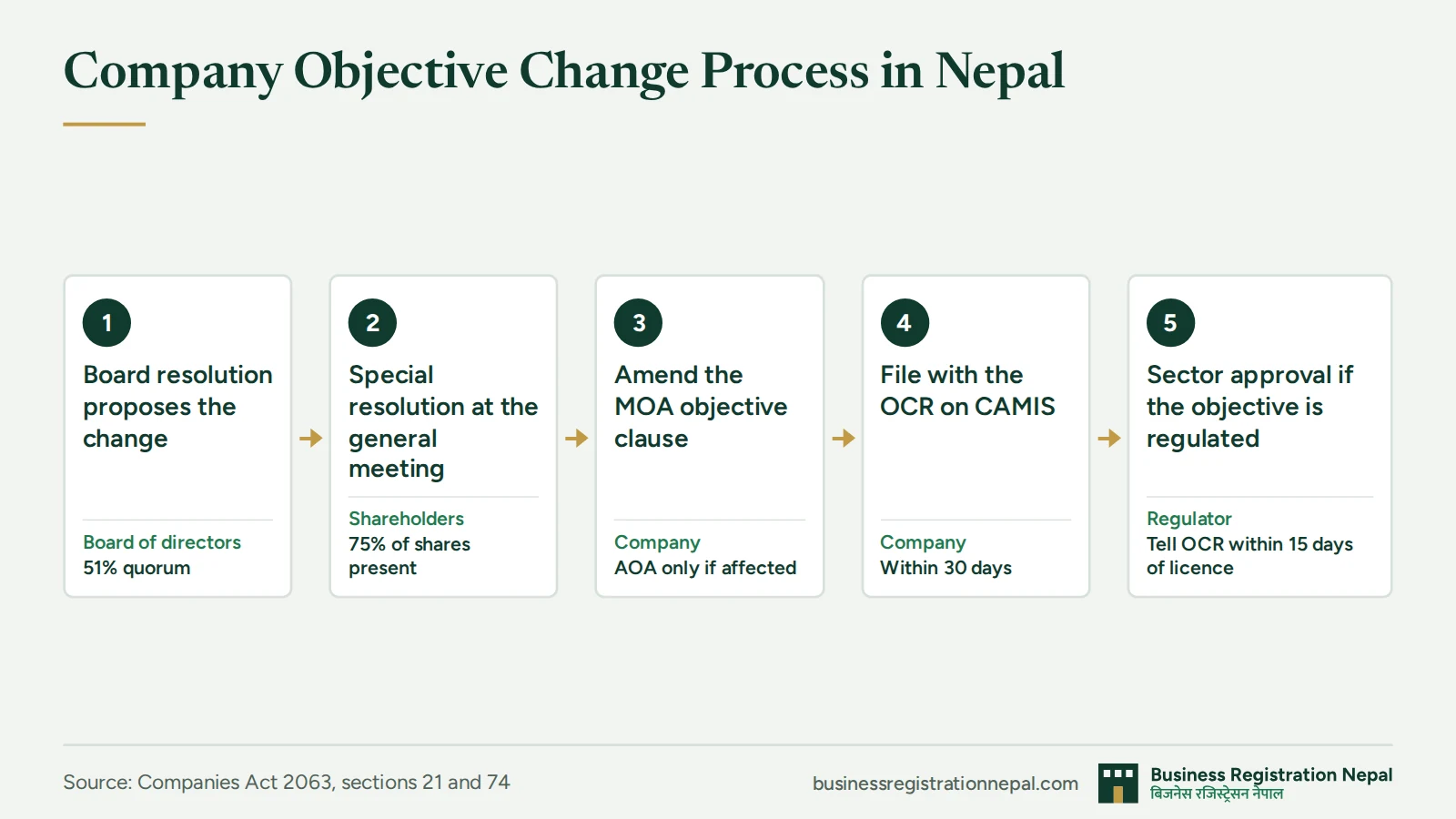
To amend MOA objectives, a company follows these 5 steps in order:
- Step 1: Pass a board resolution proposing the change. The board of directors decides by majority, with a quorum of 51% of directors. The board minutes record the decision, and the board calls the general meeting.
- Step 2: Call the general meeting (commonly 21 days notice) and pass a special resolution. A public company gives 21 days' notice for an annual general meeting and 15 days for an extraordinary one. A private company follows its articles. Under Section 74, the special resolution shareholders pass needs 75% approval, counted on the shares of the shareholders present.
- Step 3: Amend the objective clause of the MOA (and AOA if affected). The amended memorandum adds each new objective with its main activities. The articles of association (AOA) change only where a rule refers to the old objectives. This objects clause change follows the MOA amendment process, with its special resolution and 30-day OCR notice.
- Step 4: File the application and amended MOA with OCR on CAMIS. The company informs the Office of the Company Registrar (OCR) within 30 days of the amendment, through CAMIS, the OCR's online system. The OCR records the amendment and informs the company within 7 days.
- Step 5: Obtain sector/regulatory approval if the new objective is regulated. A financial, insurance, foreign-investment, foreign-employment or security-guard company adds its regulator's approval or recommendation letter to the OCR file. The company informs the OCR within 15 days of obtaining the sector licence for the new activity.
The OCR record of the amended objective clause closes the process. The company then carries out the new business activities within its registered scope.
What Documents Are Required to Change Objectives?
8 documents make up an objective change file in Nepal, led by the application, the certified general-meeting minutes with the special resolution, and the amended MOA. The company submits them to the OCR, which checks each paper against the resolution.
The OCR's list for a Section 21 amendment names the application, the certified minutes and the signed MOA copies. The 8 documents for an objective change are:
0 of 8 ready
A regulated company adds a 9th paper: the approval or recommendation letter of its regulator. The OCR names the Department of Industry (DOI) for foreign investment, Nepal Rastra Bank (NRB) for a financial company and the insurance regulator for an insurer.
How Long Does It Take and What Does It Cost?
An objective change takes up to 30 days to reach the OCR after the special resolution, and the OCR records it within 7 days. It costs any OCR charge plus the professional fee. Meeting notice and sector approval add time before the filing.
The timeline starts with the general-meeting notice. A public company gives 21 days for an annual general meeting and 15 days for an extraordinary one, and a private company follows its articles. The end-to-end duration depends on the regulator and the OCR queue. The OCR stage commonly takes 2 to 4 weeks once the file is complete.
A public company faces one more window. Shareholders with at least 5% of paid-up capital who did not vote for the change hold the right to petition the court within 21 days of the resolution. Until the court rules on that petition, the new objective clause has no effect.
The OCR revenue schedule sets a Section 21 fee for a name change, 25% of the registration fee up to NPR 5,000. The OCR confirms any fee for recording an objective amendment when the file is submitted. A regulated activity adds the licence fee its sector regulator sets.
A professional firm quotes its fee after reviewing the number of objectives, the documents and any regulator involved. An objective change that raises authorized capital as well pays the incremental OCR fee listed in company registration cost and fees.
Frequently Asked Questions
How do I add a new objective to my company in Nepal?
To add a new objective to a company in Nepal, shareholders pass a special resolution, and the company amends its MOA objective clause and files it with the OCR. A regulated activity needs sector approval from its regulator as well. The Companies Act 2063 sets this one route to add objective of company scope, for private and public companies alike.
Is a special resolution required to change objectives?
Yes, a special resolution of the general meeting is required to change objectives, because Section 21 of the Companies Act 2063 amends the MOA only that way. The resolution passes when shareholders holding 75% of the shares of those present vote for it. The company then informs the OCR within 30 days.
Can I add multiple objectives at once?
Yes, a company adds 2 or more objectives in one amendment, such as a trading objective and a consulting objective, through one special resolution and one OCR filing. The amended objective clause lists each new objective with the main activities that reach it. Each regulated objective in the set brings its own sector approval.
Do regulators verify new objectives?
Yes, a regulator reviews a new objective that falls in a regulated activity, such as finance or insurance. NRB for a financial company, or the insurance regulator for an insurer, approves or recommends the objective, and its letter joins the OCR file. The OCR itself refuses an objective contrary to law or public interest under Section 6 of the Companies Act 2063.